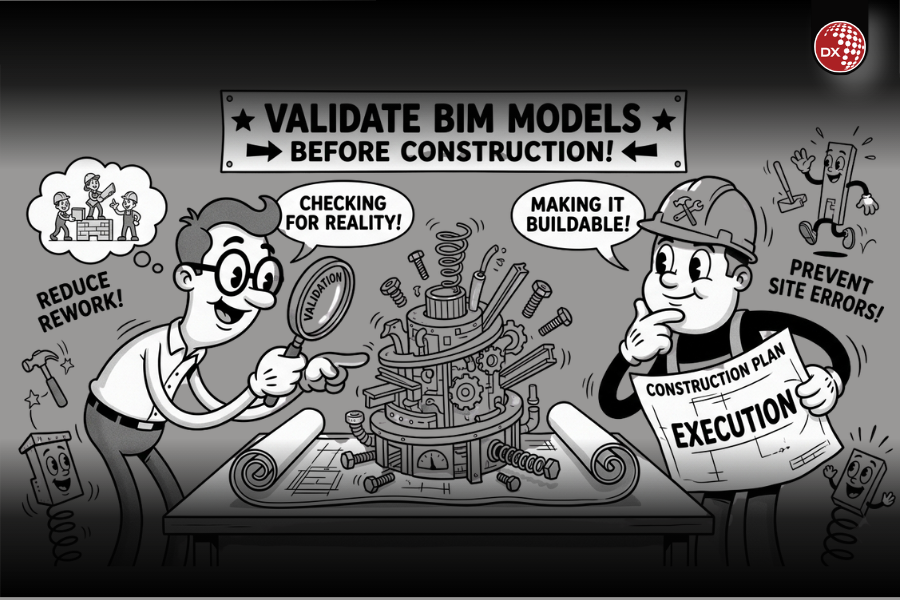
The Costly Disconnect Between BIM and Site Reality
You’re on-site. The structure is progressing. But suddenly, the MEP system doesn’t align with the structural opening. The BIM model showed no clash. Yet here you are—cutting, reworking, and losing time.
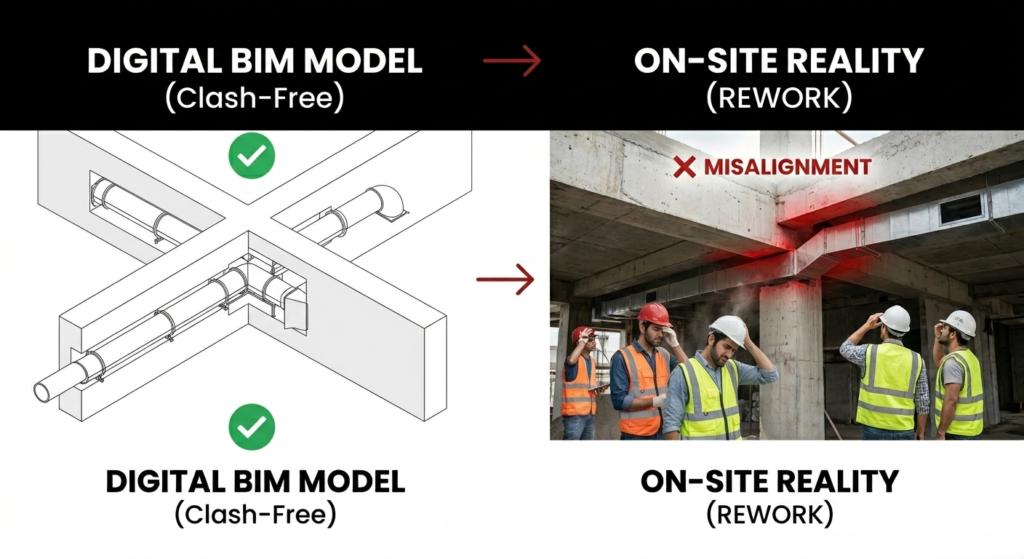
This isn’t rare. It’s a recurring issue across projects where BIM models don’t match site conditions.
The real problem isn’t BIM—it’s lack of validation before construction begins.
In this article, you’ll learn:
- Why BIM models fail on-site
- What most teams miss during coordination
- A practical BIM validation framework
- How to reduce rework by up to 30%
Where BIM Model Issues Actually Start
Most BIM model errors during construction don’t originate on-site—they begin much earlier.
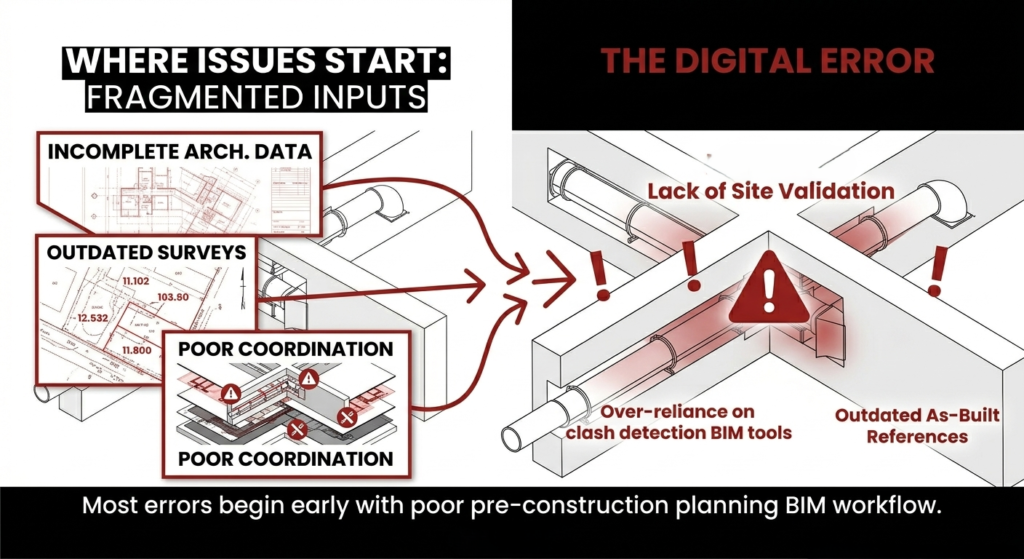
Common Root Causes
- Incomplete or outdated inputs from consultants
- Poor BIM coordination between disciplines
- Lack of constructability validation
- Over-reliance on clash detection BIM tools without context
- No structured pre-construction planning BIM workflow
Hidden Impacts on Projects
- Construction rework (cutting slabs, rerouting MEP systems)
- Delays due to redesign and approvals
- Increased cost and resource wastage
- Loss of trust between stakeholders
The biggest issue?
Teams assume the BIM model is “ready” when it’s only “modeled.”
Why Current BIM Approaches Fail
Many teams believe they are doing BIM correctly—but the reality is different.
What Teams Think vs What Actually Happens
|
What Teams Think |
What Actually Happens |
|
Clash detection is enough |
Clashes are resolved digitally, not constructively |
|
Model = Site-ready |
Model lacks real-world validation |
|
Coordination meetings solve issues |
Issues are discussed, not systematically resolved |
|
LOD 300/400 ensures accuracy |
Geometry is detailed, but workflows are incomplete |
|
BIM managers handle everything |
No accountability across disciplines |
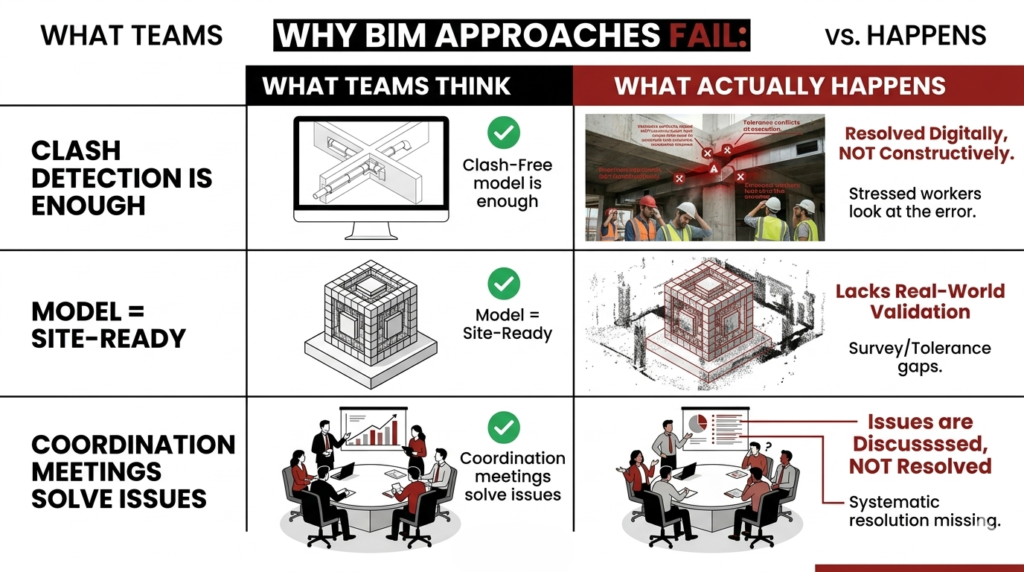
The gap is not in tools—it’s in process and ownership.
The Consultant’s Approach: BIM Validation Framework Before Construction
To bridge the BIM model vs site reality gap, you need a structured validation workflow—not just coordination.
A 5-Step BIM Model Validation Framework
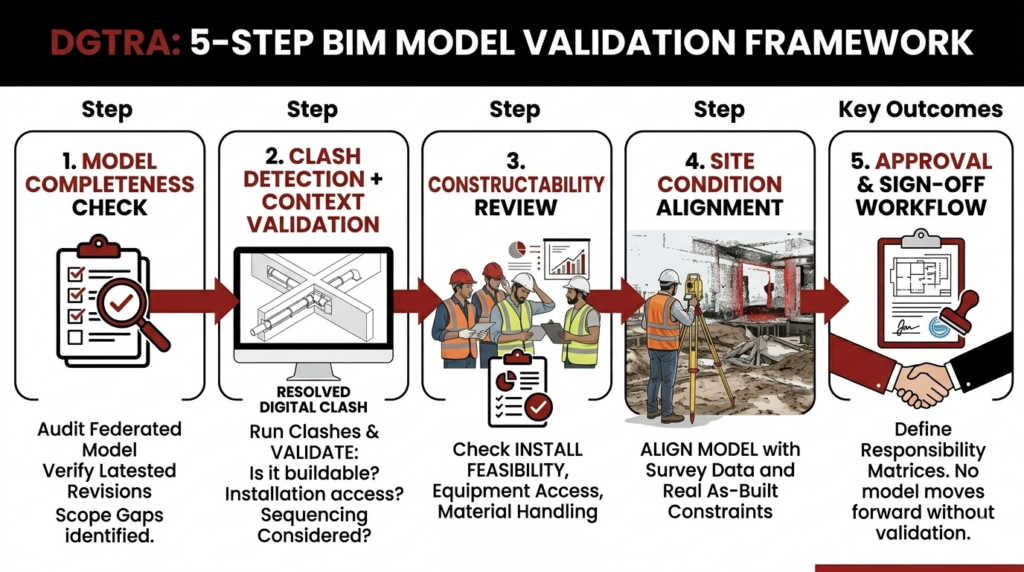
- Model Completeness Check
- Are all disciplines included in the federated BIM model?
- Are latest revisions integrated?
- Are scope gaps identified?
- Clash Detection + Context Validation
-
- Run clash detection
- Validate:
- Is it buildable?
- Is there access for installation?
- Does it consider sequencing?
Clash-free doesn’t mean construction-ready.
- Constructability Review
-
- Check
- Installation feasibility
- Equipment access
- Material handling
- Involve site engineers and construction managers
- Check
- Site Condition Alignment
-
- Compare BIM model with:
- Survey data
- As-built references
- Real site constraints
This step reduces BIM model not matching as-built drawings issues.
- Approval & Sign-off Workflow
- Define responsibility:
-
- Who validates what?
- Create:
-
- Discipline-wise approval matrix
- Ensure:
-
- No model moves forward without validation
Outcome of This Framework
- Reduced construction rework
- Improved coordination confidence
- Clear accountability
Practical Scenario: From Clash-Free to Construction-Ready
Project Situation
A commercial building project had:
- Fully coordinated BIM model
- Zero major clashes reported
Yet on-site:
- MEP ducts conflicted with beam depths
- Ceiling heights were compromised
What Went Wrong
- Clash detection ignored installation tolerances
- No constructability validation
- Lack of coordination with site execution teams
Corrective Approach
- Re-validated the BIM model using:
- Site constraints
- Installation sequencing
- Introduced MEP BIM coordination site error prevention checks
Outcome
- Reduced rework by 28%
- Faster installation cycles
- Improved stakeholder confidence
Traditional vs Validated BIM Workflow
|
Traditional BIM Workflow |
Validated BIM Workflow |
|
Focus on modeling |
Focus on buildability |
|
Clash detection only |
Clash + constructability validation |
|
Design-driven decisions |
Execution-driven decisions |
|
Limited site involvement |
Strong site collaboration |
|
Reactive issue resolution |
Proactive issue prevention |
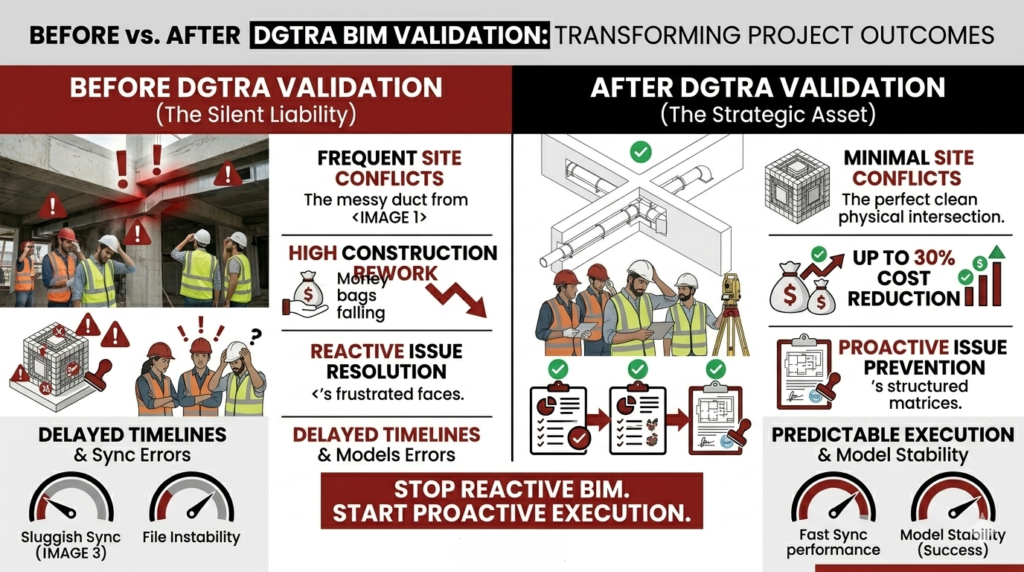
Before vs After BIM Validation Implementation
|
Before Validation |
After Validation |
|
Frequent site conflicts |
Minimal discrepancies |
|
High rework cost |
Up to 30% cost reduction |
|
Delayed project timelines |
Predictable execution |
|
Poor coordination |
Integrated workflows |
Key Takeaways
- A clash-free model is not equal to a construction-ready model
- BIM model accuracy depends on validation, not just modeling
- Involving site teams early prevents execution errors
- A structured BIM validation checklist is critical
- Proactive validation can reduce construction rework by 30%
Conclusion: BIM Success Depends on Validation, Not Just Modeling
The industry doesn’t have a BIM problem—it has a validation problem.
If your BIM models are not aligned with execution realities, they will fail on-site—no matter how advanced your tools are.
The shift you need is simple but powerful:
From modeling-focused BIM to execution-ready BIM
How DGTRA Solves This — From Modeling Support to Delivery Ownership
At DGTRA, we don’t just support BIM workflows—we take responsibility for making them work in the real world.
Our approach is built on structured BIM validation, ensuring your models move beyond coordination and become construction-ready, reliable, and execution-aligned.
We work as an embedded BIM delivery partner alongside your team—bringing clarity where models fail, and control where coordination alone falls short.
- Federated model validation across disciplines
- Deep QA/QC checks aligned with ISO 19650 workflows
- Site-aligned model verification to eliminate execution gaps
- Pre-construction BIM audits to reduce downstream risk
Because in real projects, a coordinated model is not a validated model.
And without validation, certainty does not exist.
Move From Vendor to BIM Delivery Partner
If your projects are experiencing:
- Model vs site discrepancies
- Rework due to coordination gaps
- Inconsistent parameters and standards
- Delays caused by unreliable BIM data
Then the issue isn’t just BIM execution—it’s the absence of a validation-driven process.
It’s time to move beyond transactional outsourcing and work with a partner accountable for outcomes—not just models.
Start With Insight — Join the Webinar
Before solving the problem, you need to clearly understand where it begins.
In this session, we’ll break down:
- Why most BIM models fail during construction
- The hidden risks of relying on coordination alone
- How leading firms implement validation-driven BIM workflows
- What it takes to make BIM truly buildable
Register webinar to learn more: https://zma.page/W3T
Build With Confidence — Partner With DGTRA
If your goal is not just to deliver models—but to deliver certainty on-site,
let’s move beyond conversations and build a long-term BIM partnership focused on performance, accuracy, and outcomes.
Let’s connect and redefine how your BIM delivers in the real world.