
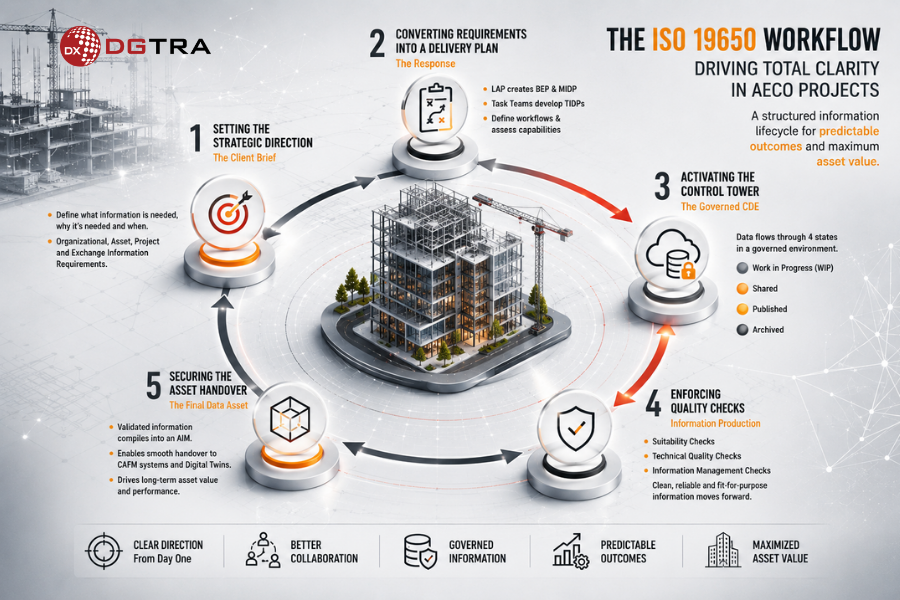
In our previous article, Executive Guide to ISO 19650 Driving Predictable AECO Projects, we established that this international standard stands as a premier business governance framework designed to maximize asset value. Now, let’s explore exactly how this framework delivers outstanding performance on a live capital project through a highly optimized information lifecycle. The secret to superior large-scale infrastructure delivery lies in absolute alignment of communication. Complex projects thrive when information flows seamlessly, datasets remain completely consistent, and goals are perfectly synchronized among clients, lead consultants, and trade contractors. ISO 19650 provides this industry excellence by introducing a structured, end-to-end information workflow. This sequence functions as the advanced operating system for project data governance. For leaders managing high-value programs across India, the UK, and the Middle East, mastering this workflow serves as your primary accelerator for driving predictable asset outcomes and maximizing operational efficiency. The Five Stages of the ISO 19650 Workflow To establish a highly collaborative, productive, and reliable project environment, the standard defines a visible, repeatable lifecycle for data production. Setting the Strategic Direction (The Client Brief) The information workflow begins with the Appointing Party (the client or asset owner). Before procurement begins, the client establishes a strong foundation by defining exactly what information is needed, why it is required, and precisely when it must be delivered. This is accomplished by authoring clear criteria, including Organizational, Asset, Project, and Exchange Information Requirements. This strategic brief empowers delivery teams with immediate clarity, ensuring optimal deliverables and excellent handover quality from day one. Converting Requirements into a Delivery Plan (The Response) Once the client issues the information requirements, the supply chain outlines the exact path to successful execution: The Lead Appointed Party (LAP): Typically, the main contractor or lead consultant, the LAP coordinates the entire tier-2 supply chain. They author the Post-Contract BIM Execution Plan (BEP) and the Master Information Delivery Plan (MIDP). Individual Task Teams: Each specific discipline (architectural, structural, MEP) maps out its own Task Information Delivery Plan (TIDP), workflow procedures, and resource capability assessments.In short: The client defines the strategic goals, while the delivery teams provide the exact execution strategy. Activating the Control Tower (The Governed CDE) The Common Data Environment (CDE) serves as the powerhouse of the ISO 19650 workflow. A compliant CDE is a disciplined protocol that guides every single model, drawing, and dataset through four productive states: Work in Progress (WIP): Focused data utilized internally by a specific task team. Shared: Validated data released to other disciplines for collaborative coordination. Published: Authorized data approved for active construction or manufacturing. Archived: A complete, traceable digital ledger of all historical transactions. By ensuring controlled transitions with explicit status codes and metadata, executives maintain total transparency over data maturity. Enforcing Quality Checks (Information Production) ISO 19650 elevates standard project delivery by introducing a highly disciplined verification process. Before any information container leaves the WIP state and enters the Shared environment, it passes through a thorough three-tier gateway: Suitability Checks: Confirming the data is ideal for its intended purpose. Technical Quality Checks: Verifying geometric accuracy and code compliance. Information Management Checks: Confirming perfect alignment with naming conventions and metadata rules. This systematic validation ensures the shared environment remains completely clean, reliable, and optimized for project efficiency. Securing the Asset Handover (The Final Data Asset) The ultimate value of the workflow is realized at project completion. Validated project information compiles beautifully into an Asset Information Model (AIM)—a highly structured, actionable dataset optimized for long-term operations and maintenance. Because the data undergoes progressive validation at every milestone, the owner receives a pristine, queryable asset dataset. This clean lineage plugs directly into CAFM platforms and powers operational Digital Twins, unlocking decades of predictive maintenance capability and long-term asset value. About DGTRA DGTRA is a digital transformation partner and process-driven consultancy operating at the absolute forefront of the global AECO industry. Backed by an elite team of over 100 specialized professionals, we bridge the gap between complex digital technology and practical, on-site execution across India, the UK, and the Middle East. We specialize in high-impact, tailored digital solutions. We work directly with asset owners, tier-1 contractors, and leading design firms to design and implement robust, forward-thinking digital roadmaps. Our deep domain expertise spans advanced BIM implementation, comprehensive ISO 19650 advisory services, customized CDE setup, and the strategic development of operational Digital Twins. At DGTRA, our core guiding principle remains clear: we engineer the digital processes that bring complete predictability, transparency, and financial certainty to the world’s most ambitious construction programs. Connect with Our Experts TodayEstablishing a transparent, end-to-end information workflow is the most powerful action an executive can take to protect project margins and elevate organization-wide delivery standards. Transitioning to this international standard replaces traditional data silos with a highly coordinated, profitable, and digitally mature delivery ecosystem. DGTRA possesses the exact process engineering expertise required to embed these international standards seamlessly into your supply chain.[Click here to schedule a strategic consultation with a DGTRA Process Specialist.] Let’s optimize your current information pathways, establish a high-performance governance model, and turn your project delivery into a highly controlled, predictable digital asset. Frequently Asked Questions (FAQs) Who monitors the day-to-day enforcement of this workflow? While the framework is established contractually by the client, the day-to-day governance, CDE tracking, and information validation are championed by specialized Information Managers or BIM Implementation leads within the Lead Appointed Party. How does the CDE workflow ensure contractor alignment? Because the ISO 19650 workflow is fully embedded into contract documents via the EIR and BEP, compliance is a core project requirement. Data must successfully clear the verification gateways to reach the “Published” state, ensuring only fully authorized information is utilized for active on-site construction. Does this workflow optimize the design and construction timeline? Yes. By proactively identifying data variations, spatial clashes, and misaligned definitions early within the controlled digital environment, this workflow saves thousands of hours of field adjustments and maximizes operational efficiency on the construction site. How does the workflow manage updates or revisions to approved models? When a
How to Drive True BIM Adoption Across Every Project Stakeholder
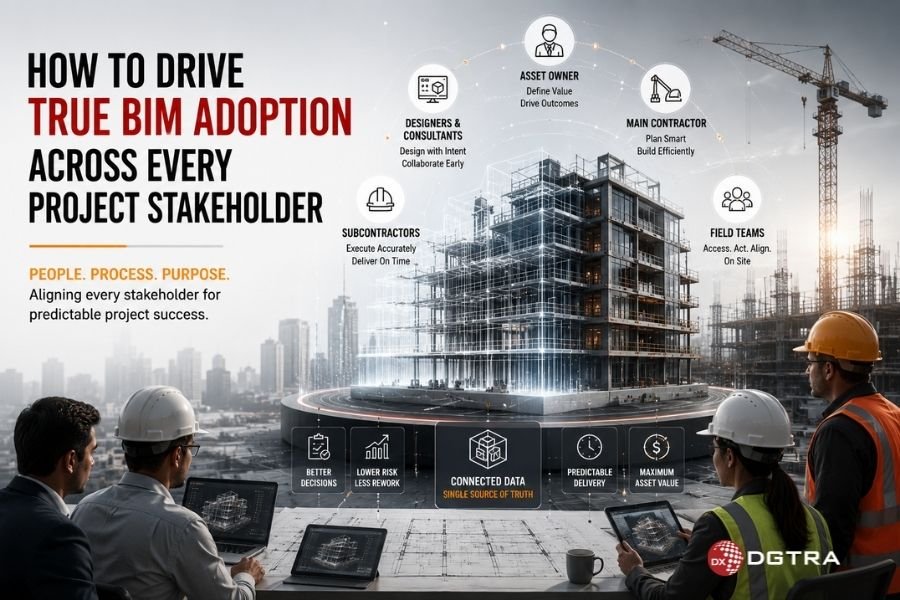
Every experienced leader in the AECO space knows the frustration of a flawless digital strategy that completely falls apart on the ground. We invest heavily in sophisticated Building Information Modeling (BIM) frameworks, map out meticulous data protocols, and secure enthusiastic signoffs at the project kickoff. Yet, the moment boots hit the mud, the disconnect begins design models remain isolated in corporate silos, contractors rely back on static sheets, and field crews improvise around immediate site pressures. True BIM adoption is never a software acquisition issue; it is a human alignment challenge that requires an operational bridge between digital design intent and the realities of construction execution. If our digital workflows stop at the office door, we aren’t running an integrated project—we are simply managing high-tech data silos. To unlock real lifecycle efficiency, we must pivot from imposing rigid mandates to driving a unified cultural shift across every project tier. The Root Cause: Why Stakeholder Adoption Stalls Real adoption stalls the moment a digital process feels like an administrative burden rather than an operational solution. When site teams and subcontractors are handed a complex system that doesn’t respect their daily realities, human nature takes over, and people naturally revert to the legacy methods that let them finish their shift fastest. To build an ecosystem that works, we must directly address the three biggest friction points across typical project teams: The Value Disconnect: Stakeholders often view BIM consulting and model coordination as an added compliance layer designed to benefit someone else further down the lifecycle, rather than an active tool created to solve their immediate on-site hurdles. Technical Asymmetry: Pushing advanced data environments onto field teams without providing simplified, intuitive entry points creates an unnecessary learning curve that slows down production schedules. Contractual Fragmentation: Traditional delivery methods rarely incentivize collaborative data management services. If a trade partner is not structurally rewarded for maintaining data continuity, they simply will not do it. A Strategic Framework to Drive Multi-Stakeholder Alignment Driving deep adoption across a diverse project ecosystem requires moving away from heavy-handed enforcement and shifting toward systemic enablement. Translate BIM into Local Value We must speak to our stakeholders in the currency they trade in. Instead of discussing complex data schemas or abstract clash matrices, focus on their immediate operational wins: For Main Contractors: Position the model as a strict risk-mitigation tool that directly protects their margins by preventing material overruns and keeping schedules predictable. For Subcontractors: Emphasize how pre-fabrication and precise spatial coordination eliminate wasted site trips, idle standby times, and frustrating field modifications. For Asset Owners: Demonstrate how a clean, lifecycle-ready data handover lowers long-term operational costs and builds a true foundation for smart facility management. Lower the Technical Barrier to Entry True accessibility means meeting your teams exactly where they are. Field crews do not need to navigate an entire master model on a chaotic site; they need quick, seamless access to the specific, isolated section relevant to their current task. By utilizing lightweight, mobile-friendly viewing tools, we can strip away the technical noise and put actionable insights right into the hands of the people building the project. Cultivate Shared Project Ownership Instead of treating coordinators as data police who flag errors after they occur, build an interactive ecosystem. Establish collaborative, cross-functional review sessions where project challenges are solved with input from the field teams, not just dictated to them. When trades see their real-world expertise actively shaping the digital environment, true buy-in follows naturally. Industry Insights: The True Cost of Disconnected Data Achieving complete stakeholder alignment is no longer just an internal operational preference—it is a critical requirement for modern project delivery. Fragmented information exchange remains one of the largest drains on construction productivity worldwide. According to global project delivery studies compiled by ResearchGate, poor communication, a lack of clear client demand, and disjointed training structures are consistently ranked as the top barriers preventing organizations from achieving full digital integration. When data isn’t unified across lines, projects lose the collaborative precision that modern infrastructure demands. Transform Your Implementation Strategy: Join Our Upcoming Webinar If your organization is ready to move past theoretical planning and build a digital workflow that your subcontractors, project managers, and clients actually want to engage with, let’s take the next step together. Join our upcoming live strategic session where we break down the practical playbooks leading firms use to secure genuine buy-in, simplify field data access, and drive measurable adoption across every project tier. Webinar: BIM Execution Plans That No One Follows Secure Your Spot Today: DGTRA Webinar Registration About DGTRA At DGTRA, we bridge the gap between complex technology and real-world construction delivery. We partner with forward-thinking asset owners, general contractors, and engineering leaders to design information management frameworks that drive collaboration, minimize risk, and safeguard project predictability. We don’t just help you deploy digital tools we ensure your entire ecosystem knows how to use them to deliver profitable, future-proof assets. Let’s work together to transform your project data into a powerful competitive advantage. Ready to bridge the gap between digital intent and site reality? Connect with our consulting team today to discover how we can help align your stakeholders and optimize your next project workflow. Who monitors the day-to-day enforcement of this workflow? While the framework is established contractually by the client, the day-to-day governance, CDE tracking, and information validation are championed by specialized Information Managers or BIM Implementation leads within the Lead Appointed Party. How does the CDE workflow ensure contractor alignment? Because the ISO 19650 workflow is fully embedded into contract documents via the EIR and BEP, compliance is a core project requirement. Data must successfully clear the verification gateways to reach the “Published” state, ensuring only fully authorized information is utilized for active on-site construction. Does this workflow optimize the design and construction timeline? Yes. By proactively identifying data variations, spatial clashes, and misaligned definitions early within the controlled digital environment, this workflow saves thousands of hours of field adjustments and maximizes operational efficiency on the construction site. How does the

Executive Guide to ISO 19650 Driving Predictable AECO Projects
Our previous article, AECO Data Shift Why Information Management Rules Project Success, demonstrated that project outcomes now depend on effective data management, not just drawings. Achieving predictability on site requires applying the same discipline to data as to physical materials. This shift makes ISO 19650 the operational standard for modern project delivery. ISO 19650 is often labeled as a technical standard for digital modeling, but this is inaccurate. It is an executive governance framework designed to transform fragmented project data into a reliable, risk-managed business asset. For executives managing high-capital programs, this guide explains what ISO 19650 delivers, why it is essential, and how it safeguards project outcomes and financial performance. The Strategic Purpose: Driving Better Decisions Traditional document management is breaking under the weight of modern infrastructure demands. When teams rely on disconnected spreadsheets, unvetted PDFs, and fragmented communication, project execution suffers. ISO 19650 introduces process discipline to replace fragmented digital practices. Its core objective is to ensure that accurate information is delivered by the appropriate team, in the correct format, at the required time, enabling informed decision-making. Applying this standard across a capital program establishes a unified approach to information management. Asset owners receive the required deliverables, contractors reduce uncertainty, and consultants operate with clear expectations. The Core Architecture of ISO 19650 The international standard covers several components, but its logic is straightforward. It manages the digital lifecycle of a project through five operational steps: Defining the Information Brief The client defines project expectations by documenting clear information requirements. This foundation, structured in four layers, removes uncertainty from the supply chain before procurement starts. Formulating the Execution Response In response to the client’s brief, lead contractors and design partners develop a detailed BIM Execution Plan (BEP). This is not a boilerplate compliance document; it is an active operational manual proving that the delivery team has the exact resource capacity, workflows, and protocols required to execute the mandate. Activating the Common Data Environment (CDE) A compliant Common Data Environment (CDE) provides strict workflow control, managing how files move between four defined states: Work in Progress, Shared, Published, and Archived. Data is only used on-site after systematic checks, reviews, and approvals. Structuring Governed Packages Unorganized file submissions are eliminated. Information is produced and exchanged in coordinated information containers, with all models, datasets, and documents following unified naming conventions, metadata rules, and status codes. Securing the Lifecycle Asset Model At handover, verified project data is compiled into a structured Asset Information Model (AIM). The asset owner receives a dataset ready for integration with facility management systems and digital twin solutions. It Is About Process, Not Software The most common question executives ask is: “Which software platform do we need to purchase to become ISO 19650 compliant?” The real question should be: “Do we have the process governance to manage our information effectively?” ISO 19650 is technology-agnostic and does not prescribe specific tools or platforms. Technology enables the process, but cannot replace disciplined workflows. The standard prioritizes accountability, data validation, and risk mitigation. Moving From Modelling to True Data Governance ISO 19650 is not limited to producing 3D models. The commercial value is in the data linked to the geometry and the auditable digital record of creation, verification, and approval. A unified governance structure reduces project risk. Teams can identify and address information errors in the digital environment before they impact the job site. About DGTRA DGTRA is a digital transformation partner and process-driven consultancy serving the global AECO industry. With a team of over 100 specialized professionals, we connect digital technology with practical on-site execution in India, the UK, and the Middle East. We work directly with asset owners, tier-1 contractors, and design firms to design and implement effective digital roadmaps. Our expertise includes advanced BIM implementation, ISO 19650 advisory, customized CDE setup, and development of operational Digital Twins. Our focus is on engineering digital processes that deliver predictability, transparency, and financial certainty for complex construction programs. Connect with Our Experts Today Transitioning to an ISO-compliant framework is a strategic business decision to reduce operational uncertainty. DGTRA provides the framework to move beyond ad-hoc digital practices and establish predictable digital delivery. Our advisory team supports the development of information strategies for capital programs and audits of supply chain digital maturity. Click here to connect directly with a DGTRA Information Governance Consultant. Let’s map your current process workflows, close the digital maturity gap, and turn your Frequently Asked Questions Is ISO 19650 compliance expensive to implement? The initial investment is focused on process engineering, team training, and setting up structured workflows. However, this cost is quickly offset by the massive reduction in site rework, procurement errors, and schedule delays caused by uncoordinated project data. Can we implement ISO 19650 on mid-sized projects, or is it only for mega-projects? The standard is entirely scalable. While the governance principles remain identical, the complexity of the requirements and the structure of the Common Data Environment can be tailored to match the specific scale, risk profile, and needs of any project. Who is responsible for setting up the ISO 19650 framework on a project? The ultimate responsibility begins with the asset owner (the Appointing Party), who must define their specific information requirements. However, experienced digital transformation partners are typically retained to design the roadmaps, author the briefs, and audit supply chain compliance. How does ISO 19650 support long-term facility management? Instead of receiving static, unverified PDFs at project handover, the owner receives a fully validated Asset Information Model (AIM). This data is structured to plug directly into asset management software, drastically reducing onboarding times and operational maintenance costs. Does our supply chain need to be fully certified to work on an ISO 19650 project? Not necessarily. While corporate certification demonstrates maturity, the project framework primarily requires that teams possess the verified capability, resource capacity, and willingness to follow the standardized workflows outlined in the project’s BIM Execution Plan. The initial investment is focused on process engineering, team training, and setting up structured workflows. However, this cost is quickly offset by the massive reduction in site rework, procurement errors, and schedule delays caused by uncoordinated project data. The standard is entirely scalable.
AECO Data Shift: Why Information Management Now Rules Project Success
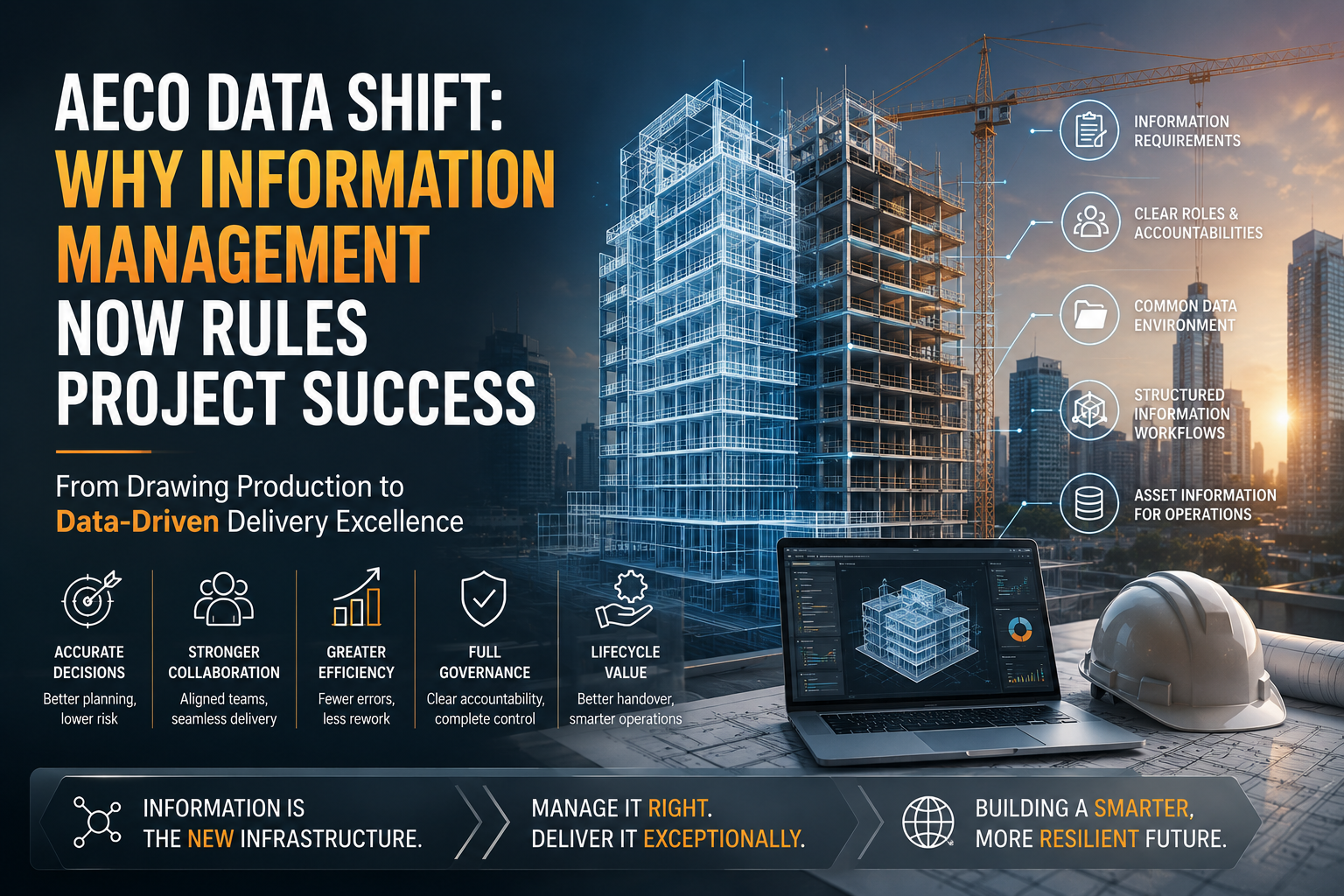
For years, the AECO industry measured progress by the volume and quality of project drawings. Today, project success is determined by how effectively organizations manage and leverage project information. As infrastructure projects increase in scale and complexity, data has become the most valuable and often the most mismanaged asset in the built environment. Leading organizations recognize that structured information management is essential for controlling costs, ensuring governance, and maximizing long-term asset value. ISO 19650 has emerged as the global standard for delivering these outcomes. The True Engine of Project Performance Modern construction economics demand precision. Margins are tight, supply chains are unpredictable, and stakeholders require traceable, auditable project records. In this environment, the quality of digital data drives four key areas of execution: Cost and schedule accuracy Team collaboration effectiveness Digital delivery maturity Asset operations and lifecycle value We have reached a critical tipping point where errors in data definitions carry far heavier financial consequences than simple errors in a sketch. A single misaligned asset attribute code can cascade into widespread procurement delays, expensive on-site rework, and decades of operational headaches. Moving your organization from basic “drawing production” to true digital information management is no longer a technical option handled by a single department. It is a core corporate strategy. ISO 19650 serves as the operational playbook that turns this strategy into a repeatable day-to-day capability. Why ISO 19650 is a Board-Level Priority ISO 19650 has rapidly evolved from a technical framework used by digital teams into a key governance tool for high-value capital programs across India, the UK, and the Middle East. It introduces three core pillars that are reshaping modern project delivery: Information as a Managed Asset Data is treated with the exact same strict discipline as physical building materials. It must be structured, thoroughly validated, strictly version-controlled, and completely secure from concept to handover. Radical Accountability Across the Delivery Chain The standard eliminates room for error by defining clear, measurable responsibilities for every project tier. It explicitly outlines the boundaries between the Appointing Party (the client), the Lead Appointed Party (the tier-1 contractor or consultant), and individual Task Teams. Repeatable, Predictable Project Flows By standardizing how information requirements are set, how approvals are managed, and how files are named, the framework systematically eliminates unnecessary variability—the single biggest driver of project risk. The AECO Industry Maturity Gap While leading global firms have fully embraced structured information governance, a significant maturity gap still splits the industry. Many project teams remain trapped in outdated, document-heavy delivery habits that actively drain profit margins. Take a look at how lagging practices contrast against an optimized, standardized workflow: Outdated Delivery Habits (High Risk) ISO 19650 Governance (Predictable Outcomes) Designing systems without clear, documented information requirements. Standardized EIR and AIR documents set before procurement begins. Creating a BIM Execution Plan (BEP) as a generic, check-the-box text document. Living, operational BEPs tied directly to resource capacity and risk matrices. Using a Common Data Environment (CDE) as a basic, unmanaged file warehouse. A strictly governed CDE workflow managing WIP, Shared, and Published states. Treating handover data as an unvetted, post-project afterthought. Progressive data validation ensuring a lifecycle-ready Asset Information Model (AIM). This industry maturity gap has become a massive competitive differentiator. Organizations that master structured information management consistently outperform their peers by securing lower rework rates, higher planning accuracy, fewer contractual disputes, and far better handover data for long-term operations. Moving Beyond Simple 3D Modelling The biggest misconception in the AECO space is that digital transformation begins and ends with a 3D model. In reality, physical geometric modelling is just one small component of the overarching data ecosystem. The real business value of modern digital workflows lies in establishing strict data requirements, enforcing structured data exchanges across different disciplines, and validating information inside a secure environment before it hits the field. It is not about generating more complex models; it is about producing the right data so your entire supply chain can make faster, smarter decisions. About DGTRA DGTRA is a digital transformation partner and process-driven consultancy operating at the absolute forefront of the global AECO industry. Backed by an elite team of over 100 specialized professionals, we bridge the gap between complex digital technology and practical, on-site execution across India, the UK, and the Middle East. We avoid generic software solutions. Instead, we partner with asset owners, contractors, and design firms to deliver robust digital roadmaps. Our expertise covers advanced BIM, ISO 19650 advisory, customized CDE setup, and operational Digital Twins. Our focus is on engineering digital processes that deliver predictability, transparency, and financial certainty for complex construction programs. Connect with Our Experts Today Let’s discuss your current digital maturity level, evaluate your project workflows, and build an unshakeable information infrastructure that guarantees long-term asset value. Get your project data right, and operational excellence will inevitably follow. Frequently Asked Questions What is the main difference between traditional BIM and ISO 19650 information management? Traditional BIM often focuses heavily on the technical creation of 3D geometric models. ISO 19650 shifts the focus to corporate governance, process discipline, and standardizing how data is requested, produced, validated, and handed over across the entire lifecycle of an asset. Why are drawings no longer enough for modern capital projects? Drawings represent a static snapshot of a design, often trapped in isolated PDF or paper formats. Modern projects require live, queryable data to feed automated cost estimation, scheduling tools, procurement platforms, and long-term facility management systems without manual data re-entry. What is a Common Data Environment (CDE) in an ISO context? An ISO-compliant CDE is not just a cloud storage platform like Google Drive or Dropbox. It is a highly governed workflow engine that strictly controls how information containers move through specific states: Work in Progress (WIP), Shared, Published, and Archived, using standardized status codes and metadata. How does poor information management impact project costs? When data is unstructured, different teams (structural, MEP, architectural) work off unverified versions. This leads directly to spatial clashes, procurement errors, scheduling delays, and expensive physical demolition and rework on the construction site. What is an Asset Information Model (AIM)? The AIM is the compiled, fully validated dataset handed over to the client upon project completion. Unlike a massive dump of unorganized files, an AIM is structured specifically to integrate directly into Computer-Aided Facility Management (CAFM) systems and power real-time Digital Twins. Traditional BIM often focuses heavily on
BIM Predictive Analytics: Reducing Construction Variations and Extra Costs
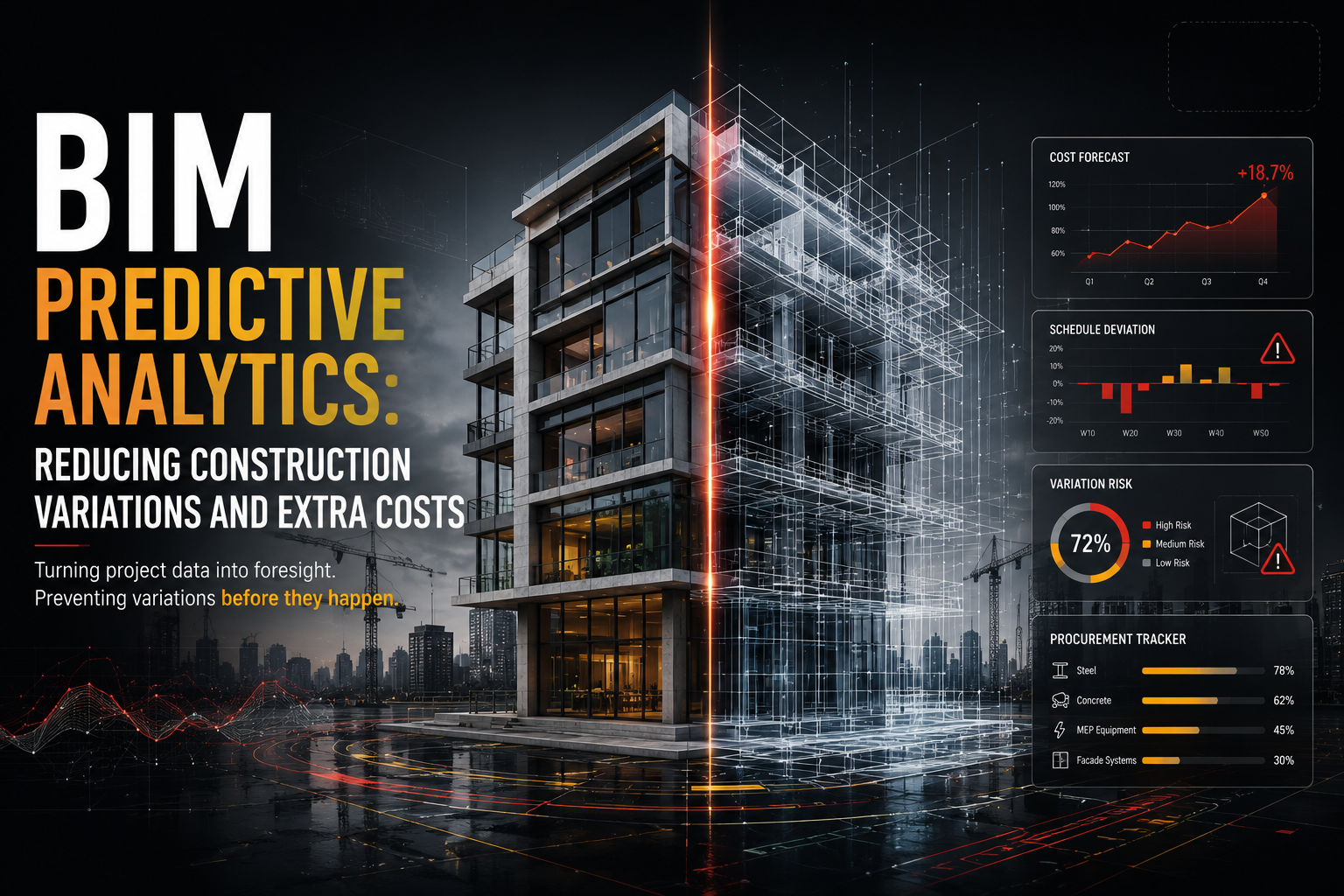
The Variation Was Written into the Project Three Months Before Anyone Saw It. That is the uncomfortable truth most construction cost control processes are not designed to surface. By the time a variation instruction lands on a project manager’s desk, the decision that caused it was made weeks — sometimes months — earlier. A structural system chosen without full constructability validation. An MEP routing was approved against an incomplete federated BIM model. A procurement timeline set without scenario analysis against the construction sequence. The variation was not a surprise. It was a predictable outcome of a decision made without the right data at the right time. This is what BIM predictive analytics is designed to solve. Not by catching problems faster — but by building the data visibility that makes those decisions differently in the first place. This blog builds on the frameworks explored in How AI Is Reshaping BIM Workflows for AEC Firms, BIM 6.0: Why Sustainability Is the New Sixth Dimension of Construction, and How to Move Your AEC Team Toward Integrated Delivery Maturity — bringing predictive analytics to bear on one of the most persistent and costly challenges in AEC project delivery. Why Traditional Cost Control Is Structurally Limited Most construction cost management frameworks share a common architecture — they measure what has happened and report it. Budget versus actual. Planned versus earned. Forecast at completion based on current burn rate. These are all retrospective instruments. They describe the past with varying degrees of accuracy. And they consistently fail to answer the question that matters most on a live project — what is about to happen, and what can we do about it right now? Research validating an integrated 4D/5D Digital Twin framework for predictive construction control found that industry data shows consistent average cost overruns above 20% and schedule deviations approaching 30% — with traditional deterministic CPM and document-based estimating identified as key contributors, as these approaches seldom reflect the uncertainty and interdependence of modern projects once execution begins. (Source: arXiv, 4D/5D Digital Twin Predictive Control 2025 →) Taylor & Francis Online Those numbers — 20% cost overrun, 30% schedule deviation — have been consistent across the industry for decades. The tools have changed. The outcomes have not. Because the tools have been getting better at describing the problem rather than preventing it. BIM predictive analytics is a distinct capability category. It is not a better version of cost reporting. It is fundamentally different from the relationship between project data and project decisions. The Distinction That Changes Everything Here is the framing most blogs on this topic miss. Predictive analytics is not about having more data. Every large AEC project generates enormous volumes of data — model files, RFIs, variation logs, progress reports, procurement records. The data has never been the problem. The problem is that most of that data sits in disconnected silos — the BIM model in one environment, cost data in another, schedule data in a third, procurement in a fourth. None of them talks to each other in real time. And none of it is structured in a way that allows patterns to be identified before they become problems. BIM predictive analytics works by connecting those silos — through a well-governed Common Data Environment and a 4D/5D BIM workflow that unifies model, cost, and schedule data — and then applying statistical and machine learning models to that dataset to identify leading indicators of cost variance and variation risk. The output is not a better report. It is earlier, more precise decision-making — at the point in the project where decisions are still affordable to make. Where Predictive Analytics Delivers Its Highest Value Early in Design — When Carbon and Cost Decisions Are Still Reversible The highest-leverage application of BIM predictive analytics is the one most teams skip entirely — early-stage design cost modeling. Research published in Scientific Reports on BIM-integrated neural network cost prediction 2025 found that AI-powered models can forecast material price fluctuations across different construction seasons — enabling procurement teams to optimize timing and contingency allocation, and effectively control hidden cost overrun risks before they surface during construction execution. When machine learning cost models are trained on structured historical project data and integrated with the BIM model from the earliest design stage, structural system selection, envelope specification, and MEP strategy decisions all carry predicted cost consequences — visible before they are committed. This is also where BIM predictive analytics intersects most directly with the 6D BIM sustainability framework explored in BIM 6.0: Why Sustainability Is the New Sixth Dimension of Construction. When cost prediction and embodied carbon tracking run from the same model at the same stage, the team makes genuinely integrated decisions rather than optimizing one dimension at the expense of another. During Pre-Construction — When Sequencing Locks In Risk 4D BIM construction sequencing is one of the most underutilized tools for variation prevention available to delivery teams. When the construction program is simulated against the federated model before mobilization, the conflicts that generate variations — spatial clashes, trade sequencing dependencies, access constraints, and procurement lead-time misalignments — are visible before the site team encounters them. The key technical distinction — and the one most implementations miss — is that 4D simulation is only as reliable as the model it runs on. A sequencing simulation built on a model with LOD mismatches, incomplete MEP coordination, or unresolved structural interfaces does not predict site conditions. It predicts an idealized version of the project that does not exist. This is why DGTRA’s Constructability Reviews validate models for buildability and sequencing logic before 4D predictive simulation runs — and why How to Validate BIM Models Before Construction Begins is a foundational read before any organization invests in 4D predictive planning. During Construction — When Variation Risk Is Highest The most immediate and operationally valuable application of BIM predictive analytics is live scenario analysis during construction — using the model to quantify the cost and schedule impact of emerging variations before a response decision is made. When a design change is proposed, a procurement delay surfaces, or a site condition differs from design assumptions, BIM-based what-if modeling allows the project team to evaluate multiple response paths simultaneously —
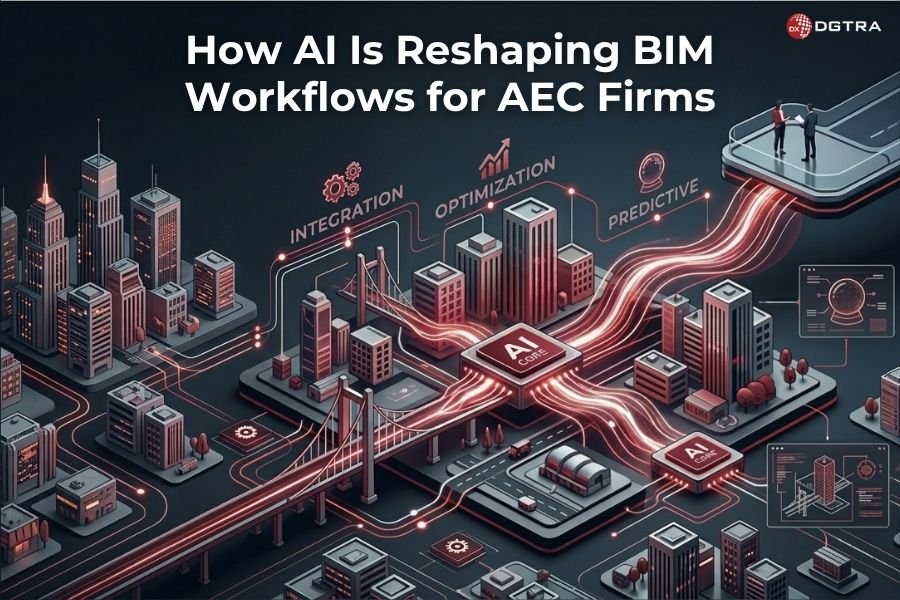
How AI Is Transforming BIM Workflows and AEC Competitive Advantage
How AI Is Reshaping BIM Workflows for AEC Firms The Model Has Always Been Smarter Than the Workflow Around It. For years, BIM models have contained more data than project teams could leverage. Geometry, specifications, quantities, schedules, and costs have been available in the federated model, but lacked a process to unlock their full value. Artificial Intelligence now provides that process. AI is not about replacing people. It is about elevating project delivery by aligning model intelligence with equally intelligent workflows. In our previous blog — BIM 6.0: Why Sustainability Is the New Sixth Dimension of Construction — we established that forward-looking delivery organizations are embedding new dimensions of intelligence into their models. AI is the engine that makes those dimensions actionable. What the Research Tells Us Performance data on AI-BIM integration is increasing, and the trends are consistent across studies. A systematic review published in Applied Sciences analyzing 1,212 studies on AI-BIM integration between 2022 and 2025 identified five primary BIM application domains where AI is delivering measurable outcomes — BIM modeling, 4D/5D planning, CDE management, clash detection, and Digital Twin development — with machine learning and deep learning emerging as the most impactful AI families across all five. (Source: Applied Sciences, MDPI — AI-BIM Systematic Review 2025 →) Research published in the Journal of Umm Al-Qura University for Engineering and Architecture examining AI-BIM integration found significant improvements across construction methodologies — including enhanced design automation, measurable reductions in coordination conflicts, and improved construction scheduling outcomes — with buildingSMART International identified as a key body for developing standardized AI-BIM validation protocols. The research is clear: AI in BIM delivers measurable improvements, but only when model data, workflow standards, and process foundations are structured to support it. Five Areas Where AI Is Reshaping BIM Delivery Intelligent Clash Detection and Coordination Traditional clash detection is reactive, performed after modeling and generating large reports that require extensive human review. AI-powered clash detection shifts this approach, enabling more efficient and targeted coordination. Research published in ScienceDirect on automating clash relevance filtering using machine learning found that AI-enhanced coordination systems — built on Navisworks and trained on historical project data — can autonomously classify, prioritize, and filter clashes by relevance, reducing the volume requiring human review and enabling coordination teams to focus on genuinely complex interface decisions that require strategic resolution. AI clash detection performance depends on the quality of the model’s data. Poor LOD alignment, inconsistent classification, or incomplete semantic data lead to weak AI outputs. Investing in model quality and classification consistency through a clear BIM Execution Plan is essential to realize the full value of AI-powered coordination. This connects directly to the coordination maturity framework in How to Move Your AEC Team Toward Integrated Delivery Maturity. DGTRA’s Design & Trade Coordination service is built around exactly this principle. 2. Generative Design and Early-Stage Optimization Generative design uses parametric optimization and AI algorithms to evaluate many design options against defined objectives such as cost, space efficiency, structural performance, and energy use. This process operates at a speed that manual workflows cannot match. Research presented at the 2025 ACM Computers and People Research Conference found that generative design tools analyze site conditions, zoning regulations, and project requirements to produce multiple optimized design options in parallel — significantly compressing early design timelines and reducing downstream coordination conflicts. The quality of generative design outputs depends on how precisely the delivery team defines objective functions from the start. Including embodied carbon targets in a 6D BIM workflow ensures that early-stage sustainability decisions are made based on data, not assumptions. This aligns with the principles outlined in BIM 6.0: Why Sustainability Is the New Sixth Dimension of Construction. 3. Predictive Analytics and Risk Management AI-powered predictive analytics provides project teams with early visibility into risk by leveraging machine learning models trained on structured historical project data. This approach identifies warning signals before they impact the schedule or cost. Research published in Applied Sciences found that AI-driven real-time predictive analytics significantly reduces the risk of project delays — and, separately, that AI-IoT sensor integration in site safety monitoring reduced workplace accidents by 30% across monitored construction environments. (Source: Applied Sciences, MDPI — AI in BIM Transformation 2025 →) The safety outcome specifically relates to AI-IoT site monitoring, which is separate from BIM-based predictive analytics, though both are part of the broader AI-construction ecosystem. For BIM-based risk analytics, value increases with the quality and structure of historical project data used for model training. Organizations with well-governed Common Data Environments and consistent data standards are better positioned to realize this capability. DGTRA’s BIM Project Management service embeds data-driven governance into live project delivery — building the data foundation that makes predictive analytics increasingly valuable over successive project cycles. 4. Automated Quantity Take-Off and Cost Intelligence AI-driven QTO delivers quantity extractions and cost projections faster and more consistently than manual estimation. Outputs are not dependent on individual estimator experience and update automatically as the model evolves. The accuracy of AI-generated quantity extractions depends directly on model LOD consistency and alignment with classification systems, such as Uniclass, OmniClass, or project-specific systems. A well-classified model at the right LOD produces reliable AI-driven QTO. A model without those foundations produces outputs that require significant manual correction. With a strong data foundation, cost intelligence shifts from a periodic milestone to a live design input. This enables real-time cost comparison across design options, which manual estimation cannot sustain over multiple iterations. 5. AI-Powered Digital Twins for Operations The most comprehensive application of AI in BIM is the intelligent Digital Twin — where the model becomes a live operational asset that learns and adapts based on real-time sensor data throughout the building’s operational life. It is important to clarify this transition. The construction BIM model and the operational Digital Twin are different assets. Moving from one to the other requires deliberate data preparation at handover, including LOD adjustment, asset data structuring, and integration with building management systems. A well-configured CDE and clearly defined Asset Information Requirements are critical at this stage. Research published in Applied Sciences found that, in the operational phase, AI enables intelligent building management through predictive analysis, operational scenario simulation, and energy performance optimization, transforming the static handover model into a continuously improving operational
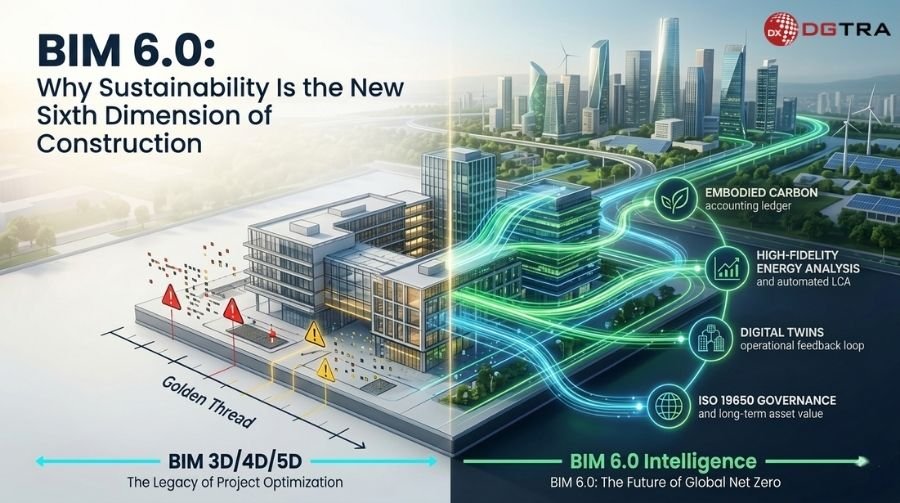
BIM 6.0: Why Sustainability Is the Sixth Dimension of Construction
For decades, the construction industry viewed sustainability as a “nice-to-have” or, worse, a regulatory hurdle to be cleared at the lowest possible cost. We mastered 3D geometry, integrated 4D schedules, and optimized 5D costs. Yet, as the global built environment remains responsible for nearly 40% of energy-related carbon emissions, the industry has reached an inflection point. The transition from BIM 5D to 6D BIM is not merely a numerical increment; it is a fundamental shift in the DNA of project delivery. Sustainability is no longer a post-script—it is the Sixth Dimension, a digital imperative that weaves environmental performance into the very fabric of the Building Information Model. It’s about intelligently orchestrating life-cycle data to ensure the structures we build today are future-ready and thrive in a climate-conscious economy through 2030 and beyond. The Market Mandate: Data-Driven Decarbonization The shift toward BIM 6.0 is fueled by more than just environmental altruism it is driven by aggressive market forces and evolving global standards. According to recent industry analysis by Grand View Research, the global green building market is projected to reach approximately $529.5 billion by 2030, growing at a CAGR of 10.3%. This growth is underpinned by the “Green Premium,” in which sustainable assets command higher valuations and lower insurance premiums. Furthermore, the International Energy Agency (IEA) emphasizes that to reach Net Zero by 2050, all new buildings and 20% of the existing building stock must be zero-carbon-ready by 2030. This requires precise management of complex project data. BIM 6.0 provides a framework for Life Cycle Assessment (LCA, a process evaluating environmental impacts across a building’s lifespan) and Energy Analytical Models (EAM, tools for forecasting and measuring building energy use). These are incorporated in the federated model, allowing real-time carbon accounting during design rather than as an afterthought. This is precisely why DGTRA integrates sustainability thinking into its BIM Consulting & Management and Integrated Project Delivery services because environmental performance embedded in delivery is the standard the market is moving toward. Beyond Geometry: The Mechanics of BIM 6.0 In the BIM 6.0 paradigm, the model becomes a living simulation. It’s no longer just about where a pipe goes, but what that pipe is made of, the carbon footprint of its transport, and its thermal contribution to the building’s efficiency over 50 years. Integrated Life Cycle Assessment (LCA) BIM 6.0 enables experts to automate embodied carbon calculations. Embodied carbon is the environmental impact of materials used in construction. By linking Material Take-Offs (MTOs, itemized lists and quantities of materials) directly to environmental product declaration (EPD) databases—EPDs are reports detailing materials’ environmental effects—BIM managers can run comparative analyses of structural systems within the native modeling environment. Operational Energy Simulation The “6D” aspect integrates building performance analysis (BPA, a method for simulating a building’s energy use) into the early design stages. By using detailed weather data and occupancy-tracking sensors, the 6.0 model predicts energy consumption patterns. This “Digital Twin” approach—where a virtual model mirrors the real building—ensures that the “as-built” energy performance matches “as-designed” expectations. Circularity and the “Building as a Material Bank.” Sustainability in 6.0 extends to deconstruction. By embedding metadata on material recyclability (the ability to reuse or recycle materials) and disassembly procedures (the steps to take apart a building), we are essentially creating a “Material Passport,” a digital record of the materials used and their reuse potential. When a building reaches the end of its life, the BIM 6.0 model serves as a ledger for the circular economy, keeping resources in use. This is the kind of delivery infrastructure DGTRA helps organizations build through Strategic BIM Roadmap and BIM Maturity Audits — identifying where the current workflow sits and what specifically needs to change to support 6D sustainability integration. Why BIM Experts Must Lead the 6.0 Transition The transition to BIM 6.0 requires a sophisticated understanding of interoperability, which means different software tools must exchange information seamlessly. It’s about the flow of data between the BIM environment and specialized simulation engines such as EnergyPlus (a tool for modeling building energy use) or One Click LCA (a software for assessing lifecycle impacts). As a leading BIM services provider, we recognize that the challenge isn’t just software—it’s the Information Requirements (EIR, the data needed for project delivery). We must advocate for “Sustainability Information Requirements” at the project’s start. If the data isn’t structured for 6D analysis from Stage 1, opportunities for significant carbon reduction are often lost by Stage 4. For context on how model quality and delivery readiness connect to this challenge, see: Why Your BIM Models Don’t Match Site Reality and How to Validate BIM Models Before Construction Begins. The Strategic Value of 6D Implementation Risk Mitigation: With the rise of ESG (Environmental, Social, and Governance) reporting, developers are increasingly liable for the carbon footprint of their portfolios. BIM 6.0 provides the audit trail required for compliance. Operational Excellence: 6D models transition seamlessly into Facility Management (FM), which encompasses systems for maintaining and operating built assets. An energy-optimized model enables predictive maintenance, anticipating and resolving issues before they cause problems, reducing long-term OPEX (operational expenses) for the owner. Regulatory Readiness: As global building codes tighten, BIM 6.0 is the only reliable way to ensure a project remains “future-proof.” FAQs: Navigating the 6th Dimension How does BIM 6.0 differ from 7D BIM? While BIM 6. focuses specifically on Sustainability, including energy analysis, Life Cycle Assessment (LCA), and carbon tracking, 7D BIM is traditionally associated with Facility Management (FM, the operation and maintenance of buildings) and ongoing operations. In modern workflows, these two dimensions are becoming integrated. Can BIM 6.0 be applied to renovation projects? Absolutely. In fact, BIM 6.0 is critical for “Deep Retrofits,” comprehensive updates that significantly reduce carbon emissions. By creating a BIM model of an existing structure through Point Cloud-to-BIM (converting laser scans into 3D models), experts can simulate various retrofit strategies to determine the most cost-effective path to decarbonization. What are the primary software tools for BIM 6.0? The core modeling happens in platforms like Revit or OpenBIM environments (such as IFC, a model exchange standard), but the “6D” intelligence comes from integrations with tools like Insight 360, Covetool, and specialized building performance simulation (BPS) plugins. Is BIM 6.0 only for LEED or BREEAM certification? No. While BIM 6.0 significantly simplifies the process for certifications such as LEED (Leadership in Energy and Environmental Design) or BREEAM (Building Research Establishment Environmental Assessment Method), its primary goal is to deliver high-performance buildings
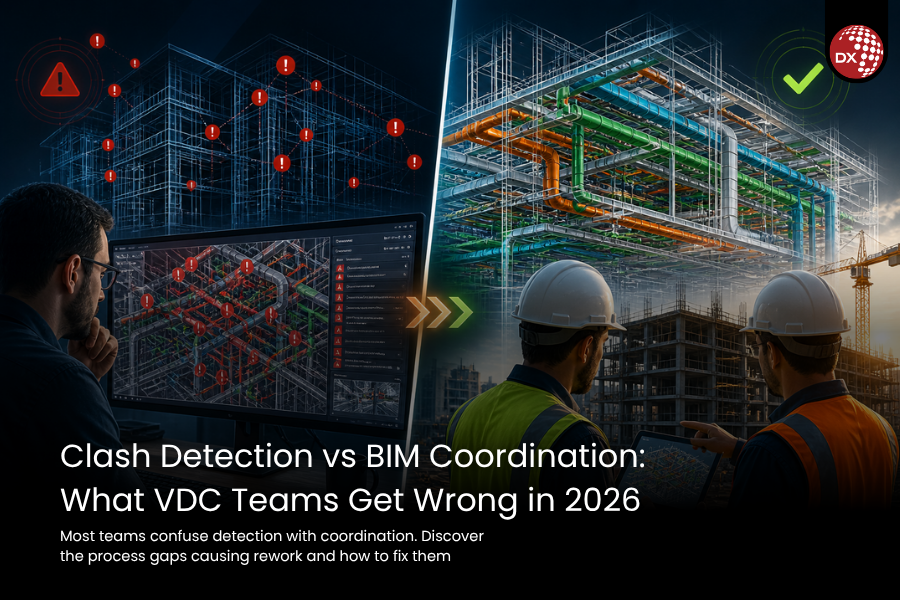
Clash Detection vs. Coordination: What Most Teams Get Wrong
Category: BIM Coordination | VDC Performance | Digital Construction | MEP Coordination | Construction Delivery The most costly errors in BIM delivery are not captured in clash reports. They become apparent on site, often weeks after teams have signed off on models they believed were construction ready. This disconnects between expectation and actual site conditions leads to lost time, increased costs, and diminished project credibility. The root cause is a persistent misalignment in how coordination is defined and executed across the industry. The Coordination Gap That Drives Project Costs In complex commercial, infrastructure, and MEP-intensive projects, the highest rates of site conflict are not found in teams that skip coordination. Instead, they occur in teams that rely solely on clash detection workflows and measure success by the number of conflicts logged and closed. That distinction matters more than most project leaders realize. According to McKinsey’s Global Construction Productivity Report, the construction industry loses an estimated $1.6 trillion annually to inefficiency, rework, and poor delivery coordination — with coordination breakdown identified as one of the leading contributors to schedule and cost overruns on complex builds. A study published in Automation in Construction found that, despite widespread BIM adoption, a significant proportion of construction rework still stems from unresolved coordination gaps — not because clash detection was absent, but because the coordination process surrounding it lacked the decision traceability and resolution accountability needed to resolve conflicts completely before construction began. These findings point to a structural gap in BIM coordination workflows. Leading VDC teams are prioritizing investments to close this gap and drive better project outcomes. Clash detection is a tool. Coordination is a discipline. Decision-makers must recognize this distinction to implement effective coordination strategies that drive project success. Clash detection provides a consistent geometric check of completed models, pinpointing spatial conflicts between disciplines at a given time. However, it lacks context, decision tracking, and insight into whether coordination is improving project efficiency. BIM coordination goes beyond clash detection. It ensures interface clarity, discipline alignment, decision traceability, and model integrity, while making sure digital solutions are executed accurately on site. Conflating clash detection with coordination shifts focuses away from preventing site conflicts. Increased detection rates and more meetings do not resolve issues if reports are not actionable. Effective coordination must prioritize outcomes that eliminate on-site problems. Three Patterns That Signal a Coordination Gap When coordination focuses on detection rather than outcomes, predictable issues arise. Decision-makers who recognize these patterns early can intervene and prevent delivery setbacks. Resolution Without Confirmation A clash may be assigned, addressed, and marked as closed in the coordination tracker. However, closure in the tracker does not guarantee resolution on site. Fixes can be temporary, models may not reflect the agreed solution, or decisions may be confirmed by someone without proper authority. The issue appears resolved but remains unresolved in the field. Leading VDC teams now use confirmed-resolution workflows instead of simple open/closed tracking. An item is only closed after the updated model is reviewed, the decision is documented with clear accountability, and downstream impacts are verified. This process directly reduces RFI rates and site conflicts. Detection Without Context Clash detection identifies geometric conflicts but does not provide the reasoning, decision history, or consequences of different resolutions. When coordination relies only on reports, critical context is scattered across meeting notes, emails, and individual memory. This information is fragile, difficult to retrieve, and cannot be audited when issues arise on-site. Top digital construction teams embed decision traceability into their workflows from the start. Each resolution documents who made the decision, the rationale, and the downstream impacts. This institutional memory prevents repeated coordination failures across zones, packages, and trades. Velocity Without Direction Efficient clash detection and logging workflows can process high volumes of conflicts at speed. But speed through detection means very little if the resolution process downstream is slow, contested, or structurally unclear. Teams can move quickly through coordination meetings while the decisions that matter are stalling — and the clash report gives no visibility into that dynamic. BIM coordination KPIs, such as resolution velocity, decision cycle time, and recurring conflict rates, provide critical insights. These metrics reveal whether coordination is driving toward a construction-ready outcome or just producing documentation. Explore how DGTRA approaches coordination performance tracking: BIM Clash Detection with Navisworks and Autodesk Construction Cloud → What a Coordination-First Workflow Actually Looks Like The teams consistently delivering cleaner sites and tighter RFI cycles in 2026 have built their workflows around a different sequence one where coordination strategy is established before detection begins, and where clash detection validates work already done rather than initiating work yet to start. Interface Definition Before Modeling Before disciplines open their first model file, the zones where systems interact, the sequencing logic governing installation order, and the ownership protocols determining resolution responsibility are agreed, documented, and distributed. This upstream investment is what makes every subsequent coordination decision faster and less contested. Without it, clash detection surfaces conflicts that have no clear resolution path — and coordination slows down precisely when the program needs it to accelerate. This is the foundation of DGTRA’s Integrated Project Delivery approach and the single highest-impact process change available to most BIM and VDC teams today. Model Integrity Between Cycles A clash detection report is only as reliable as the model it ran against. When disciplines update independently between coordination cycles, when design changes are issued without federated model updates, or when field conditions begin diverging from the coordinated model, the report loses its connection to project reality. Leading BIM coordination workflows include model integrity protocols that keep the federated model current across every cycle — so detection is always running against a model that reflects actual project state, not a version that was accurate three weeks ago. Explore how DGTRA’s Construction Quality Control services help teams define and maintain model integrity standards across the full delivery lifecycle. Outcome-Based Coordination Metrics The metrics that matter in a mature coordination workflow are not how many clashes were found or how many meetings were held. They are how quickly identified conflicts move to confirmed resolution, how often the same interface zones generate recurring conflicts, how many RFIs trace back to coordination gaps, and how closely the coordinated model tracks to field installation. These are the metrics that give VDC teams genuine visibility into whether coordination is
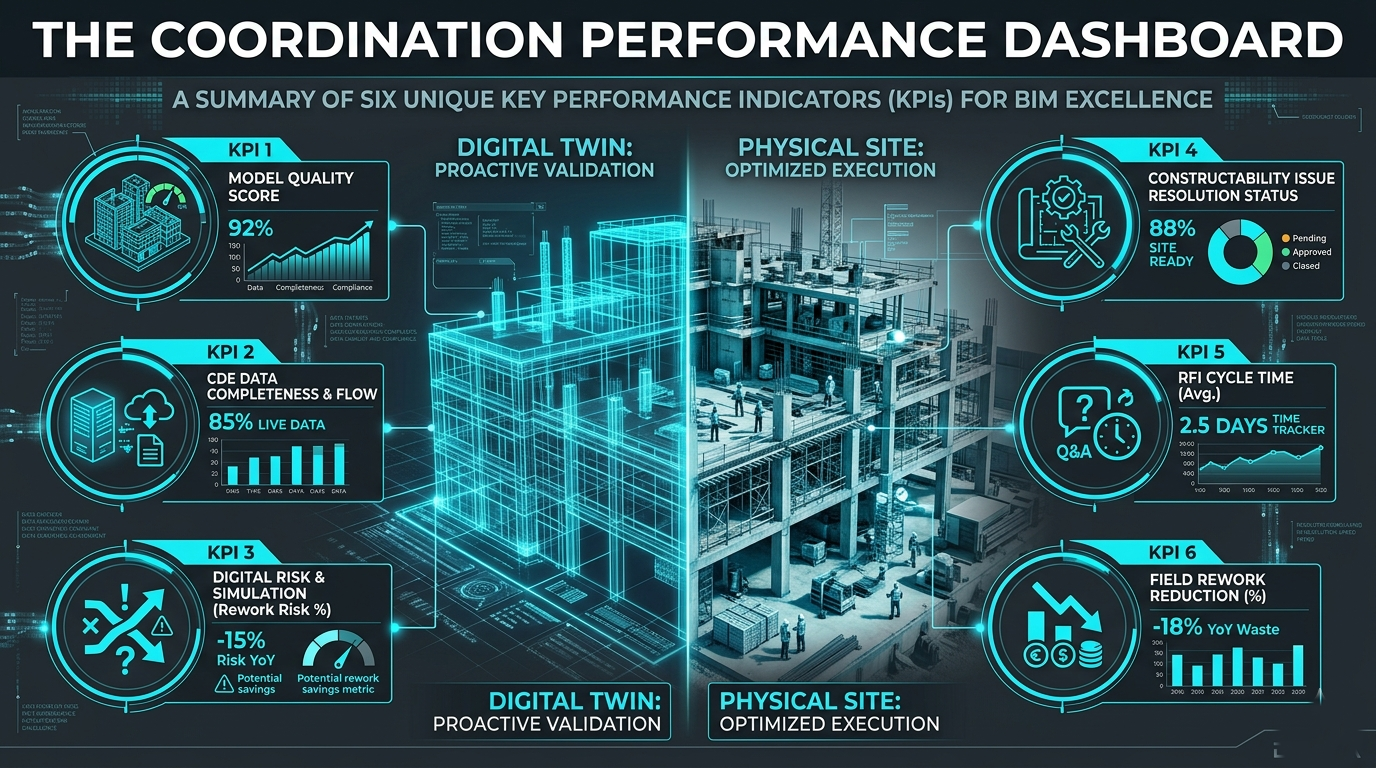
6 BIM Coordination KPIs Driving VDC Performance in 2026
The coordination metrics that predict project outcomes and what elite BIM teams are measuring instead Category: VDC Performance | BIM Coordination Metrics | Integrated Delivery | AEC Leadership Most VDC Teams Are Measuring Activity. The Best Ones Are Measuring Outcomes. In our previous blog, The Hidden Cost of Clash Report Overload in BIM, we made the case that clash detection is a QA step, not a coordination strategy. This blog takes that argument further. Most VDC directors and BIM managers already sense it you can run a textbook coordination process, hit every milestone, and still walk into a site conflict that nobody saw coming. Not because the process failed, but because the metrics being used to evaluate it were never designed to surface the right signals in the first place. Tracking clash counts tells you how many conflicts exist in the model at a given point in time. Tracking meeting frequency tells you how often teams meet in person. Tracking report volume tells you how much was found. None of these tells you whether your BIM coordination process is moving in the right direction and in high-stakes digital construction environments, that blind spot carries real cost. This is the measurement gap that DGTRA is built to close, giving VDC teams the outcome visibility they need to connect coordination activity to actual project performance. This blog breaks down exactly what those teams are tracking and why each metric has a direct line to project outcomes. Why Measurement Is the Missing Layer in Most BIM Coordination Workflows Before getting into specific KPIs, it is worth understanding why most teams coordinate at high frequency but measure at low resolution. Stanford’s Center for Integrated Facility Engineering identified metrics as one of the core tools within VDC — directly tied to continuous improvement across design quality, time, cost, and collaboration. Yet only a small number of academic papers have examined metrics specifically in VDC projects, a gap that mirrors what is happening on the ground. Research across BIM and Lean Construction frameworks confirmed that the KPIs which actually reflect coordination effectiveness are cost efficiency, time savings, stakeholder collaboration, and process automation — not model completion or clash volume. A study spanning NTNU and Stanford’s VDC Certificate Program identified 35 performance metrics across six design management control areas and found that the most valuable ones measure decision-making velocity and coordination readiness — not output volume. BIM coordination performance is measurable in ways that surface delivery risk long before the site does. The teams doing this well are not just better at coordination — they have visibility into whether it is working. Here is what they are tracking. The 6 KPIs Leading VDC Teams Are Tracking in 2026 KPI 1 — Decision Velocity What it measures: Average time from a coordination conflict being identified to a documented, approved resolution. Most teams track how many clashes are open. High-performing VDC teams track how long decisions take. A model with 50 unresolved clashes and a 48-hour decision cycle is in a far stronger position than one with 20 clashes and a 14-day resolution cycle. Research published in Scientific Reports found that structured BIM coordination workflows reduce coordination cycle time to 1–2 days — significantly faster than BIM-only approaches averaging 5–7 days — with the reduction directly tied to integrated decision-making structures and standardized data governance. KPI 2 — Coordination Readiness Score What it measures: Percentage of interface zones with confirmed ownership, agreed LOD, and documented coordination agreements — measured at the start of each milestone, not the end. This is the upstream metric most teams have never defined — and the most predictive indicator of whether a coordination phase runs proactively or reactively. Research in Frontiers in Built Environment found that design coordination ranked highest among BIM functionalities with a Significance Index of 90% — and that structured coordination ownership frameworks delivered an 80% reduction in design-related change orders. KPI 3 — Interface Resolution Rate What it measures: Percentage of coordination items reaching full resolution — documented decision, updated model, confirmed sign-off — within a single review cycle. Research published in Discover Materials found that the strongest rework reductions — 40–50% — occur specifically in projects where coordination items are tracked to full resolution within structured review cycles rather than carried across multiple meetings. United-BIM This metric tells you whether coordination is moving forward or building technical debt that lands on site. KPI 4 — LOD Alignment Index What it measures: The degree to which all disciplines are modeling at consistent, agreed LOD levels at each coordination milestone. A federated model where one discipline is at LOD 350 and another at LOD 200 produces clash reports that look clean — and fail the moment the lower-LOD discipline develops further. Research in the KSCE Journal of Civil Engineering found that increasing LOD and information integration by even one usage level produces measurable improvements in design satisfaction, cost variance, and delivery outcomes. KPI 5 — Site Trust Index What it measures: Percentage of coordination decisions requiring no revision or clarification after reaching the construction team — tracked per discipline and per zone. Sign-off rate tells you someone approved the model. Site Trust Index tells you whether it held up on site. Research in Scientific Reports found that ISO 19650-aligned BIM coordination reduced pipeline dismantling rates — systems requiring removal and reinstallation due to spatial conflicts — by 22–35% compared to traditional approaches, directly linking upstream coordination quality to site execution accuracy. KPI 6 — Coordination Cost per Resolved Item What it measures: Total coordination resource cost — time, meetings, rework cycles — divided by items reaching full resolution per review cycle. This is the metric that makes the ROI case for upstream coordination investment most clearly. A 2025 case study of a Performing Arts Center found that a structured BIM coordination workflow reduced total coordination time by 40% — with gains attributed directly to proactive digital resolution before construction began, rather than reactive on-site correction. Teams investing in Shared Modeling Intent consistently see this number improve from cycle one. How These KPIs Work Together — The Coordination Performance Dashboard The power of these six metrics is not in tracking them individually. It is in reading them as a system. Decision Velocity + Interface Resolution Rate = how fast your coordination engine is
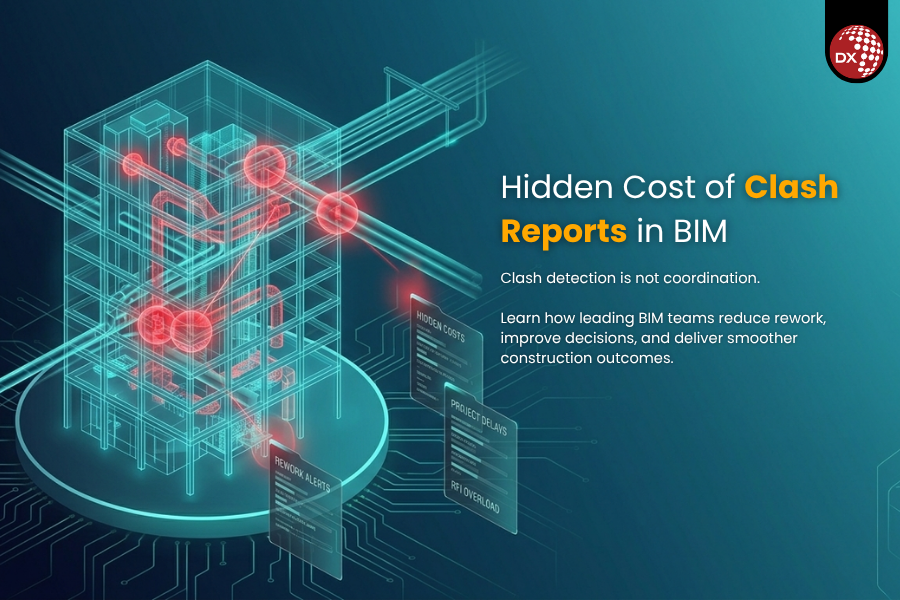
The Hidden Cost of Clash Detection Report Overload in BIM
How smarter BIM coordination unlocks the project performance your team is already capable of Category: BIM Coordination | VDC Workflows | Construction Delivery | MEP Coordination The best BIM and VDC teams in the world share one thing in common. They have built a coordination process so intentional, so well-structured from day one that the site team walks in knowing exactly what to build. Fewer surprises. Faster decisions. Cleaner installations. And a clash detection workflow that validates great coordination rather than scrambling to create it. BIM coordination performance and clash report volume are two very different things. The teams that understand that distinction and build their process around it are the ones delivering the projects everyone else wants to talk about. If your team is investing serious effort into MEP coordination, design coordination, and constructability validation, and most are, this blog will show you where the highest-value opportunity in that effort lives. What the Research Tells Us About BIM’s Real Upside The ceiling on coordination performance when the process is built well is genuinely impressive. Research published in Discover Materials found that well-implemented BIM reduces design errors by 50–60%, cuts rework costs by 40–50%, and reduces coordination RFIs by up to 80%. These are not marginal improvements. These are project-defining outcomes — the kind that show up in budgets, delivery timelines, and the confidence of every stakeholder in the room. A study published in Scientific Reports found that BIM adoption reduced rework-related time waste by 70–85% and delivered cost savings of 65–75% specifically in projects where coordination and modeling processes were aligned from the outset of delivery. The common thread across every high-performing outcome is alignment. Early, intentional, structured alignment between disciplines, between teams, and between the digital model and the physical build. That alignment is what this blog is about. And it starts with understanding what happens when the clash detection volume grows faster than the BIM coordination process behind it. When Volume Outpaces Process — What to Watch For Here is a pattern that shows up on complex BIM coordination projects more often than most teams realize. The project is moving. Clash detection workflows are running on schedule. Reports are generating data. Coordination meetings have a cadence. By week 6 or 7, the rhythm feels strong. By week 12, something shifts not dramatically, but perceptibly. The reports are longer. The meetings are fuller. And the number of decisions per meeting is getting lower. This is not a performance problem. It is a structural signal. And recognizing it early is one of the most valuable things a BIM manager or VDC lead can do for a project. Here is what those signals look like in practice. Attention Concentrates on Volume, Not Value When the clash report volume is high, teams gravitate naturally toward what is flagged as critical. That instinct is right, but only when the classification system behind it is precise, consistent, and aligned with actual constructability risk. When it is not, genuinely important coordination decisions share visual space with minor clearance adjustments. Both live in the same column of the same spreadsheet. One of them quietly carries weeks of site delay into the construction phase. The opportunity here is not to review more carefully. It is to structure the report so that what matters is unmistakably visible. Coordination Decisions Take Longer Than They Should High-volume BIM coordination reviews tend toward caution sign-offs slow, meetings extend, and project momentum flattens. The solution is not speed for its own sake. It is a process clean enough that decisions are easy to reach with confidence, because the right people are in the room with the right information in front of them. Research in the Journal of Building Engineering shows that BIM delivers its strongest coordination results when clash detection is applied early and proactively enabling trades to execute their installation sequences independently, without mid-construction conflicts disrupting the build. Early and proactive. Two words that define where the best VDC coordination workflows are built and where most teams still have significant room to grow. Ownership Gets Distributed Rather Than Defined In a BIM coordination workflow built around high volume, responsibility can spread across zones and trade codes, making resolution difficult to track. Assignment is not the same as ownership. A discipline tag is not the same as a person accountable for a decision. The teams seeing the best clash resolution rates have moved toward named individual accountability a specific person, a clear decision, a defined deadline for every open item in the coordination workflow. That shift alone changes how quickly and cleanly clashes move through the resolution process. The Biggest Coordination Opportunity Lives Upstream Here is the insight that changes everything about BIM project coordination. The quality of a coordination outcome is largely determined before the first clash detection report ever runs. It is determined by how well the project set up discipline alignment, interface agreements, and constructability thinking in the strategy phase — before a single model was opened. When architecture, structure, and MEP teams begin modeling with shared BIM Execution Plan standards, agreed interface zones, and defined ownership protocols, the federated model becomes a coordination asset from day one. Clashes that do appear are fewer, better categorized, and faster to resolve because the decision-making structure is already in place around them. This upstream investment is what separates high-performing BIM coordination teams from teams working just as hard but fighting harder battles downstream. Research on BIM-based construction readiness confirms that coordination gaps arising during pre-construction modeling from design changes, incomplete interface planning, or ambiguous discipline ownership are among the leading contributors to clashes persisting into the construction phase. The good news is that these gaps are entirely addressable — with the right process structure in place before modeling begins. This is precisely what DGTRA builds through Constructability Reviews and BIM Maturity Audits & Competency Assessments — finding exactly where the upstream coordination opportunity lives on your specific project. What High-Performing BIM Coordination Teams Do Differently The practices that separate the best VDC and BIM coordination workflows from the rest are not complicated. They are consistent, intentional, and built into the process before the pressure of