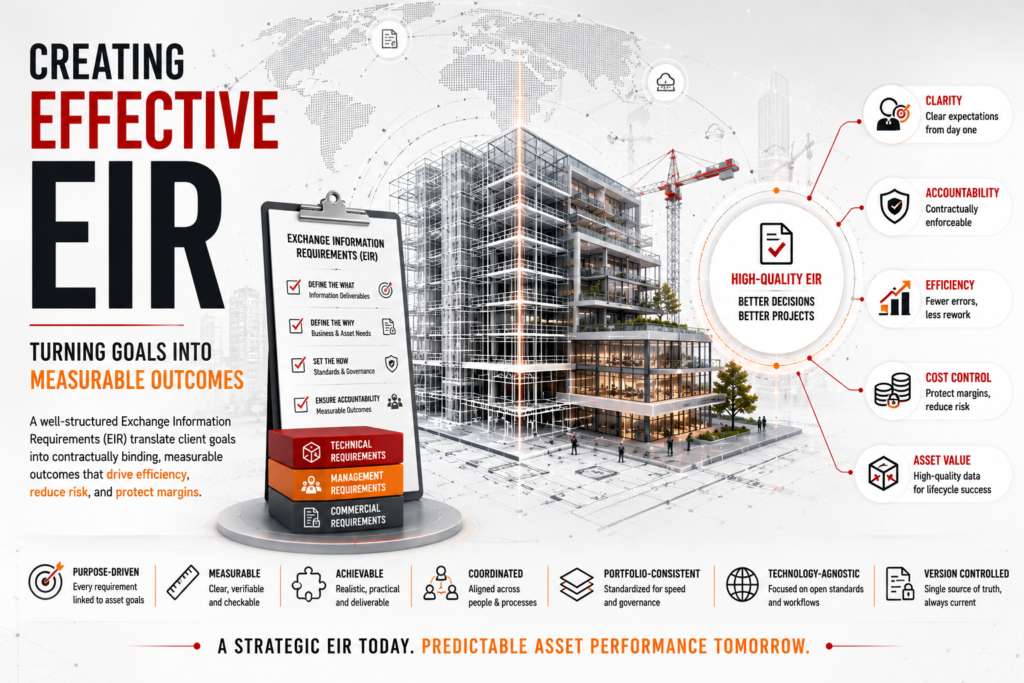
Exchange Information Requirements (EIR) sit at the center of project governance. Within a modern AECO framework, the EIR is a contractually binding document. It translates high-level business goals into precise mandates for the delivery team.
A well-structured EIR is a powerful risk-management tool. A poor one creates immediate ambiguity, widespread model rework, and expensive commercial disputes.
Most project delivery bottlenecks do not stem from software limitations. Instead, they trace back to unclear, unmeasurable, or unrealistic information requirements.
An effective EIR brings predictability and accountability to complex project environments. It defines exactly what information is required, why it is needed, and how teams must validate it.
What an EIR Is
Many industry teams mistakenly treat the EIR as an exhaustive technical manual. They pack it with arbitrary modeling instructions and outdated standards copied from older projects.
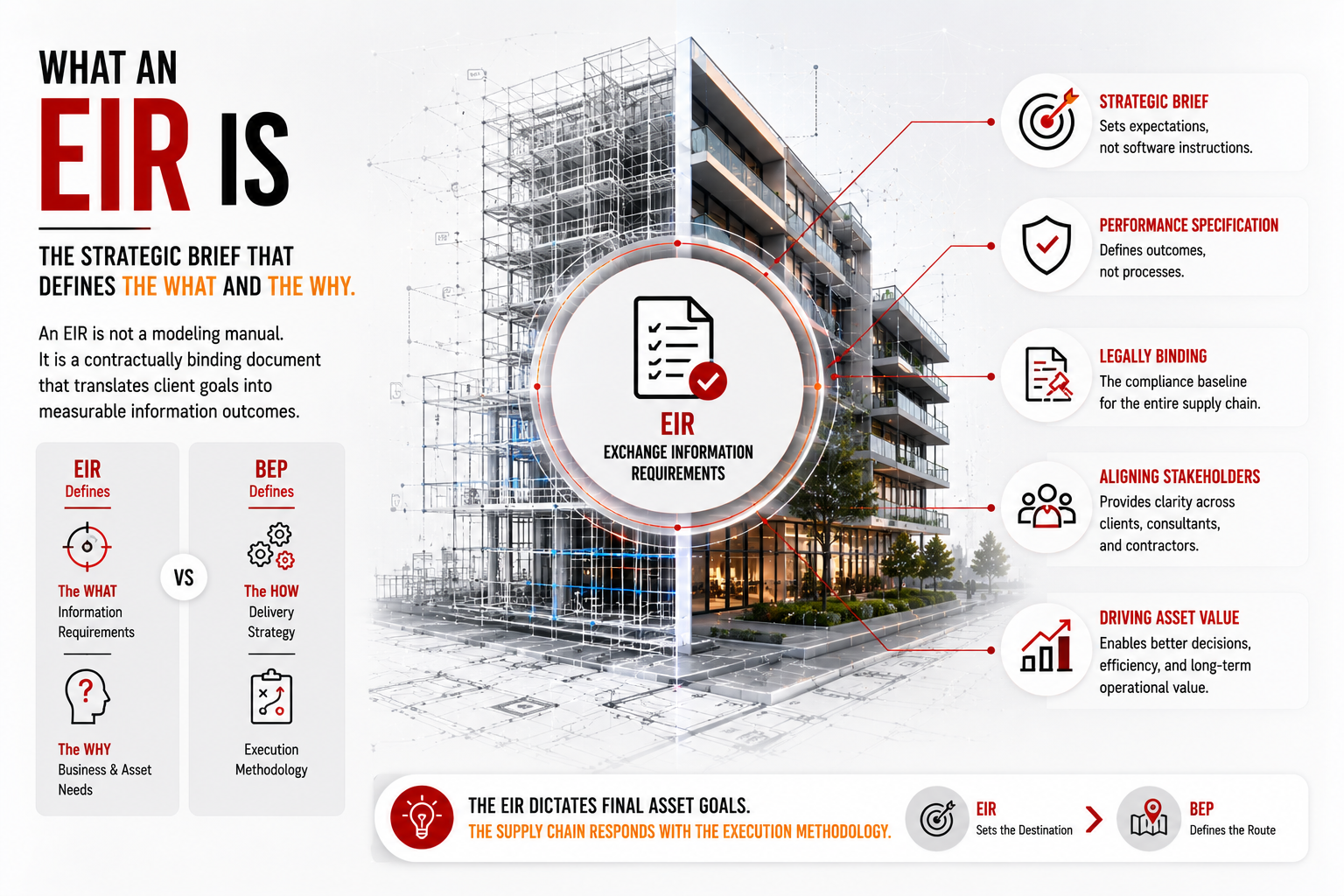
An elite EIR is completely different. It serves as a strategic brief, a performance specification, and a legally binding compliance baseline.
The EIR establishes project expectations rather than software instructions. The EIR defines the “what” and the “why.”
The actual delivery strategy belongs entirely within a well-structured BIM Execution Plan. The EIR dictates final asset goals, and the supply chain responds with the execution methodology.
The Three Pillars of an Effective EIR
A high-quality EIR categorizes project expectations into three clear, interconnected groups:
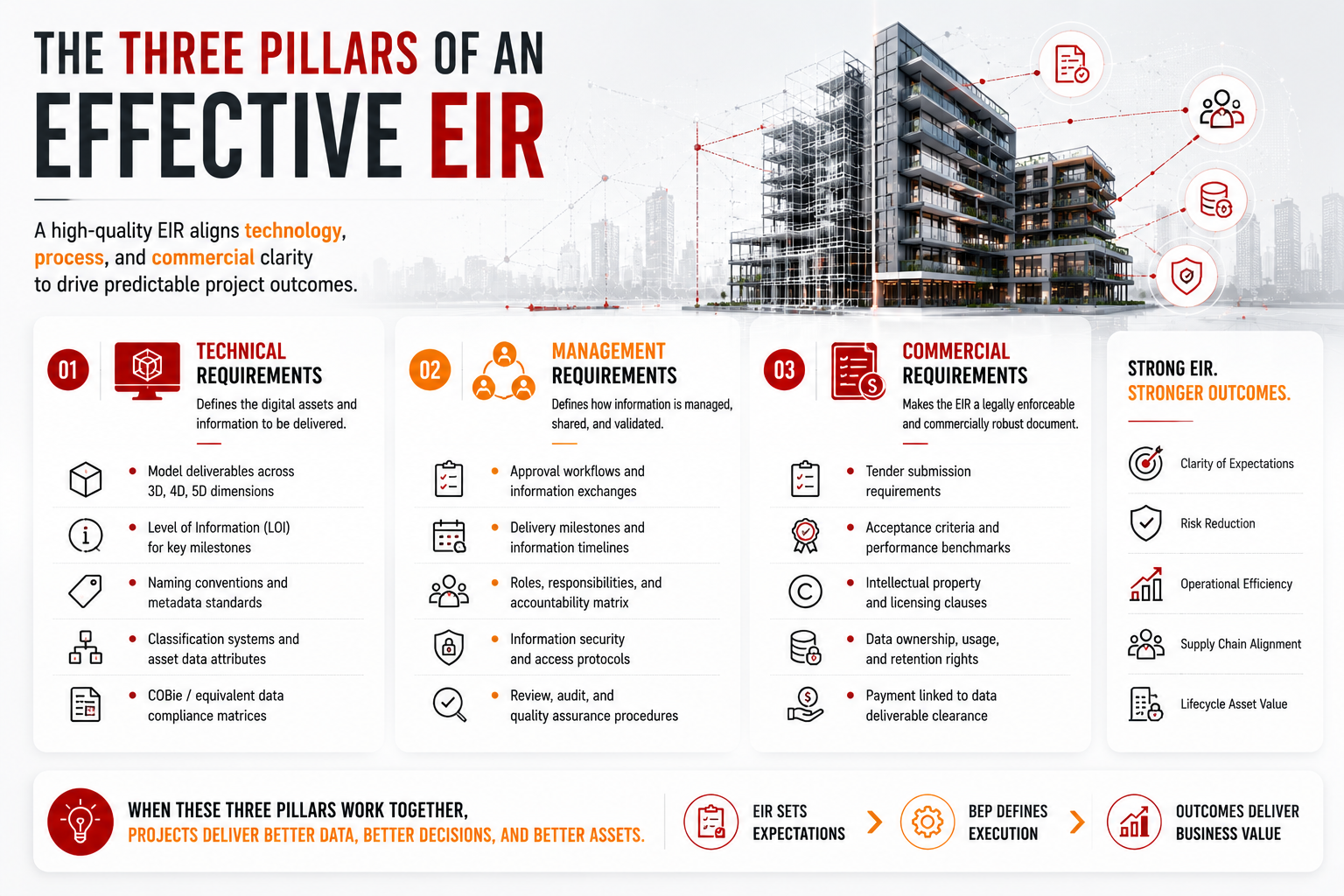
1. Technical Requirements
Technical requirements define the literal anatomy of the digital assets. They must be specific and measurable. Key elements include:
- Precise model deliverables across project dimensions (3D, 4D, and 5D)
- The exact Level of information needed for specific milestones
- Strict project-wide naming conventions and metadata standards
- Unified classification systems and required asset data attributes
- Comprehensive COBie or equivalent operational data compliance matrices
2. Management Requirements
Management requirements outline the digital governance structure. They specify how information moves across the building lifecycle.
This pillar defines approval workflows, delivery milestones, team roles, information security protocols, and independent review procedures. It ensures data remains reliable from conceptual design through construction.
3. Commercial Requirements
Commercial requirements transform the EIR into an enforceable legal instrument. This section outlines tender submission formats, strict acceptance criteria, intellectual property clauses, and data ownership rights.
High-performing asset owners tie vendor payment structures directly to the successful clearance of these data deliverables. This approach ensures financial accountability across the supply chain.
The 7 Characteristics of a High-Quality EIR
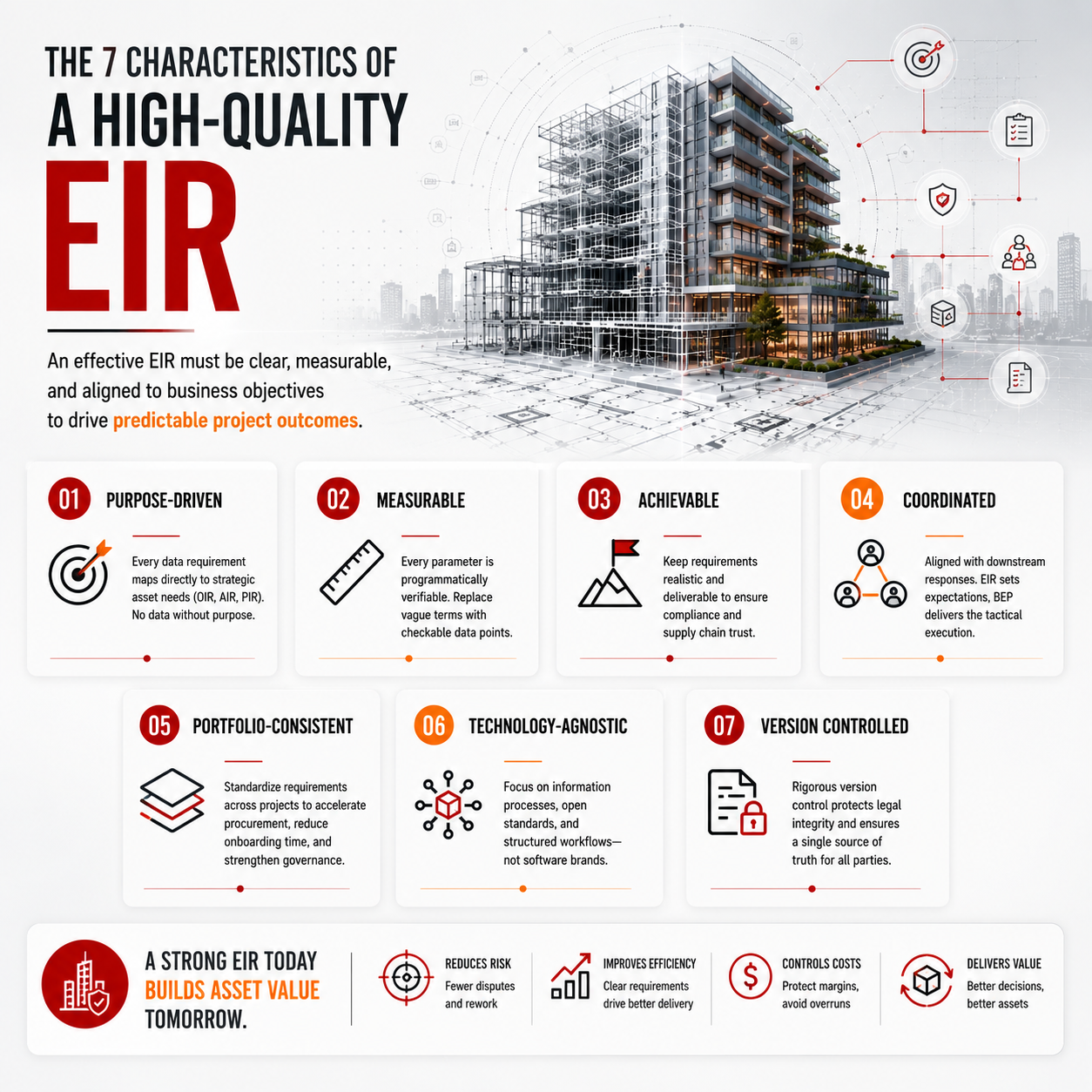
An effective EIR must exhibit seven distinct characteristics to drive genuine asset value:
| Characteristic | Operational Impact |
| Purpose-Driven | Every data requirement maps directly back to strategic asset needs (OIR, AIR, and PIR). No data points exist without a clear operational purpose. |
| Measurable | Every parameter is programmatically verifiable. Vague phrases are eliminated and replaced with explicit, checkable data points to reduce disputes. |
| Achievable | Demands remain realistic. Setting unachievable data targets erodes supply chain trust and leads to widespread non-compliance in the field. |
| Coordinated | The document stays perfectly aligned with downstream responses. The EIR establishes expectations, while the BEP delivers the tactical response. |
| Portfolio-Consistent | Standardizing requirements across an owner’s portfolio accelerates procurement, minimizes onboarding friction, and strengthens governance. |
| Technology-Agnostic | The mandates focus strictly on information processes, open data standards, and structured workflows—never on proprietary software brands. |
| Version Controlled | Rigorous version control protects the document’s legal integrity, ensuring the entire supply chain works from a single source of truth. |
Why EIRs Fail: Common Mistakes in the Industry
Global capital projects frequently run into identical, predictable failure points during procurement:
- Copying and pasting text from unrelated legacy projects
- Overloading documents with restrictive modeling instructions that suffocate vendor workflows
- Demanding dense asset data that fails to link back to a real asset management strategy
- Failing to outline clear, unambiguous acceptance criteria for milestone handovers
- Imposing unrealistic tracking schedules that exceed the digital maturity of the supply chain
These systemic failures trigger a quick chain reaction. Unclear contractual expectations produce flawed digital submissions. This lack of data integrity leads to geometric clashes, project delays, and expensive on-site rework.
A Proven Framework for Developing an Effective EIR
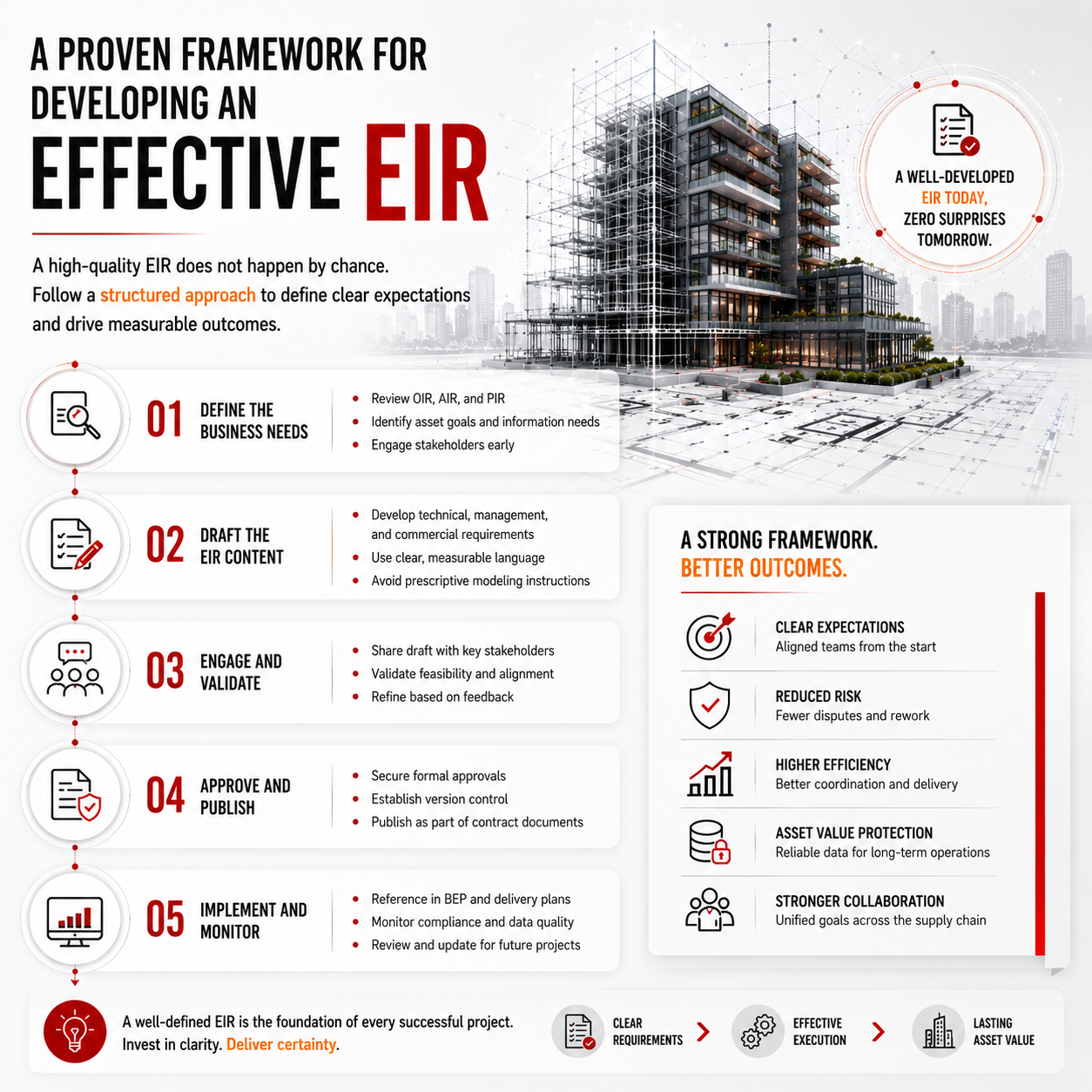
Forward-thinking organizations follow a highly disciplined, repeatable framework to author and enforce their information requirements:
- Anchor to Core Operational Needs: Trace every requirement back to the business’s organizational and asset management goals.
- Isolate High-Risk Deliverables: Focus structural enforcement on critical-path information. Avoid overloading the supply chain with low-value data requirements.
- Define Digital Acceptance Criteria: Establish clear, binary checklists and automated status codes to remove subjective interpretation from reviews.
- Enforce Governance via the CDE: Move review workflows entirely into a centralized Common Data Environment. This ensures file compliance is audited at the gate.
- Pilot Test with Sample Deliverables: Instruct bidding teams to submit small sample digital deliverables early in the procurement phase to verify that criteria are realistic.
- Maintain as a Living System: Refine requirements continuously based on live project feedback loops. An effective EIR adapts to evolving project realities.
The Executive Impact of a Strong EIR
Investing in a robust EIR is a major commercial differentiator. For asset owners and C-suite leaders, a high-quality EIR pays immediate dividends. It slashes design rework, minimizes contractual disputes, and drives down tender ambiguity.
It ensures the facility management team receives a pristine, verified Asset Information Model at handover. This rich data foundation accelerates operational readiness, powers advanced Digital Twin configurations, and enables profitable lifecycle decision-making.
About DGTRA
DGTRA is a premier digital transformation partner and process-driven management consultancy operating at the global forefront of the AECO industry. Backed by an elite team of over 100 specialized professionals, we bridge the gap between complex digital technology and practical, profitable execution across India, the UK, and the Middle East.
We work directly with asset owners, Tier-1 contractors, and leading design firms to architect robust, forward-thinking digital roadmaps. Our deep domain expertise spans advanced open BIM implementation, strategic asset information modeling, customized CDE orchestration, and the practical deployment of operational Digital Twins. At DGTRA, our core guiding principle remains absolute: we engineer the digital processes that bring total predictability, structural transparency, and financial certainty to the world’s most ambitious construction programs.
Ready to build complete predictability across your supply chain? Read our comprehensive guide, “The ISO 19650 Workflow Driving Total Clarity in AECO Projects,” or click here to schedule a strategic consultation with a DGTRA Process Specialist to secure your upcoming portfolio margins today.