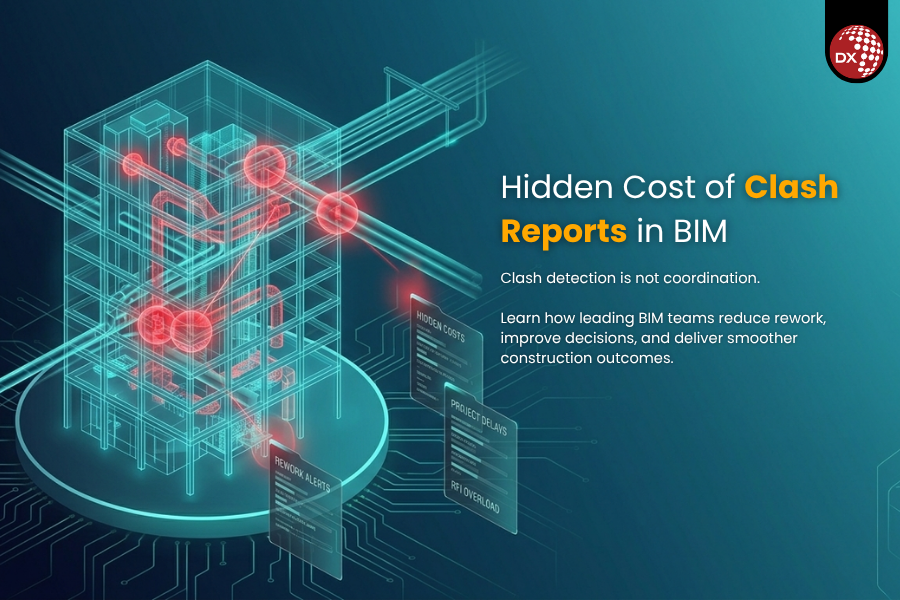
The Hidden Cost of Clash Detection Report Overload in BIM 

How smarter BIM coordination unlocks the project performance your team is already capable of Category: BIM Coordination | VDC Workflows | Construction Delivery | MEP Coordination 

The best BIM and VDC teams in the world share one thing in common. They have built a coordination process so intentional, so well-structured from day one that the site team walks in knowing exactly what to build.

Fewer surprises. Faster decisions. Cleaner installations. And a clash detection workflow that validates great coordination rather than scrambling to create it.

BIM coordination performance and clash report volume are two very different things. The teams that understand that distinction and build their process around it are the ones delivering the projects everyone else wants to talk about.

If your team is investing serious effort into MEP coordination, design coordination, and constructability validation, and most are, this blog will show you where the highest-value opportunity in that effort lives.

What the Research Tells Us About BIM's Real Upside 

The ceiling on coordination performance when the process is built well is genuinely impressive.

Research published in Discover Materials found that well-implemented BIM reduces design errors by 50–60%, cuts rework costs by 40–50%, and reduces coordination RFIs by up to 80%. These are not marginal improvements. These are project-defining outcomes — the kind that show up in budgets, delivery timelines, and the confidence of every stakeholder in the room.

A study published in Scientific Reports found that BIM adoption reduced rework-related time waste by 70–85% and delivered cost savings of 65–75% specifically in projects where coordination and modeling processes were aligned from the outset of delivery.

The common thread across every high-performing outcome is alignment. Early, intentional, structured alignment between disciplines, between teams, and between the digital model and the physical build.

That alignment is what this blog is about. And it starts with understanding what happens when the clash detection volume grows faster than the BIM coordination process behind it.

When Volume Outpaces Process — What to Watch For 

Here is a pattern that shows up on complex BIM coordination projects more often than most teams realize.

The project is moving. Clash detection workflows are running on schedule. Reports are generating data. Coordination meetings have a cadence. By week 6 or 7, the rhythm feels strong.

By week 12, something shifts not dramatically, but perceptibly. The reports are longer. The meetings are fuller. And the number of decisions per meeting is getting lower.

This is not a performance problem. It is a structural signal. And recognizing it early is one of the most valuable things a BIM manager or VDC lead can do for a project.

Here is what those signals look like in practice.

Attention Concentrates on Volume, Not Value 

When the clash report volume is high, teams gravitate naturally toward what is flagged as critical. That instinct is right, but only when the classification system behind it is precise, consistent, and aligned with actual constructability risk.

When it is not, genuinely important coordination decisions share visual space with minor clearance adjustments. Both live in the same column of the same spreadsheet. One of them quietly carries weeks of site delay into the construction phase.

The opportunity here is not to review more carefully. It is to structure the report so that what matters is unmistakably visible.

Coordination Decisions Take Longer Than They Should 

High-volume BIM coordination reviews tend toward caution sign-offs slow, meetings extend, and project momentum flattens. The solution is not speed for its own sake. It is a process clean enough that decisions are easy to reach with confidence, because the right people are in the room with the right information in front of them.

Research in the Journal of Building Engineering shows that BIM delivers its strongest coordination results when clash detection is applied early and proactively enabling trades to execute their installation sequences independently, without mid-construction conflicts disrupting the build.

Early and proactive. Two words that define where the best VDC coordination workflows are built and where most teams still have significant room to grow.

Ownership Gets Distributed Rather Than Defined

In a BIM coordination workflow built around high volume, responsibility can spread across zones and trade codes, making resolution difficult to track. Assignment is not the same as ownership. A discipline tag is not the same as a person accountable for a decision.

The teams seeing the best clash resolution rates have moved toward named individual accountability a specific person, a clear decision, a defined deadline for every open item in the coordination workflow. That shift alone changes how quickly and cleanly clashes move through the resolution process.

The Biggest Coordination Opportunity Lives Upstream 

Here is the insight that changes everything about BIM project coordination. 

The quality of a coordination outcome is largely determined before the first clash detection report ever runs. It is determined by how well the project set up discipline alignment, interface agreements, and constructability thinking in the strategy phase — before a single model was opened. 

When architecture, structure, and MEP teams begin modeling with shared BIM Execution Plan standards, agreed interface zones, and defined ownership protocols, the federated model becomes a coordination asset from day one. Clashes that do appear are fewer, better categorized, and faster to resolve because the decision-making structure is already in place around them. 

This upstream investment is what separates high-performing BIM coordination teams from teams working just as hard but fighting harder battles downstream. 

Research on BIM-based construction readiness confirms that coordination gaps arising during pre-construction modeling from design changes, incomplete interface planning, or ambiguous discipline ownership are among the leading contributors to clashes persisting into the construction phase. 

The good news is that these gaps are entirely addressable — with the right process structure in place before modeling begins. This is precisely what DGTRA builds through Constructability Reviews and BIM Maturity Audits & Competency Assessments — finding exactly where the upstream coordination opportunity lives on your specific project.

What High-Performing BIM Coordination Teams Do Differently

The practices that separate the best VDC and BIM coordination workflows from the rest are not complicated. They are consistent, intentional, and built into the process before the pressure of delivery hits. 

They filter intelligently before the coordination meeting. Soft clashes, tolerance-based conflicts, and pre-agreed accepted conditions are automated out of the review queue before the team sits down. This protects the team's attention for items that genuinely require a decision — and makes BIM coordination meetings sharper, shorter, and more productive. DGTRA's BIM Clash Detection with Navisworks and Autodesk Construction Cloud workflow is built around exactly this principle — reducing noise before it reaches the coordination table. 

They assign ownership at the person level. Every open clash resolution item carries a named individual responsible for the decision — with clear criteria and a deadline. When accountability is personal and specific, resolution rates improve and the same items stop reappearing in consecutive clash detection reports. 

They set a model readiness standard before coordination review. Before a model enters the BIM coordination review process, it meets an agreed quality threshold. This keeps coordination meetings focused on genuinely complex interface decisions and builds a culture where model quality is a shared team standard, not a post-review discovery. DGTRA's Construction Quality Control services help teams define and embed these standards into their delivery workflow. 

They define a coordination strategy before modeling begins. Interface agreements, zone ownership, sequencing logic, and LOD vs LOI alignment are defined in the project strategy phase — giving every discipline a shared foundation before the first model file is opened. This is the foundation of DGTRA's Integrated Project Delivery approach and the single highest impact change most BIM and VDC teams can make. 

They treat coordination as a continuous discipline rather than a milestone. The best BIM coordination workflows run throughout the project lifecycle — with regular decision-based reviews, progressive as-built accuracy, and clear escalation paths when interface conflicts arise between trades. Coordination is not something that gets signed off on and moved past. It runs alongside the project until the site is complete.

For a deeper look at what this looks like in practice, explore: How to Validate BIM Models Before Construction Begins and 7 Reasons BIM Models Fail During Construction. 

The Coordination Maturity Curve — Where Does Your Team Sit?

One of the most useful frameworks for understanding BIM coordination performance is the coordination maturity model. Most teams in the industry today are operating at Level 1 or Level 2. The teams delivering the best outcomes are at Level 3 and 4. 

Level 1 — Clash Detection Coordination is centred on running Navisworks clash detection and reviewing reports. The focus is on geometric conflict identification. Resolution accountability is informal. 

Level 2 — Clash Resolution Teams have a structured clash resolution workflow — items are assigned, tracked, and closed. But coordination still starts after modeling, and constructability validation is limited. 

Level 3 — Coordination Planning the BIM coordination strategy is defined before modeling begins. Disciplines align on interface zones, ownership, and standards upfront. Clash detection becomes a validation step inside a larger coordination framework — not the framework itself. 

Level 4 — Integrated Delivery Coordination, constructability, sequencing, and 4D BIM planning are fully integrated into the project delivery workflow. The site team operates from a model they trust completely — because the decisions behind it were made deliberately, early, and with full discipline alignment. 

Most organizations have the capability to move from Level 1 to Level 3 without a technology change. The shift is a process one. And it starts with a single decision to build a coordination strategy upstream of detection. 

DGTRA's Strategic BIM Roadmap service is designed specifically to support that move — giving teams a clear, actionable path to higher coordination maturity on their next project. 

The Measure of Great BIM Coordination Is Simplicity on Site

The best BIM coordination workflows are almost invisible by the time construction starts. 

Models are clean. Ownership is clear. Decisions have been made. The site team has a construction-ready BIM model they can build from with confidence — and the coordination meetings that happened upstream feel worth every minute they took. 

That outcome is achievable. It is happening on projects right now — across commercial construction, MEP-heavy infrastructure, and complex mixed-use developments globally. And it starts with a process decision made well before clash detection ever runs. 

Your team already has the capability. The structure built around it is what makes the difference.

Join us for the upcoming webinar on Clash Detection Is Not Coordination Why the Best BIM Projects Start Coordination Long Before the First Report Runs 

May 20, 2026  |   08:30 PM IST  |   45 Minutes 

In this session, we cover the full BIM coordination framework from upstream strategy to site-ready delivery.

About DGTRA 

DGTRA is a global BIM consulting and digital engineering firm supporting AEC and construction teams across the US, UK, Europe, and India. We specialize in building the coordination structures that help project teams deliver confidently through constructability-led workflows, ISO 19650-aligned BIM delivery, and ownership-driven VDC coordination frameworks.

Frequently Asked Questions 

What is clash report overload in BIM coordination and how do teams recognize it?

Clash report overload occurs when BIM clash detection volume grows faster than a team’s capacity to review and act on reports with intention. Early signs include coordination meetings running long, the same items reappearing across consecutive reports, and sign-off timelines extending without clear resolution progress. Recognizing it early is the first step toward building a stronger BIM coordination workflow around it. 

When BIM project coordination is built around early discipline alignment, named ownership, and constructability validation — decisions get made before they become site discoveries. The model reaching construction is one the site team can trust, which means faster installation, fewer surprises, and significantly less corrective work. Research confirms that well-structured BIM coordination workflows can reduce rework costs by 40–50%. 

Clash detection is a quality assurance step that identifies geometric conflicts in a federated BIM model. BIM coordination is an ongoing process — involving discipline alignment, interface planning, ownership structure, and constructability validation throughout the project lifecycle. Clash detection is most powerful when it runs inside a well-structured coordination framework — not as a replacement for one. 

They automate soft clashes and tolerance-based conflicts out of the review queue, set model readiness standards before BIM coordination review begins, and assign named individual ownership to every open item. The result is a leaner, faster, and more accountable BIM coordination workflow — with fewer reports carrying more decision value. 

Before modeling begins. The teams seeing the strongest BIM project delivery outcomes define coordination strategy, interface zones, and discipline ownership in the pre-modeling phase — so the foundation is in place before the first model file is opened. This is the single highest-impact process change available to most BIM and VDC teams. 

Most teams benefit most from moving from Level 1 clash detection to Level 3 coordination planning — where coordination strategy is defined upstream, ownership is clear, and clash detection workflows serve as validation steps inside a larger framework. DGTRA’s BIM Maturity Audits help teams understand exactly where they are and build a clear path forward. 

DGTRA embeds BIM coordination strategy into the project delivery phase — not the detection phase. Our focus is process design, ownership clarity, and constructability validation working together from day one. Our teams work across commercial building, MEP-heavy infrastructure, and complex mixed-use projects globally — bringing both strategic and hands-on coordination expertise to every engagement. 

Ready to explore what smarter BIM coordination looks like on your next project? Book a free 30-minute consultation with the DGTRA team → 

Start Your Digital Transformation Journey

Get a free consultation to explore how our AI, automation, and strategic BIM Solutions can drive exponential growth for your business.

Let’s build a smarter, more efficient future, together.

Please fill in the form to get in touch with us.
I agree to the Privacy Policy and Terms of Use.

DGTRA acts as a System Integration and Consulting Partner to several large Real Estate, Construction, Infrastructure and Manufacturing companies in India, US, UK and Australia. Our vision is to get established as a change agent, a catalyst that triggers the process of Digital transformation within an organization enhancing overall project and Business efficiency.

Get In Touch

DGTRA © 2025 All Right Reserved .

Need Help?

Start a Conversation

Our team is here to help you!

DGTRA

DGTRA

Sales
Start Chat

Struggling with Tender Deadlines?

See how our manual Quantity Take-off (QTO) helped a contractor deliver accurate BOQs — ahead of schedule.

This free case study reveals how professional quantity take-off improved cost reliability, prevented overruns, and enabled confident bidding.

You’ll Learn:
✔ Approach & Workflow
✔ Accuracy Results
✔ Project Outcome
✔ Quantity Take-off (QTO) Checklist