You’ve seen it before.
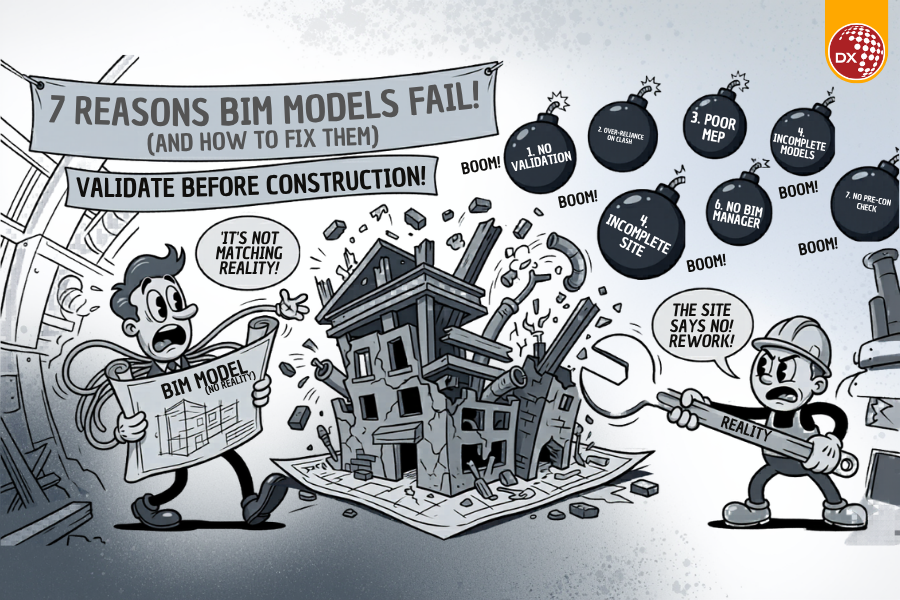
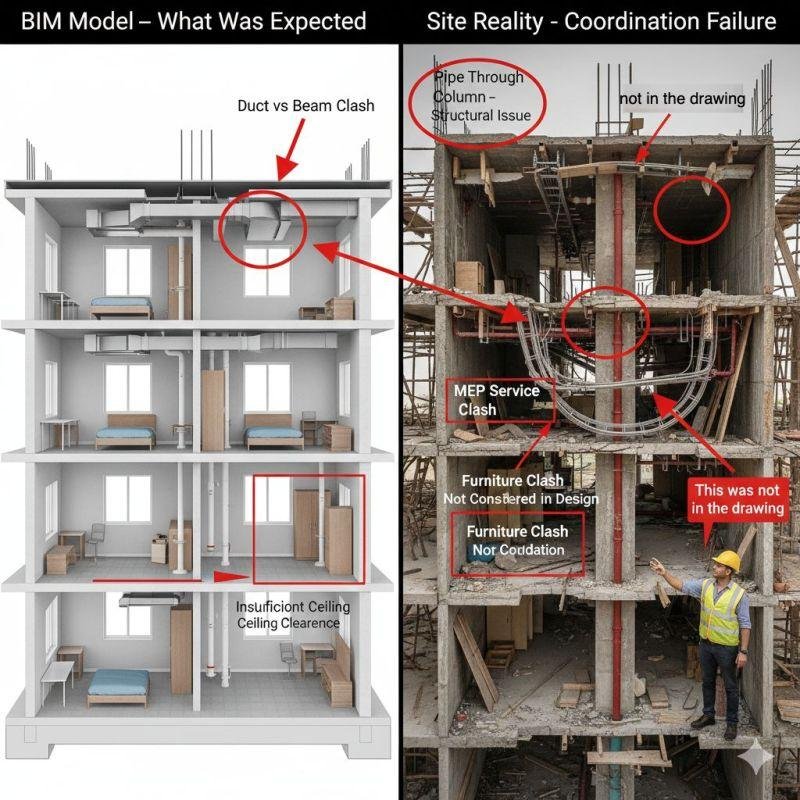
The BIM model looks flawless in coordination meetings—no visible clashes, clean documentation, and confident approvals. But once construction begins, reality tells a different story:
- Services don’t align
- Structural openings are misplaced
- MEP systems clash on-site
- Teams start improvising
And suddenly, your “coordinated” model becomes a source of rework, delays, and cost overruns.
This isn’t a rare issue—it’s a recurring industry problem.
In this article, we’ll break down why BIM models fail during construction, what teams often overlook, and how to implement a practical validation framework that bridges the gap between digital models and site reality.
Where the Problem Starts: The Hidden Gaps in BIM Models
The issue isn’t BIM itself—it’s how BIM models are created, coordinated, and validated.
Most failures originate in the pre-construction phase, where:
- Coordination is treated as a checklist activity
- Clash detection BIM is mistaken for full validation
- Design intent is not aligned with construction feasibility
The Real Impact on Projects
When BIM model accuracy doesn’t reflect site conditions, the consequences are immediate:
- Construction rework increases by 20–40%
- Delays due to redesign and approvals
- Loss of trust between teams
- Budget overruns and contractual disputes
These are not software problems—they are process and decision-making failures.
Why Current BIM Approaches Fail
What Teams Think vs What Actually Happens
What Teams Think | What Actually Happens |
“Clash detection is complete, so we’re good” | Only geometric clashes are resolved—not constructability |
“The model is approved, so it’s accurate” | Approval ≠ validation against site conditions |
“All disciplines are coordinated” | Coordination lacks depth (especially MEP BIM coordination) |
“We can fix issues during construction” | Fixing on-site = expensive rework |
The Core Problem
Most teams focus on model completeness, not model reliability.
That’s why BIM models don’t match site conditions—even when they appear technically correct.
7 Reasons BIM Models Fail During Construction
- Lack of Pre-Construction BIM Validation
Models are often pushed forward without a structured validation checklist.
Result: Errors are discovered only during execution.
- Over-Reliance on Clash Detection
Clash detection BIM identifies conflicts—but doesn’t answer:
- Can this be installed?
- Is there enough clearance?
- Is sequencing feasible?
Clash-free doesn’t mean construction-ready.
- Poor MEP BIM Coordination
MEP systems are the most complex—and most prone to errors.
Common issues:
- Incorrect routing assumptions
- Missing tolerances
- Ignoring site constraints
Result: Major site-level conflicts.
- Incomplete Federated BIM Models
Disciplines are combined—but not fully integrated.
- Structural, architectural, and MEP models lack alignment
- Dependencies are not validated
This creates hidden coordination gaps.
- Ignoring Site Reality
Design teams often work with ideal conditions, while sites operate under constraints:
- Space limitations
- Installation sequence
- Material availability
This creates a digital vs physical mismatch.
- Lack of Ownership (No Clear BIM Manager Role)
Without a defined BIM manager or VDC leader:
- Coordination becomes fragmented
- Decisions lack accountability
Result: Errors slip through unnoticed.
- No BIM Model Quality Check Before Construction
Teams skip final model audits before execution.
Missing checks include:
- Tolerance validation
- Installation feasibility
- Access and maintenance clearance
This is where most construction rework originates.
BIM Validation Framework for Construction Readiness
To prevent these failures, you need more than coordination—you need a structured validation workflow.
The 5-Step BIM Validation Framework
Step 1: Model Integrity Check
- Ensure all disciplines are fully integrated
- Validate geometry consistency
Step 2: Clash Detection + Contextual Review
- Go beyond clashes
- Assess constructability and sequencing
Step 3: MEP Coordination Deep Dive
- Validate routing against real site conditions
- Check installation feasibility
Step 4: Site Reality Alignment
- Compare model with site constraints
- Incorporate real-world limitations
Step 5: Final BIM Model Quality Audit
- Use a pre-construction BIM validation checklist
- Sign off only after practical verification
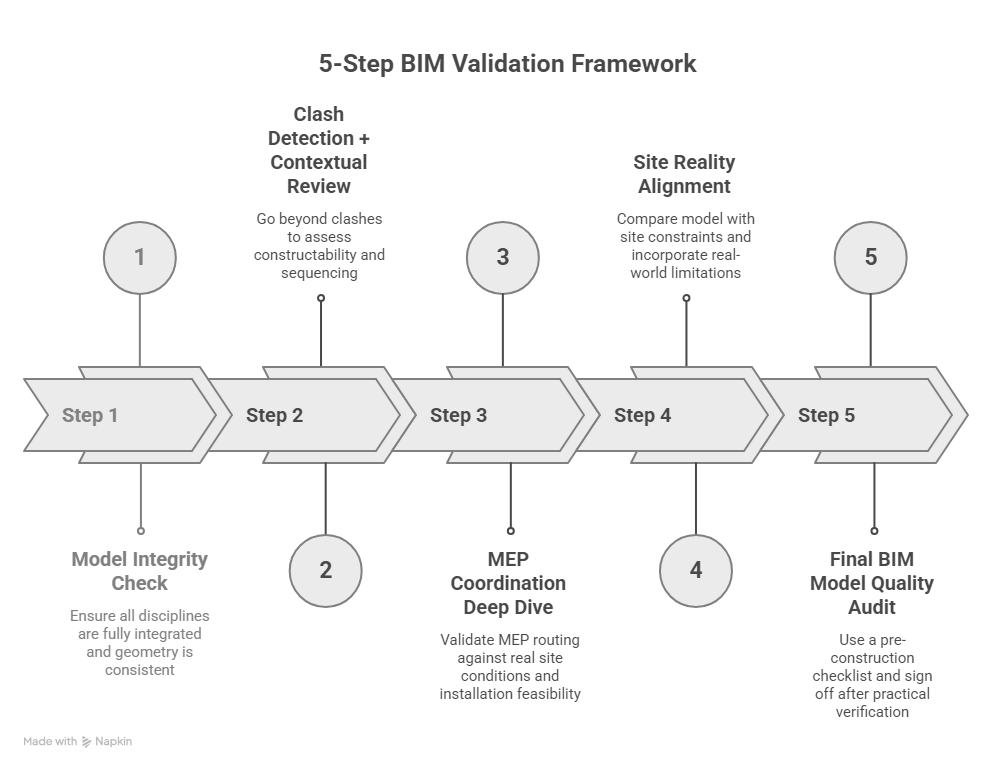
This approach shifts BIM from design validation to construction readiness.
Reducing Construction Rework with BIM Validation
Project Scenario
A mid-sized commercial project faced repeated MEP clashes during construction, despite prior BIM coordination.
Problem
- Clash detection was completed
- No constructability validation
- No final BIM model quality check
Approach
- Implemented a structured BIM validation workflow
- Conducted detailed MEP coordination review
- Introduced site-based validation checks
Outcome
- Reduced construction rework by 30%
- Improved coordination between teams
- Faster execution with fewer disruptions
The difference wasn’t tools—it was process clarity.
Comparison: Traditional vs BIM-Driven Construction Workflow
Traditional Approach | BIM Validation Approach |
Reactive issue resolution | Proactive error prevention |
Site-driven corrections | Pre-construction validation |
High rework costs | Reduced rework (up to 30%) |
Fragmented coordination | Integrated decision-making |
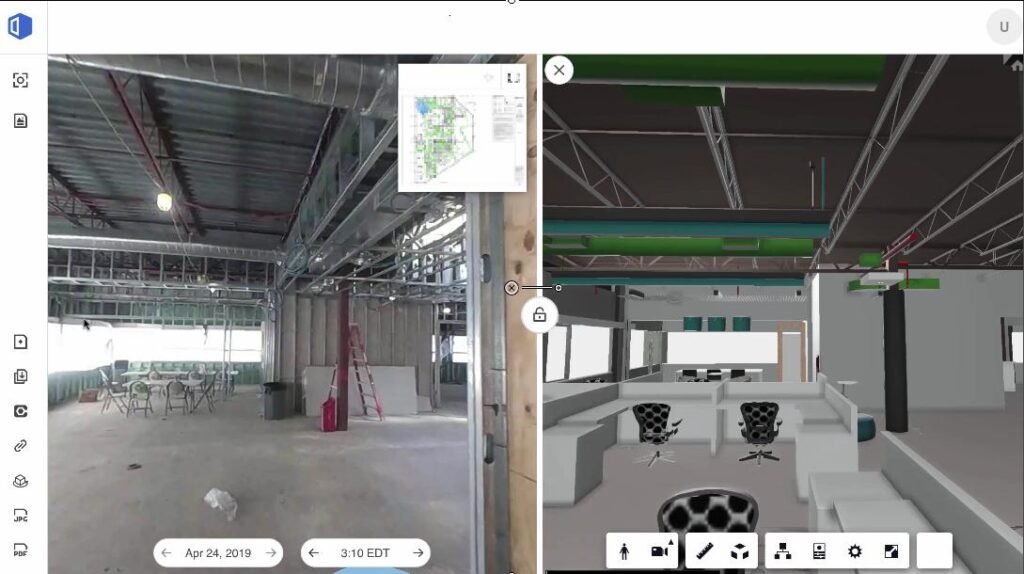
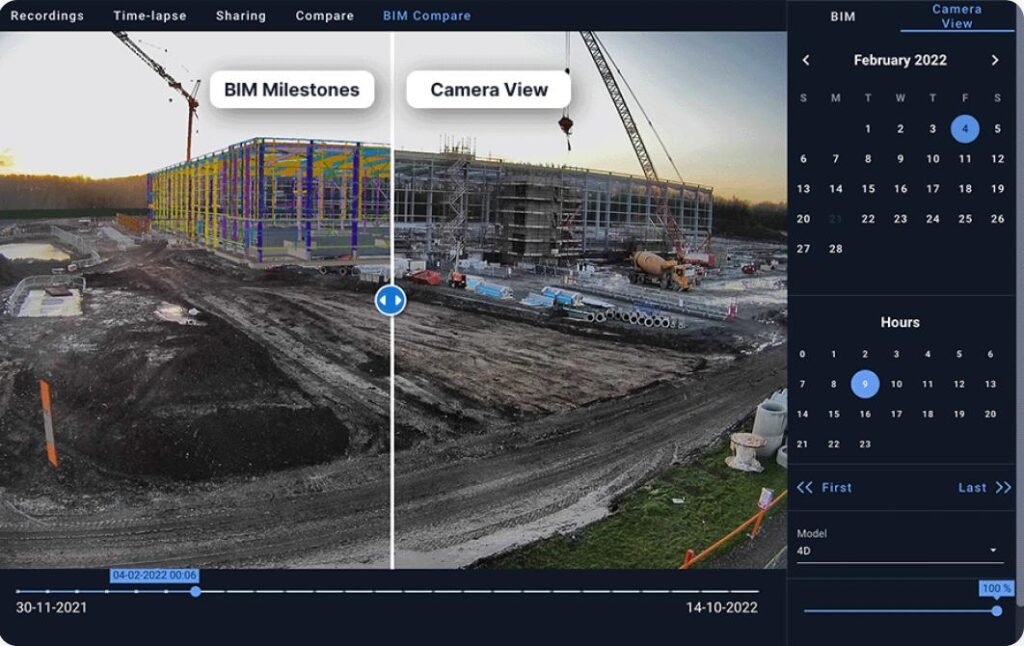
Before vs After BIM Implementation
Before BIM Validation | After BIM Validation |
Frequent site conflicts | Minimal on-site clashes |
Delays and rework | Smooth execution |
Misaligned models | Site-aligned BIM models |
High uncertainty | Predictable outcomes |
Key Takeaways
- Clash detection alone is not enough—you need full BIM validation
- Most BIM failures originate before construction begins
- MEP coordination is the biggest risk area
- A structured BIM validation workflow can reduce rework by up to 30%
- BIM success depends on process, not just technology
BIM Doesn’t Fail—Processes Do
BIM models don’t fail because of technology—they fail because of gaps in validation, coordination, and decision-making.
If your projects are facing:
- Frequent rework
- Model-to-site discrepancies
- Coordination breakdowns
…it may be time to rethink your current BIM approach.
A validated BIM model isn’t just a design asset—it’s a construction enabler.
If you’re exploring how to improve BIM model accuracy, reduce construction rework, or implement a validation-driven workflow, this is exactly where strategic consulting makes the difference.
How DGTRA Solves This — Beyond Coordination, Toward Certainty
At DGTRA, we don’t just coordinate BIM models—we take ownership of making them construction-ready.
Our validation-first approach is built for projects where accuracy isn’t optional. We work alongside your team as a BIM delivery partner, identifying hidden risks, validating model integrity, and aligning every element with real site conditions—before execution begins.
From deep MEP coordination validation to pre-construction BIM audits, we ensure your models don’t just look right—they perform right on-site.
Because in real projects, coordination is not enough.
Confidence is built through validation.
Move From Vendor to Partner
If your projects are facing BIM discrepancies, coordination gaps, or repeated rework—this isn’t just a model issue. It’s a process gap.
It’s time to move beyond transactional support and work with a BIM validation partner invested in your project outcomes.
Start With Insight — Join the Webinar
Before you fix the problem, you need to see it clearly.
In our upcoming session, we break down:
- Why BIM models fail on-site
- Where coordination actually breaks down
- How a validation-driven approach changes project outcomes
Join the webinar and rethink how your BIM should perform in the real world.
Build It Right — Together
If you’re serious about reducing rework and delivering with confidence, let’s not just connect—
let’s build a long-term BIM partnership.