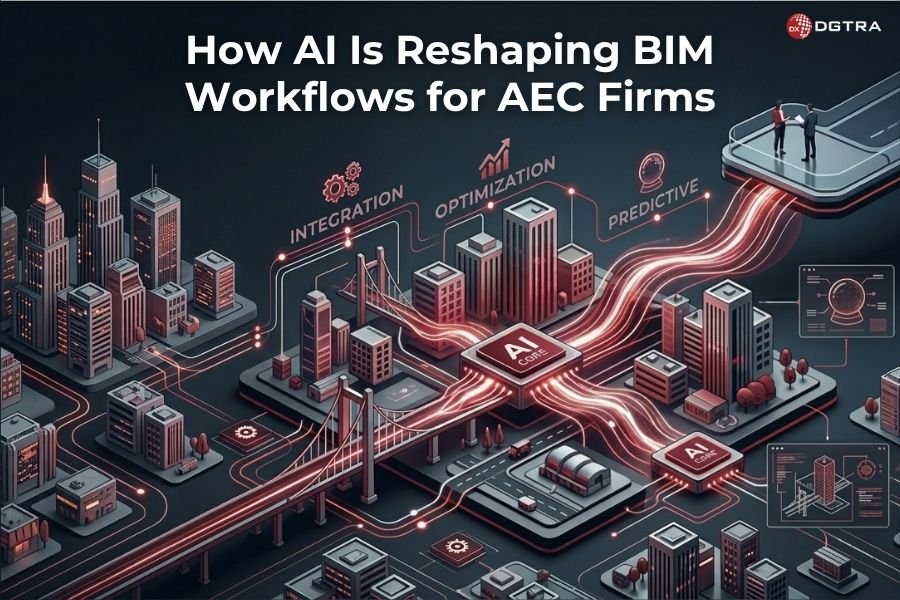
How AI Is Reshaping BIM Workflows for AEC Firms
The Model Has Always Been Smarter Than the Workflow Around It.
For years, BIM models have contained more data than project teams could leverage. Geometry, specifications, quantities, schedules, and costs have been available in the federated model, but lacked a process to unlock their full value.
Artificial Intelligence now provides that process.
AI is not about replacing people. It is about elevating project delivery by aligning model intelligence with equally intelligent workflows.
In our previous blog — BIM 6.0: Why Sustainability Is the New Sixth Dimension of Construction — we established that forward-looking delivery organizations are embedding new dimensions of intelligence into their models. AI is the engine that makes those dimensions actionable.
What the Research Tells Us
Performance data on AI-BIM integration is increasing, and the trends are consistent across studies.
A systematic review published in Applied Sciences analyzing 1,212 studies on AI-BIM integration between 2022 and 2025 identified five primary BIM application domains where AI is delivering measurable outcomes — BIM modeling, 4D/5D planning, CDE management, clash detection, and Digital Twin development — with machine learning and deep learning emerging as the most impactful AI families across all five. (Source: Applied Sciences, MDPI — AI-BIM Systematic Review 2025 →)
Research published in the Journal of Umm Al-Qura University for Engineering and Architecture examining AI-BIM integration found significant improvements across construction methodologies — including enhanced design automation, measurable reductions in coordination conflicts, and improved construction scheduling outcomes — with buildingSMART International identified as a key body for developing standardized AI-BIM validation protocols.
The research is clear: AI in BIM delivers measurable improvements, but only when model data, workflow standards, and process foundations are structured to support it.
Five Areas Where AI Is Reshaping BIM Delivery
-
Intelligent Clash Detection and Coordination
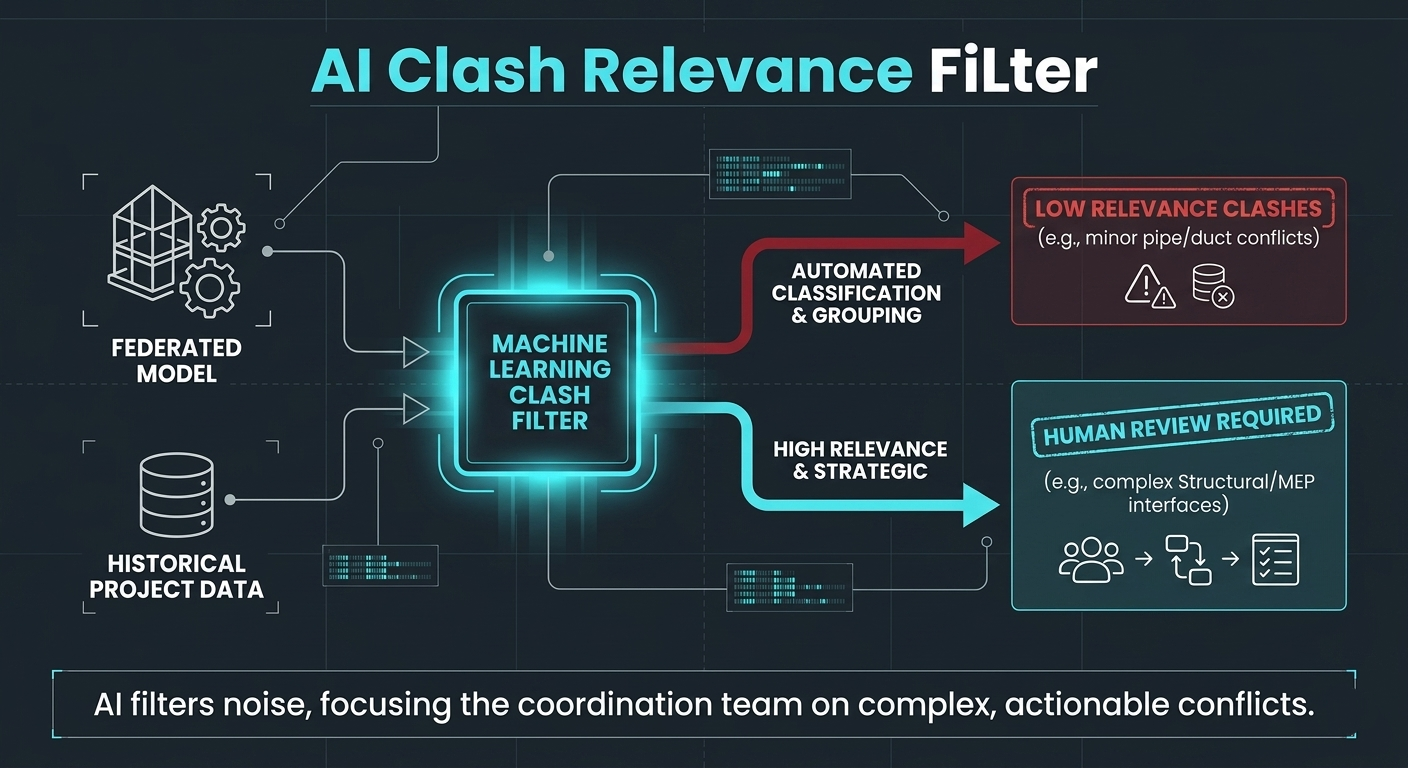
Traditional clash detection is reactive, performed after modeling and generating large reports that require extensive human review. AI-powered clash detection shifts this approach, enabling more efficient and targeted coordination.
Research published in ScienceDirect on automating clash relevance filtering using machine learning found that AI-enhanced coordination systems — built on Navisworks and trained on historical project data — can autonomously classify, prioritize, and filter clashes by relevance, reducing the volume requiring human review and enabling coordination teams to focus on genuinely complex interface decisions that require strategic resolution.
AI clash detection performance depends on the quality of the model’s data. Poor LOD alignment, inconsistent classification, or incomplete semantic data lead to weak AI outputs. Investing in model quality and classification consistency through a clear BIM Execution Plan is essential to realize the full value of AI-powered coordination.
This connects directly to the coordination maturity framework in How to Move Your AEC Team Toward Integrated Delivery Maturity. DGTRA’s Design & Trade Coordination service is built around exactly this principle.
2. Generative Design and Early-Stage Optimization
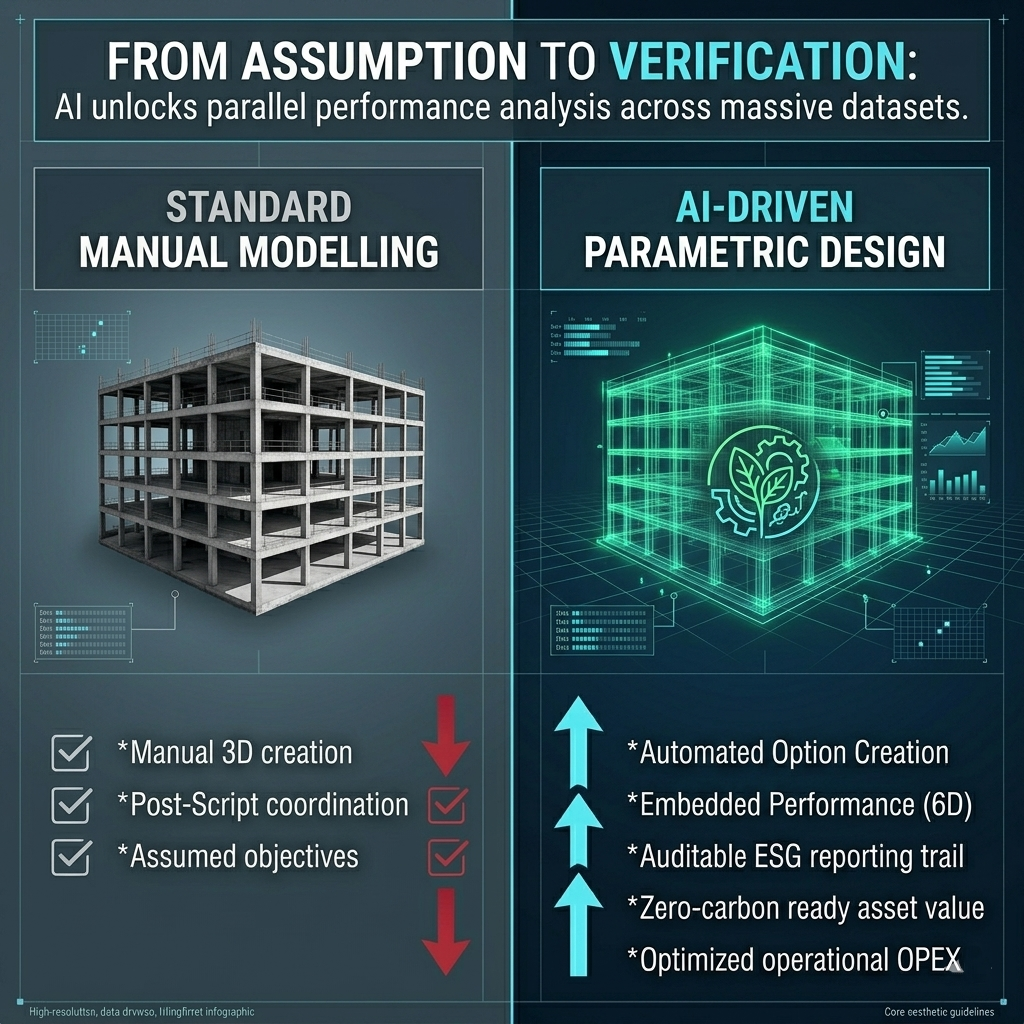
Generative design uses parametric optimization and AI algorithms to evaluate many design options against defined objectives such as cost, space efficiency, structural performance, and energy use. This process operates at a speed that manual workflows cannot match.
Research presented at the 2025 ACM Computers and People Research Conference found that generative design tools analyze site conditions, zoning regulations, and project requirements to produce multiple optimized design options in parallel — significantly compressing early design timelines and reducing downstream coordination conflicts.
The quality of generative design outputs depends on how precisely the delivery team defines objective functions from the start. Including embodied carbon targets in a 6D BIM workflow ensures that early-stage sustainability decisions are made based on data, not assumptions. This aligns with the principles outlined in BIM 6.0: Why Sustainability Is the New Sixth Dimension of Construction.
3. Predictive Analytics and Risk Management
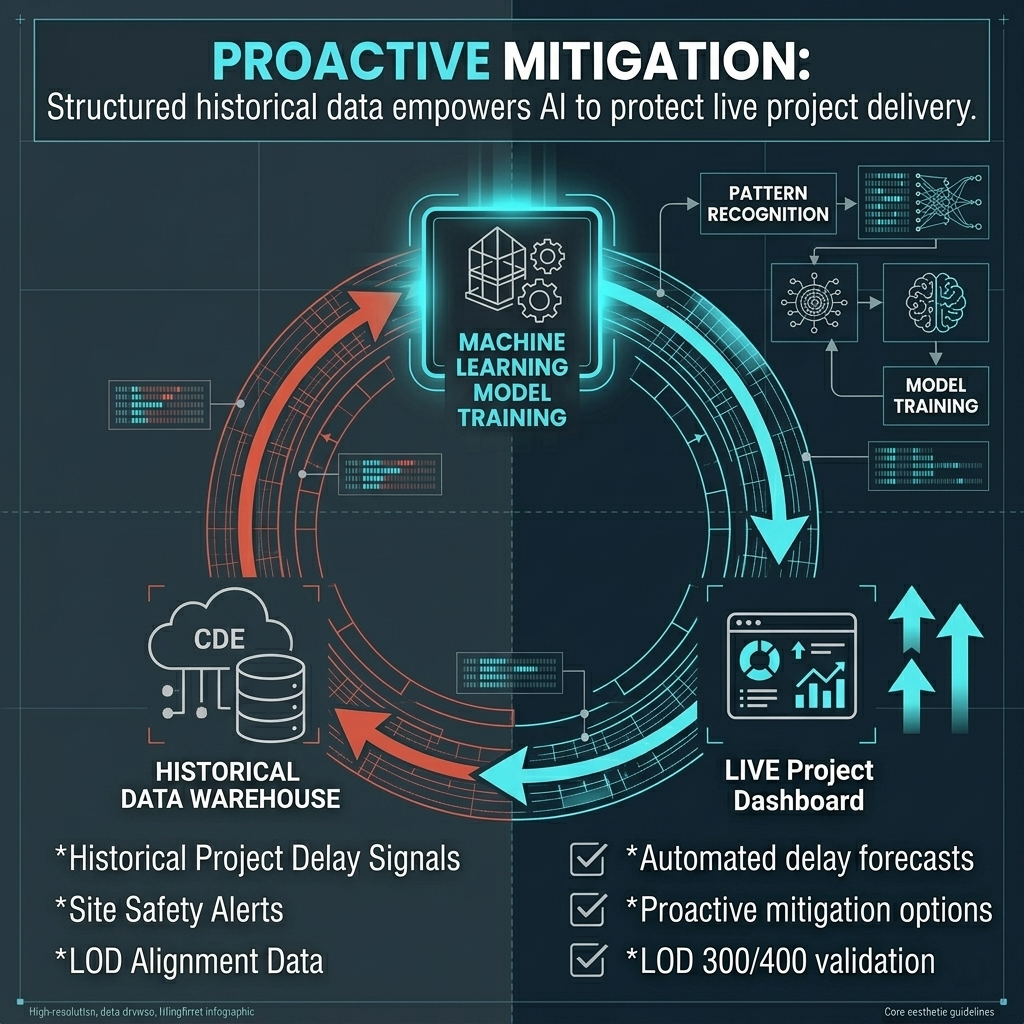
AI-powered predictive analytics provides project teams with early visibility into risk by leveraging machine learning models trained on structured historical project data. This approach identifies warning signals before they impact the schedule or cost.
Research published in Applied Sciences found that AI-driven real-time predictive analytics significantly reduces the risk of project delays — and, separately, that AI-IoT sensor integration in site safety monitoring reduced workplace accidents by 30% across monitored construction environments. (Source: Applied Sciences, MDPI — AI in BIM Transformation 2025 →)
The safety outcome specifically relates to AI-IoT site monitoring, which is separate from BIM-based predictive analytics, though both are part of the broader AI-construction ecosystem. For BIM-based risk analytics, value increases with the quality and structure of historical project data used for model training. Organizations with well-governed Common Data Environments and consistent data standards are better positioned to realize this capability.
DGTRA’s BIM Project Management service embeds data-driven governance into live project delivery — building the data foundation that makes predictive analytics increasingly valuable over successive project cycles.
4. Automated Quantity Take-Off and Cost Intelligence
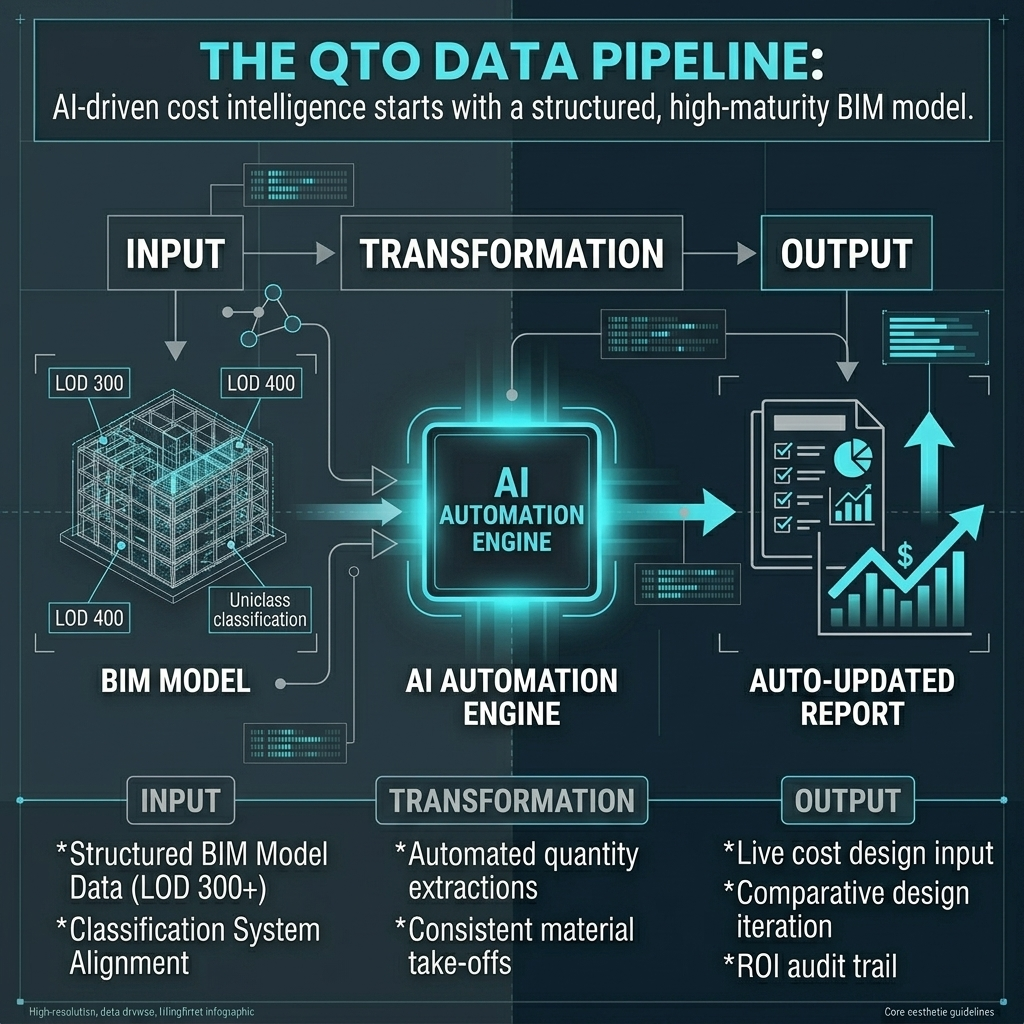
AI-driven QTO delivers quantity extractions and cost projections faster and more consistently than manual estimation. Outputs are not dependent on individual estimator experience and update automatically as the model evolves.
The accuracy of AI-generated quantity extractions depends directly on model LOD consistency and alignment with classification systems, such as Uniclass, OmniClass, or project-specific systems. A well-classified model at the right LOD produces reliable AI-driven QTO. A model without those foundations produces outputs that require significant manual correction.
With a strong data foundation, cost intelligence shifts from a periodic milestone to a live design input. This enables real-time cost comparison across design options, which manual estimation cannot sustain over multiple iterations.
5. AI-Powered Digital Twins for Operations
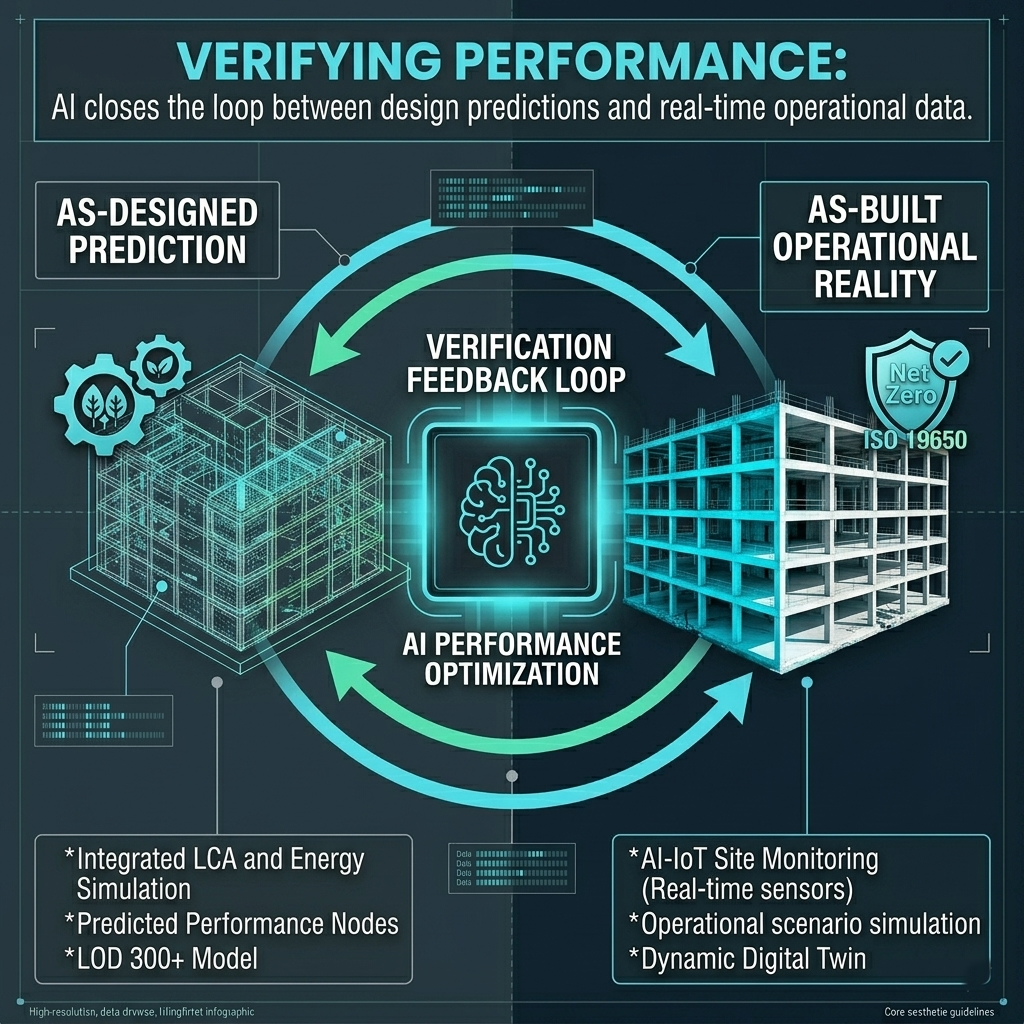
The most comprehensive application of AI in BIM is the intelligent Digital Twin — where the model becomes a live operational asset that learns and adapts based on real-time sensor data throughout the building’s operational life.
It is important to clarify this transition. The construction BIM model and the operational Digital Twin are different assets. Moving from one to the other requires deliberate data preparation at handover, including LOD adjustment, asset data structuring, and integration with building management systems. A well-configured CDE and clearly defined Asset Information Requirements are critical at this stage.
Research published in Applied Sciences found that, in the operational phase, AI enables intelligent building management through predictive analysis, operational scenario simulation, and energy performance optimization, transforming the static handover model into a continuously improving operational intelligence platform.
When built on a well-structured BIM 6D foundation with sustainability and lifecycle data embedded from the start, AI-powered Digital Twins enable owners to track carbon performance against net-zero targets and make data-driven asset decisions over the long term.
DGTRA’s CDE Software Implementation provides the data infrastructure that makes the construction-to-operational transition structured and deliberate — with model data governed, versioned, and prepared for AI-powered operational use from project kickoff.
AI in BIM Is a Process Decision, not a Technology Purchase
Organizations achieving the strongest returns from AI-BIM integration have one thing in common: they invested in data quality and process structure before adopting AI tools.
This requires BIM models with consistent classification and LOD alignment that AI systems can learn from, BIM Execution Plans that include AI-readiness requirements, and Common Data Environments that make historical project data available for model training. Teams must also be able to define objective functions, validate AI outputs, and act on AI-generated insights with sound judgment.
This is the capability DGTRA helps organizations build through BIM Maturity Audits and Strategic BIM Roadmaps — assessing where the current process sits and defining the structured path forward.
For a foundation on model quality and delivery readiness, see: Why Your BIM Models Don’t Match Site Reality and How to Validate BIM Models Before Construction Begins.
The Direction Is Clear. The Investment Is a Process One.
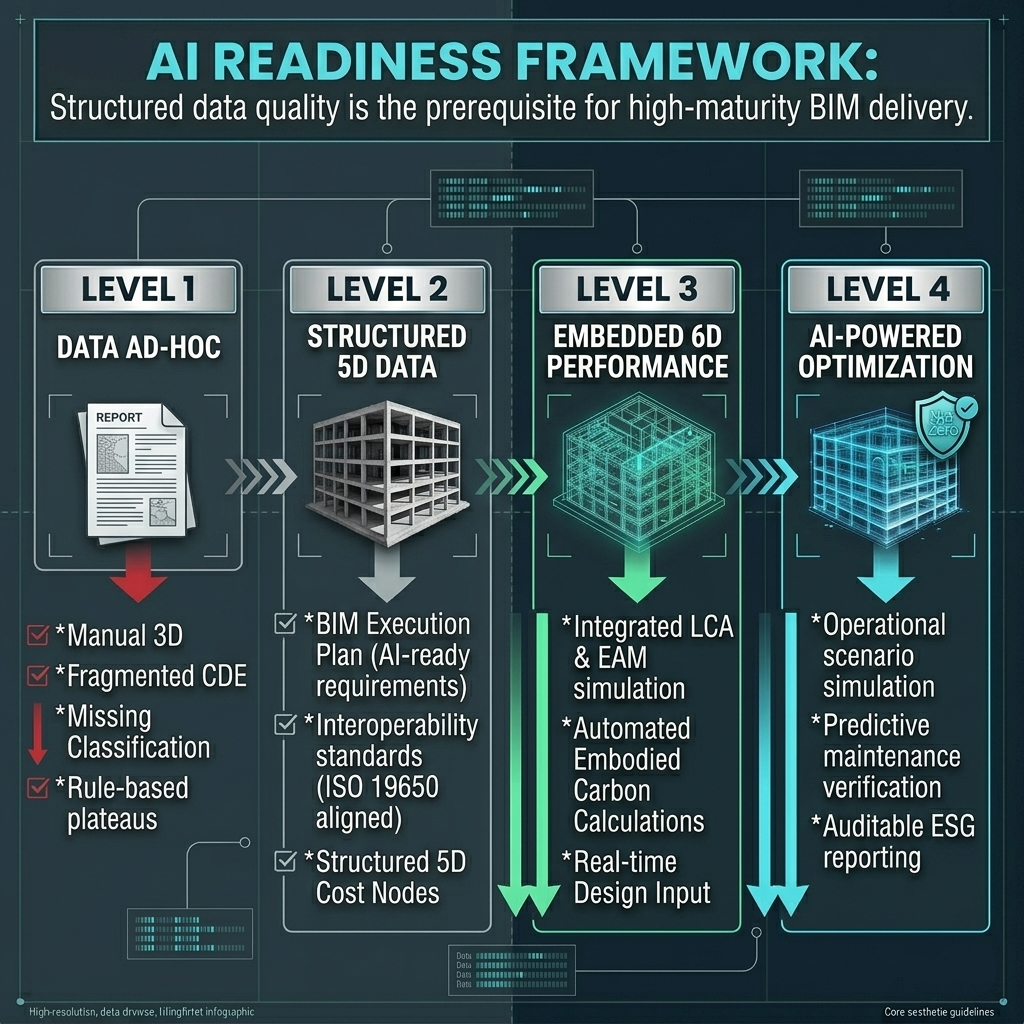
Productivity gains, improved coordination, and cost efficiencies from AI-BIM integration are well documented. These benefits increase with each project cycle as data accumulates, models improve, and organizational AI-readiness advances.
The organizations capturing these gains are distinguished by the quality of their processes, data structures, and workflow foundations, not by access to better tools.
The BIM model has always had the potential to be the most intelligent asset on a project. AI turns that potential into operational value across design, coordination, construction, and the full asset lifecycle.
Organizations investing in this foundation now will see their delivery capability strengthen with every completed project.
About DGTRA
DGTRA is a global BIM consulting and digital engineering firm supporting AEC and construction teams across the US, UK, Europe, and India. We specialize in building the delivery frameworks — from AI-ready BIM data structures and coordination maturity to 6D sustainability integration and ISO 19650-aligned workflows — that help organizations capture the full value of AI-BIM convergence.
Frequently Asked Questions
How is AI different from traditional automation in BIM?
Traditional automation executes predefined rules — clash detection runs, reports generate, quantities extract. AI in BIM learns from historical project data, identifies patterns that rules cannot anticipate, and improves with every project cycle. The distinction matters because AI-powered workflows become more capable over time as structured data accumulates — whereas rule-based automation plateaus at its initial level of capability.
Where should organizations start with AI-BIM integration?
The highest-ROI starting point is AI-powered clash detection and coordination filtering — delivering immediate value within existing workflows. The prerequisite is model data quality — consistent LOD, classification alignment, and semantic completeness. Without that foundation, AI tools produce outputs that require significant manual correction. DGTRA’s BIM Maturity Audits identify exactly where these gaps live.
Does AI-BIM integration require rebuilding existing workflows?
No. The most effective integrations build on existing workflows — enhancing coordination processes, automating repetitive tasks, and adding predictive capabilities to established governance structures. The investment is in data quality, classification standards, and workflow structuring — not in replacing what already works.
How does AI in BIM connect to 6D sustainability workflows?
Generative design enables sustainability to be evaluated as a real-time design input when embodied carbon targets are defined as objective functions from the outset. This connects directly to the 6D BIM framework explored in BIM 6.0: Why Sustainability Is the New Sixth Dimension of Construction — where early-stage design decisions carry the highest carbon reduction leverage, and AI makes acting on that leverage operationally practical.
How does DGTRA support AI-BIM integration?
DGTRA approaches AI-BIM readiness as a process and data-quality challenge first — building the model structure, classification standards, CDE governance, and workflow foundations that enable AI tools to operate at full capability. Our Strategic BIM Roadmap defines the specific steps toward AI-ready BIM delivery for your organization — and our BIM Consulting & Management team supports implementation across live project delivery.
Traditional automation executes predefined rules — clash detection runs, reports generate, quantities extract. AI in BIM learns from historical project data, identifies patterns that rules cannot anticipate, and improves with every project cycle. The distinction matters because AI-powered workflows become more capable over time as structured data accumulates — whereas rule-based automation plateaus at its initial level of capability.
The highest-ROI starting point is AI-powered clash detection and coordination filtering — delivering immediate value within existing workflows. The prerequisite is model data quality — consistent LOD, classification alignment, and semantic completeness. Without that foundation, AI tools produce outputs that require significant manual correction. DGTRA’s BIM Maturity Audits identify exactly where these gaps live.
No. The most effective integrations build on existing workflows — enhancing coordination processes, automating repetitive tasks, and adding predictive capabilities to established governance structures. The investment is in data quality, classification standards, and workflow structuring — not in replacing what already works.
Generative design enables sustainability to be evaluated as a real-time design input when embodied carbon targets are defined as objective functions from the outset. This connects directly to the 6D BIM framework explored in BIM 6.0: Why Sustainability Is the New Sixth Dimension of Construction — where early-stage design decisions carry the highest carbon reduction leverage, and AI makes acting on that leverage operationally practical.
DGTRA approaches AI-BIM readiness as a process and data-quality challenge first — building the model structure, classification standards, CDE governance, and workflow foundations that enable AI tools to operate at full capability. Our Strategic BIM Roadmap defines the specific steps toward AI-ready BIM delivery for your organization — and our BIM Consulting & Management team supports implementation across live project delivery.