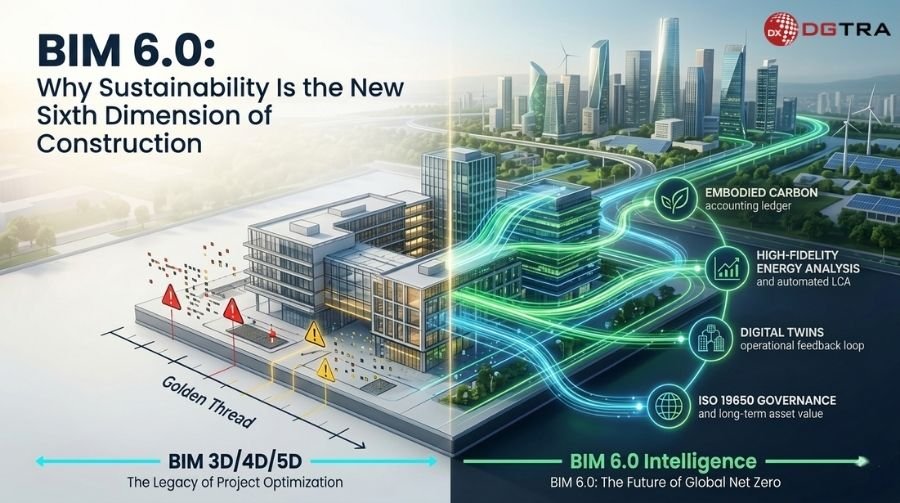
For decades, the construction industry viewed sustainability as a “nice-to-have” or, worse, a regulatory hurdle to be cleared at the lowest possible cost. We mastered 3D geometry, integrated 4D schedules, and optimized 5D costs. Yet, as the global built environment remains responsible for nearly 40% of energy-related carbon emissions, the industry has reached an inflection point. The transition from BIM 5D to 6D BIM is not merely a numerical increment; it is a fundamental shift in the DNA of project delivery. Sustainability is no longer a post-script—it is the Sixth Dimension, a digital imperative that weaves environmental performance into the very fabric of the Building Information Model.
It’s about intelligently orchestrating life-cycle data to ensure the structures we build today are future-ready and thrive in a climate-conscious economy through 2030 and beyond.
The Market Mandate: Data-Driven Decarbonization
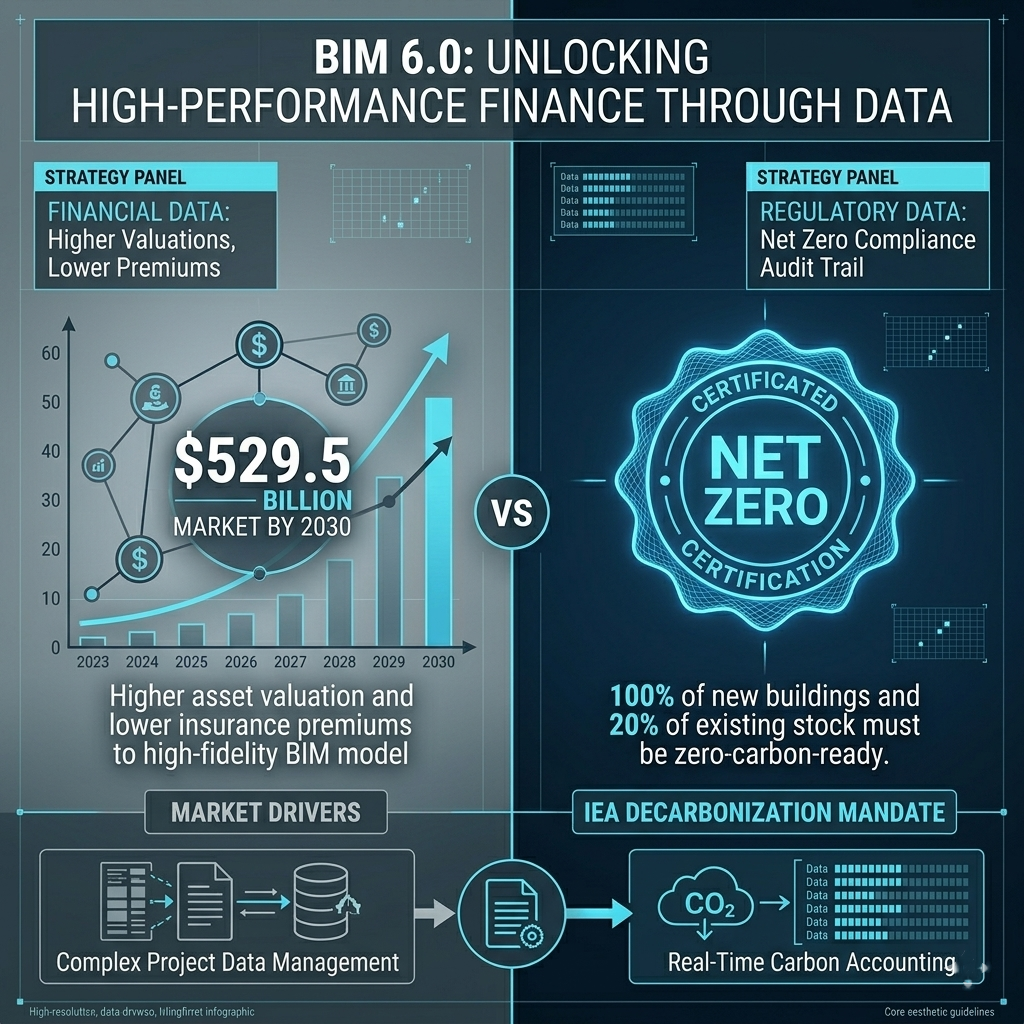
The shift toward BIM 6.0 is fueled by more than just environmental altruism it is driven by aggressive market forces and evolving global standards. According to recent industry analysis by Grand View Research, the global green building market is projected to reach approximately $529.5 billion by 2030, growing at a CAGR of 10.3%. This growth is underpinned by the “Green Premium,” in which sustainable assets command higher valuations and lower insurance premiums.
Furthermore, the International Energy Agency (IEA) emphasizes that to reach Net Zero by 2050, all new buildings and 20% of the existing building stock must be zero-carbon-ready by 2030. This requires precise management of complex project data. BIM 6.0 provides a framework for Life Cycle Assessment (LCA, a process evaluating environmental impacts across a building’s lifespan) and Energy Analytical Models (EAM, tools for forecasting and measuring building energy use). These are incorporated in the federated model, allowing real-time carbon accounting during design rather than as an afterthought.
This is precisely why DGTRA integrates sustainability thinking into its BIM Consulting & Management and Integrated Project Delivery services because environmental performance embedded in delivery is the standard the market is moving toward.
Beyond Geometry: The Mechanics of BIM 6.0
In the BIM 6.0 paradigm, the model becomes a living simulation. It’s no longer just about where a pipe goes, but what that pipe is made of, the carbon footprint of its transport, and its thermal contribution to the building’s efficiency over 50 years.
- Integrated Life Cycle Assessment (LCA)
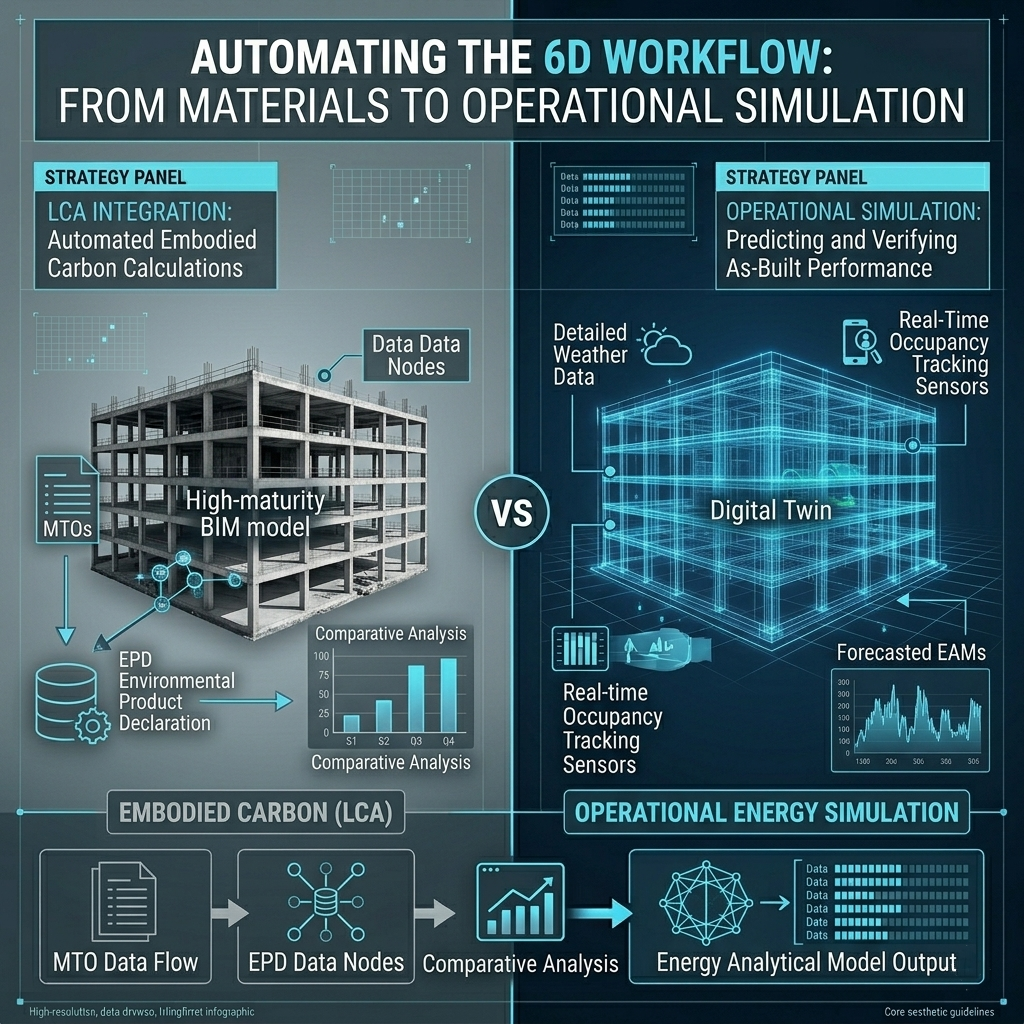
BIM 6.0 enables experts to automate embodied carbon calculations. Embodied carbon is the environmental impact of materials used in construction. By linking Material Take-Offs (MTOs, itemized lists and quantities of materials) directly to environmental product declaration (EPD) databases—EPDs are reports detailing materials’ environmental effects—BIM managers can run comparative analyses of structural systems within the native modeling environment.
- Operational Energy Simulation
The “6D” aspect integrates building performance analysis (BPA, a method for simulating a building’s energy use) into the early design stages. By using detailed weather data and occupancy-tracking sensors, the 6.0 model predicts energy consumption patterns. This “Digital Twin” approach—where a virtual model mirrors the real building—ensures that the “as-built” energy performance matches “as-designed” expectations.
- Circularity and the “Building as a Material Bank.”
Sustainability in 6.0 extends to deconstruction. By embedding metadata on material recyclability (the ability to reuse or recycle materials) and disassembly procedures (the steps to take apart a building), we are essentially creating a “Material Passport,” a digital record of the materials used and their reuse potential. When a building reaches the end of its life, the BIM 6.0 model serves as a ledger for the circular economy, keeping resources in use.
This is the kind of delivery infrastructure DGTRA helps organizations build through Strategic BIM Roadmap and BIM Maturity Audits — identifying where the current workflow sits and what specifically needs to change to support 6D sustainability integration.
Why BIM Experts Must Lead the 6.0 Transition
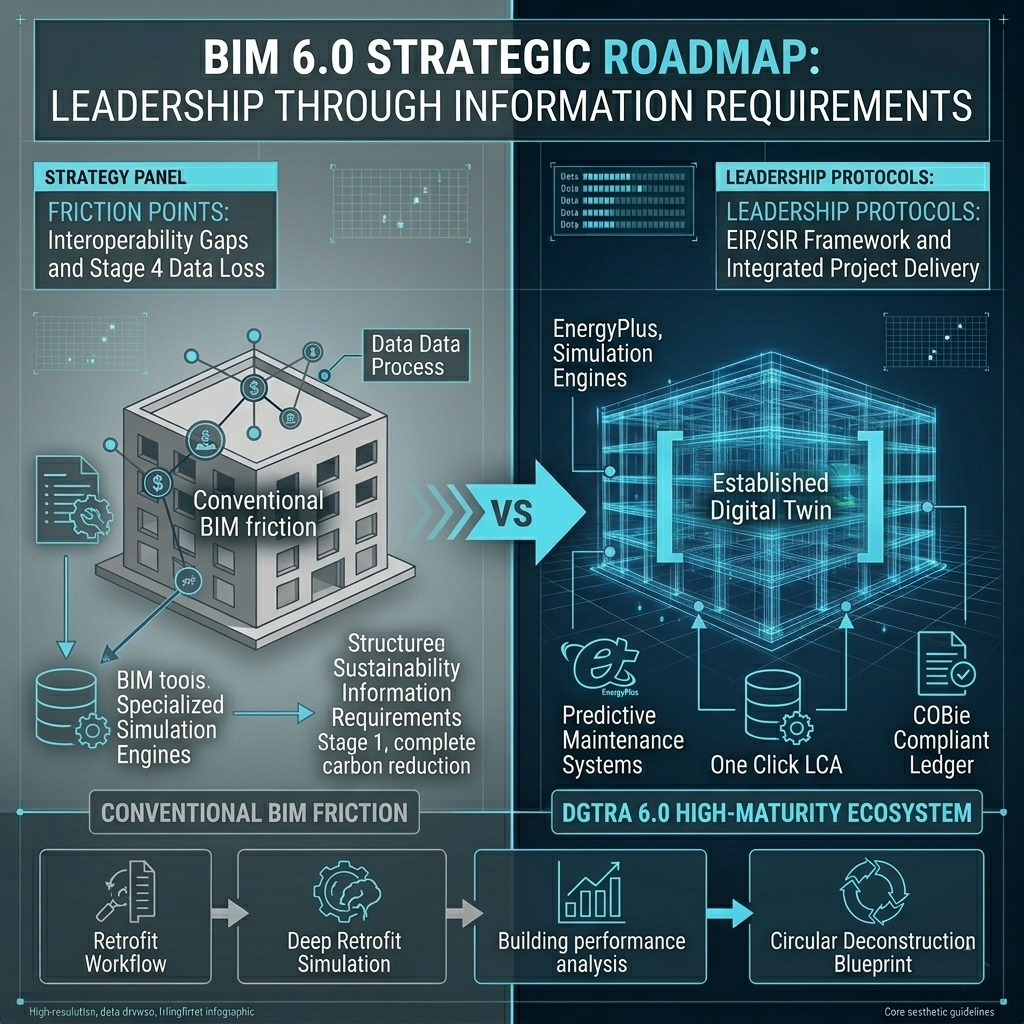
The transition to BIM 6.0 requires a sophisticated understanding of interoperability, which means different software tools must exchange information seamlessly. It’s about the flow of data between the BIM environment and specialized simulation engines such as EnergyPlus (a tool for modeling building energy use) or One Click LCA (a software for assessing lifecycle impacts).
As a leading BIM services provider, we recognize that the challenge isn’t just software—it’s the Information Requirements (EIR, the data needed for project delivery). We must advocate for “Sustainability Information Requirements” at the project’s start. If the data isn’t structured for 6D analysis from Stage 1, opportunities for significant carbon reduction are often lost by Stage 4.
For context on how model quality and delivery readiness connect to this challenge, see: Why Your BIM Models Don’t Match Site Reality and How to Validate BIM Models Before Construction Begins.
The Strategic Value of 6D Implementation
- Risk Mitigation: With the rise of ESG (Environmental, Social, and Governance) reporting, developers are increasingly liable for the carbon footprint of their portfolios. BIM 6.0 provides the audit trail required for compliance.
- Operational Excellence: 6D models transition seamlessly into Facility Management (FM), which encompasses systems for maintaining and operating built assets. An energy-optimized model enables predictive maintenance, anticipating and resolving issues before they cause problems, reducing long-term OPEX (operational expenses) for the owner.
- Regulatory Readiness: As global building codes tighten, BIM 6.0 is the only reliable way to ensure a project remains “future-proof.”