In modern capital project delivery, few moments bring as much confidence as the approval of a baseline schedule. Complete with detailed Gantt charts, critical path milestones, and comprehensive resource allocations, a well-crafted schedule feels like an infallible roadmap to success.
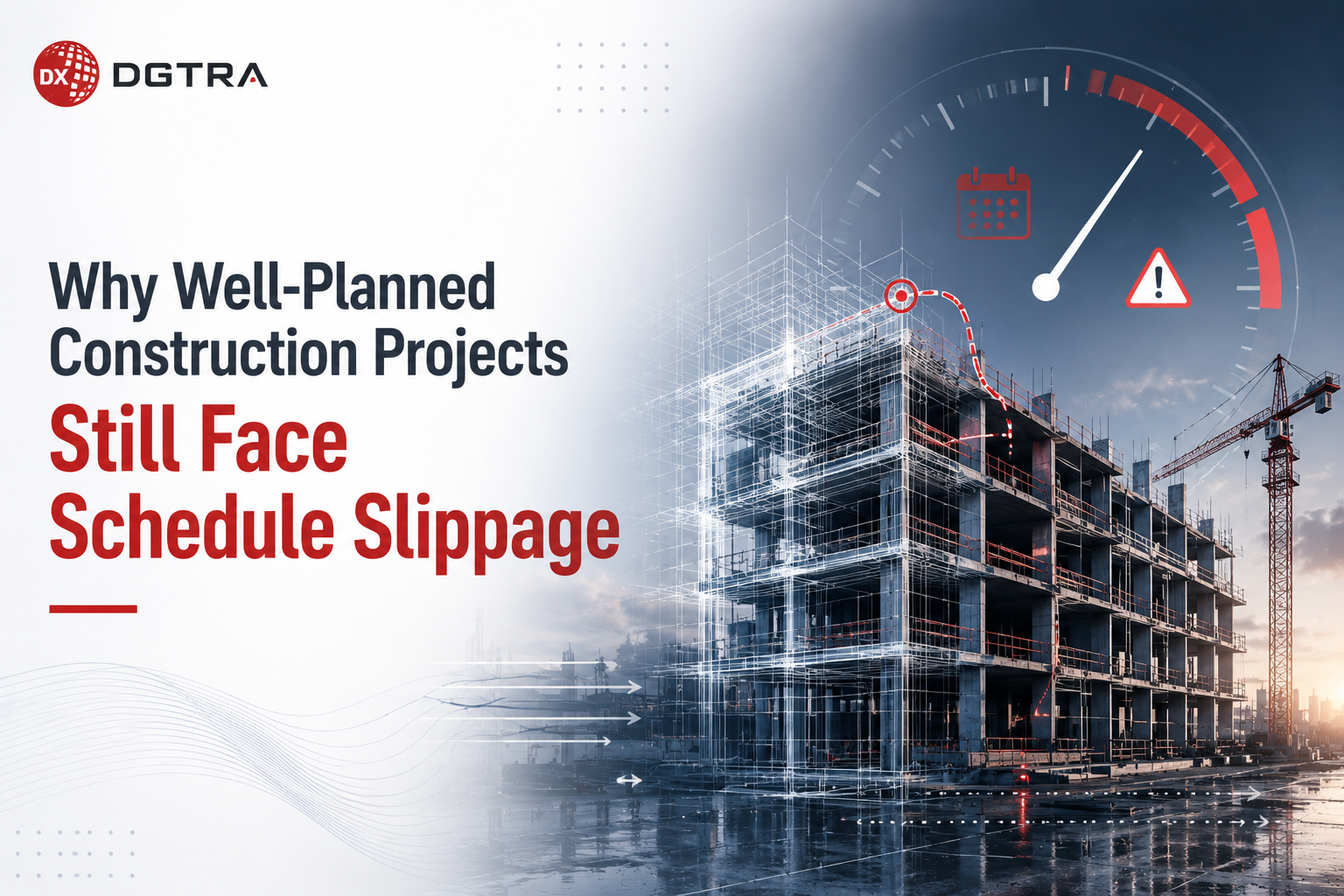
Yet, industry leaders across the globe share a familiar frustration: even meticulously planned projects frequently experience schedule slippage.
According to research by McKinsey Global Institute, 77% of large-scale construction projects globally suffer from significant schedule overruns, often delaying completion by 40% or more. Additionally, industry reports reveal that nearly 95% of data generated across design and construction stages goes unused, leaving decision-makers in the dark until delays have already compounded into major cost impacts.
Why does this happen? The answer lies in a fundamental miscalculation: confusing a detailed schedule with an executable plan.
The Illusion of a “Perfect Schedule”
A schedule is essentially an idealized static model built on assumptions. It represents how a project should unfold under frictionless conditions—where every design document is fully coordinated, lead times remain predictable, and site conditions align perfectly with structural drawings.
However, construction environments are dynamic, living ecosystems. When project executives place absolute faith in a schedule without verifying the underlying coordination between design models and site workflows, an illusion of control is created.
The schedule isn’t failing because project planners lacked skill; it fails because a 2D timeline cannot account for 3D physical constraints, sequencing conflicts, and real-time human decision-making on the job site.
Why Schedules Drift Over Time
Schedule slippage in complex builds rarely happens overnight through a single catastrophic event. Instead, it occurs through micro-drifts—small, almost imperceptible friction points that accumulate silently week after week until critical milestones are missed.
When spatial clashes or design discrepancies are discovered late on site, the domino effect begins:
- Information Latency: Field teams wait days (or weeks) for Request for Information (RFI) responses, causing trade crews to pause or remobilize.
- Cascading Dependencies: A delay in MEP (Mechanical, Electrical, and Plumbing) rough-ins forces drywall installers, ceiling contractors, and equipment integrators to adjust their sequences.
- Unplanned Workarounds: To maintain artificial progress against the baseline, teams execute site-level workarounds that often lead to costly rework later.
These small friction points quickly widen the gap between what the CPM (Critical Path Method) schedule says should be happening and what is taking place on the ground.
Common Sources of Disconnect
To prevent schedule drift, leadership must identify the key operational disconnects that pull planning away from execution:
- Design Evolution vs. Procurement Lead Times: Changes in design specifications frequently occur while long-lead items are already in transit or manufacturing, creating on-site installation stalls.
- Multi-Trade Coordination Silos: Structural, MEP, and architectural models managed in isolation create spatial clashes that only surface during physical assembly.
- Constructability Gaps: Designs that appear feasible on paper or 2D CAD drawings run into physical access and installation bottlenecks on site.
- As-Built vs. As-Designed Variance: Minor field modifications made during early foundation or shell stages render subsequent prefabricated components misaligned.
Why Project Delivery is More Than Schedule Management
Traditional project controls often treat schedule management as a reporting exercise—tracking variances, updating Gantt charts, and flagging late tasks. But reporting on a delay after it has occurred is like driving while looking exclusively in the rearview mirror.
True project delivery requires shifting from passive monitoring to proactive predictability.
Leading developers and engineering leaders realize that managing a schedule isn’t about pushing trade contractors to work faster; it is about eliminating the systemic friction that prevents work from flowing continuously. To protect completion dates, capital projects require an integrated ecosystem where Digital Engineering Solutions and real-time site insights feed directly into project governance.
When project data flows seamlessly across designers, general contractors, and trade specialists, teams can resolve physical and temporal clashes before a single dollar is wasted on site.
Transition: Connecting Planning with Execution
If detailed schedules alone cannot guarantee on-time delivery, what bridges the gap between static timelines and dynamic site realities?
The answer lies in establishing a single, data-rich operational truth—one that turns abstract dates into clear, visual, and spatial steps that teams can execute with complete confidence.
So, what creates that connection? That’s where Virtual Design & Construction begins to change the conversation.
Next Up in Our Series:
In our next blog, we examine how modern VDC workflows convert schedule data into dynamic 4D/5D visual frameworks, empowering project leaders to simulate construction sequences, de-risk supply chains, and deliver projects predictably every single time.
Upcoming Live Discussion
Why do detailed schedules still fail to translate into predictable jobsite delivery?
We’re diving into this exact challenge in our live executive webinar: The Missing Link Between Project Schedules and Site Execution. We’ll break down practical ways project directors are using VDC to catch constraints earlier and align paper plans with field realities.
Reserve Your Spot for the Webinar Here
About DGTRA
DGTRA is a digital engineering and BIM consulting partner empowering AECO (Architecture, Engineering, Construction, and Operations) stakeholders worldwide to deliver complex projects efficiently and profitably. Combining domain expertise with modern technology, DGTRA acts as a catalyst for digital transformation—helping owners, general contractors, and design teams replace project uncertainty with data-driven clarity.
Frequently Asked Questions (FAQs)
Why isn't a CPM schedule enough to prevent project delays?
A Critical Path Method (CPM) schedule maps time and dependencies, but it lacks spatial awareness. It cannot detect physical design clashes, site access bottlenecks, or constructability issues before they occur on-site.
How does BIM and VDC prevent schedule slippage?
Virtual Design & Construction (VDC) integrates 3D models with 4D schedule data. This allows teams to visually simulate construction sequences, resolve inter-trade clashes in a virtual environment, and validate constructability before actual execution begins.
What is information latency in construction?
Information latency is the delay between identifying a site problem (e.g., an MEP clash) and receiving an approved solution or RFI response. Late information directly halts trade workflows and creates cascading schedule delays.
Ready to Bridge the Gap Between Planning and Execution?
Don’t let hidden clashes and schedule drift compromise your project delivery dates. Partner with DGTRA to bring spatial intelligence, proactive BIM management, and data-driven predictability to your next build.