
Most modular projects fail long before reaching the factory floor, and not because of fabrication. It is because DfMA was never embedded into the design.
A simple search of the internet will show data centers and critical facilities in the UK and USA are using modular construction to streamline construction time. Standard practices include using prefabricated modular MEP skids, modular electrical rooms, containerized utility plants, and modular technical spaces.
Even with the use of modular data center construction in the UK and USA, many projects still face:
- Design rework
- Factory delays
- Site coordination clashes
- Extended commissioning cycles
Construction is rarely the root cause of these issues.
Instead, it’s the design workflows not optimized for DfMA-based construction in UK and USA projects.
At DGTRA, we consistently see that construction speed is impacted by decisions made long before the project breaks ground. These decisions are made during the initial phases of design and delineate the success of manufacturing and assembly.
DfMA Starts in Design — Not in the Factory
While Design for Manufacture and Assembly (DfMA) is often misconstrued as simply a fabrication tactic, the abbreviation real essence of the abbreviation emanates from the design as the prime focus.
In data centers and critical facilities across the UK and USA, key design choices made early on dictate:
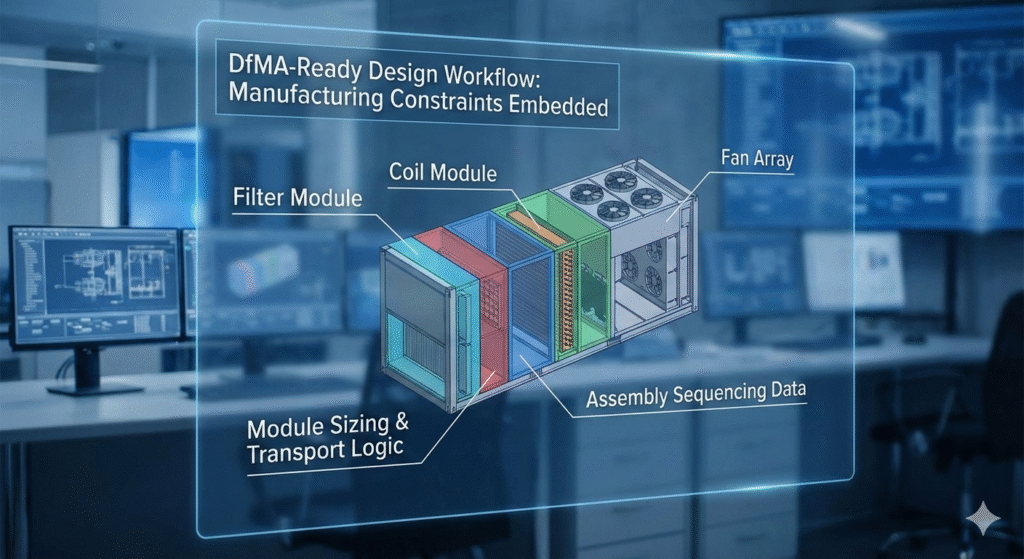
- Module size and transport limitations
- Design and access strategies for plant rooms
- MEP integration scope
- Sequence of installation
- Logic of handover for commissioning and operations
If design progresses while these considerations are absent, it is only a matter of time before modular execution shifts from a strategy to a reaction, and in doing so, creates risk instead of eliminating it.
By the time the manufacturing process is set in motion, lost time becomes a void from which recovery is simply not possible.
Developers of mission-critical facilities in the UK and USA are increasingly tasked with:
- Accelerating time-to-market
- Quickly scaling capacity
- Uptime and redundancy
- Capital risk
- Predictable delivery timelines
Why Modular Construction Alone Doesn’t Deliver Speed
Production acceleration through prefabrication occurs only when:
- Construction modules are designed with UK & USA manufacturing limitations in mind
- Standard interfaces between combined disciplines
- BIM models contain required construction and production intelligence
- Plans and strategies are constructed for logistics and lifting
- Design data includes construction sequences
Without DfMA-driven design for UK and USA modular data centers, modular construction becomes an isolated production activity rather than an integrated delivery strategy.
At DGTRA, we summarize it simply:
- A BIM model built only for visualization is a digital liability.
- A BIM model built for manufacturing and assembly is a delivery engine.
Common Design & Coordination Bottlenecks
Across data centers and complex facilities in the UK & USA, we observe the following recurring challenges:
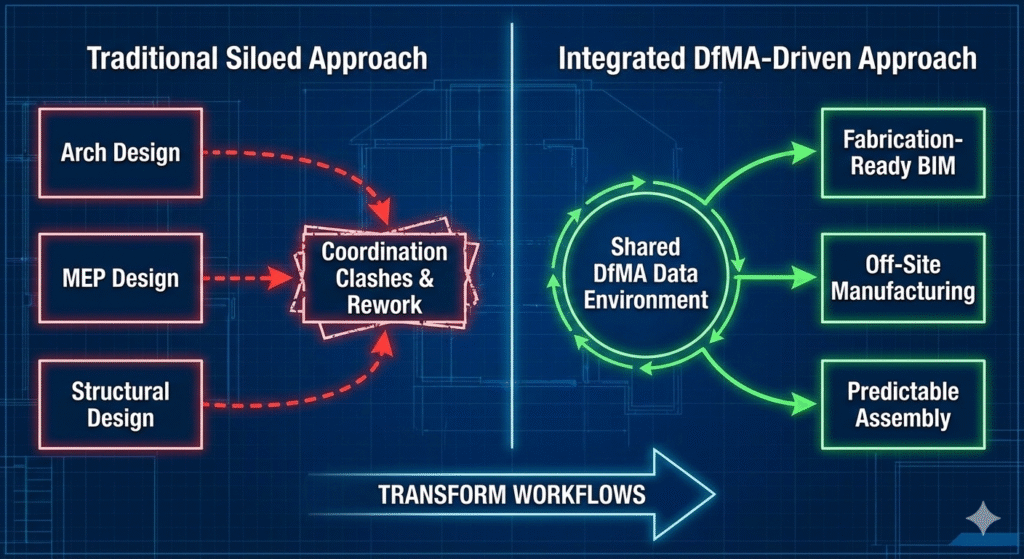
- Lack of coordination between the architectural, structural and MEP design
- Absence of modular logic when developing BIM
- Late involvement of fabricators
- Team data standards that lack uniformity
- Layouts for Technical Rooms That Cannot Be Repeated
- Exclusion of Design Commissioning Requirements
These are workflow and governance issues, not technological issues.
What DfMA-Ready Design Workflows Look Like
DfMA workflows integrate design, manufacturing, and construction from the outset.
- A modular approach is set at concept design.
- Design rules incorporate UK & USA manufacturing limitations.
- BIM serves as a manufacturing data backbone.
- Preliminary engagement with fabricators and installers.
- Uniform typologies for technical spaces and plant rooms.
- Design Logistics and Assembly planning is complemented by construction sequencing.
The Need for Integration
While mission-critical data centers in the UK & USA are being built, there is a need to integrate the BIM/VDC team along with MEP and systems designers, modular fabricators, construction and installation teams, and commissioning and operations teams.
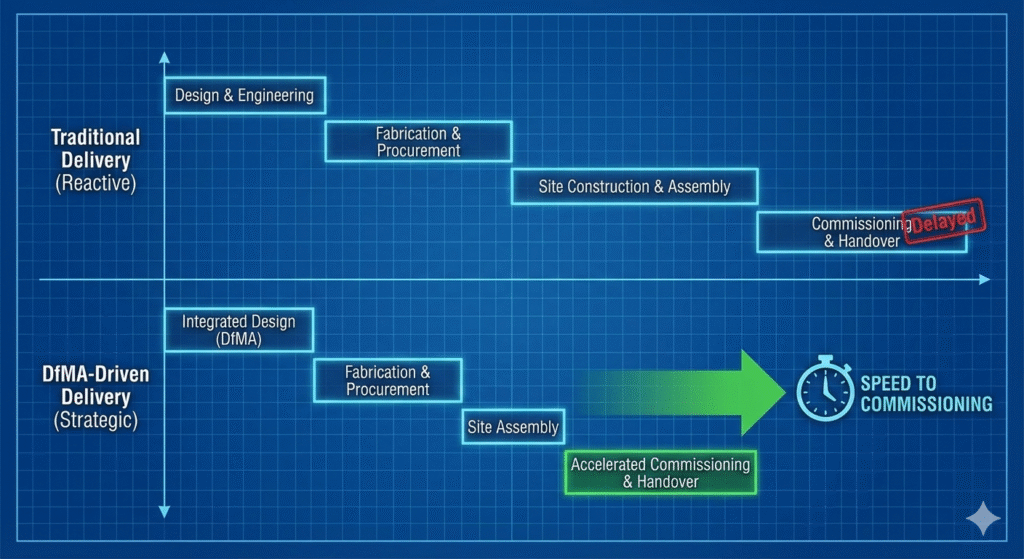
When all stakeholders work together in a DfMA environment, there is minimal rework, and procurement, factory production, and site installation are all optimized and sequenced — leading to accelerated commissioning.
The result is the ultimate “real speed” to commissioning and not just faster construction.
The Balancing Act of Standardization
When streamlining operations, a primary concern is that standardization will eliminate opportunities for flexibility. However, through systemized design, scalability is achieved.
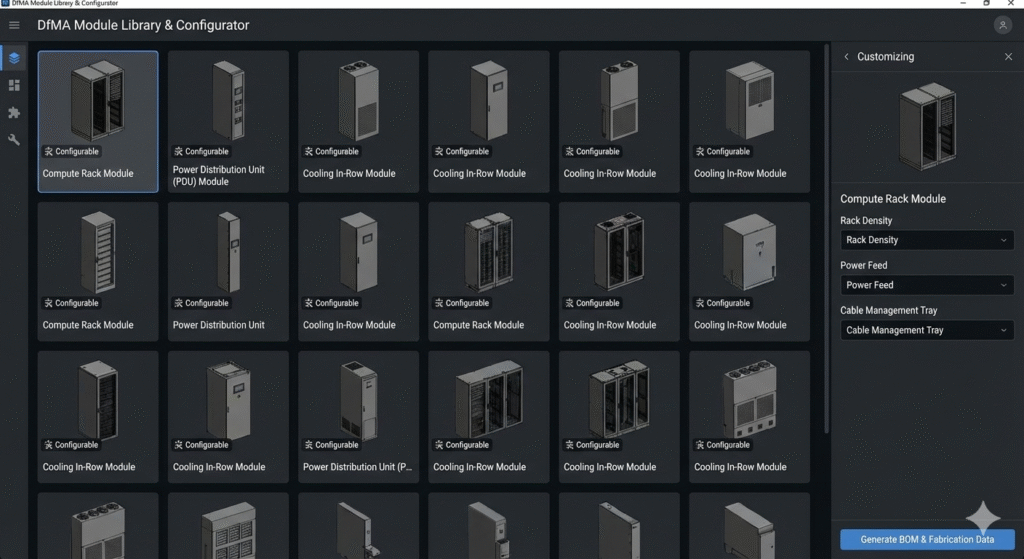
By creating repeatable module libraries, configurable design templates, and setting standards for interfaces and expandable frameworks, organizations can rapidly deploy new system designs to an operational capacity without a complete redesign — a key differentiator for DfMA-led construction in UK and USA data centers.
From an executive perspective, this provides lower design costs, faster replication, decreased program risk, and predictable performance outcomes.
The Business Impact
Projects that utilize DfMA-based design for data centers in the UK and USA can expect shorter design-to-factory cycles, no mid-production redesigns, faster procurement, and assembly on site. This leads to early revenue realization.
In environments where there is no room for downtime, DfMA becomes a strategic advantage in the UK and USA for mission-critical markets.
Why This Matters Now
The current global need for data centers in the UK & USA has created a surge in modular construction adoption, which is only part of the solution. To truly transform construction, design workflows must be addressed.
The ability to embed DfMA from the design phase will shape the next frontier in:
- Delivery speed
- Cost efficiency
- Operational reliability
- Growth potential
The design will dictate the future of mission-critical delivery, not construction sites.
Join DGTRA’s Upcoming Webinar
To assist industry leaders in closing the design-to-delivery gap, DGTRA will host an exclusive webinar for UK & USA Data Center professionals on Modular Strategies & Design Optimization for Data Centers & Complex Facilities.
What you will learn:
- Why modular construction does not guarantee faster delivery.
- Frequent design and coordination bottlenecks.
- DfMA-ready, first design workflows.
- Synchronizing the BIM, MEP, manufacturing, and construction.
Who should attend:
Data Center Design Managers, BIM/VDC Leads, Construction Managers, Program Directors, Operational Managers, and Modular Delivery Teams from the UK & USA regions.
👉 Registration is now open. Reserve your spot to learn how to embed DfMA in design for predictable and accelerated commissioning.
👉 Register Now: DGTRA Webinar
Final Thought
The method is modular construction. The multiplier is DfMA-driven design.
Those that shift design workflows today will dictate the speed, certainty, and scalability of mission-critical delivery in the UK and USA tomorrow.
DGTRA is turning DfMA theory into DfMA practice — Design to commissioning.