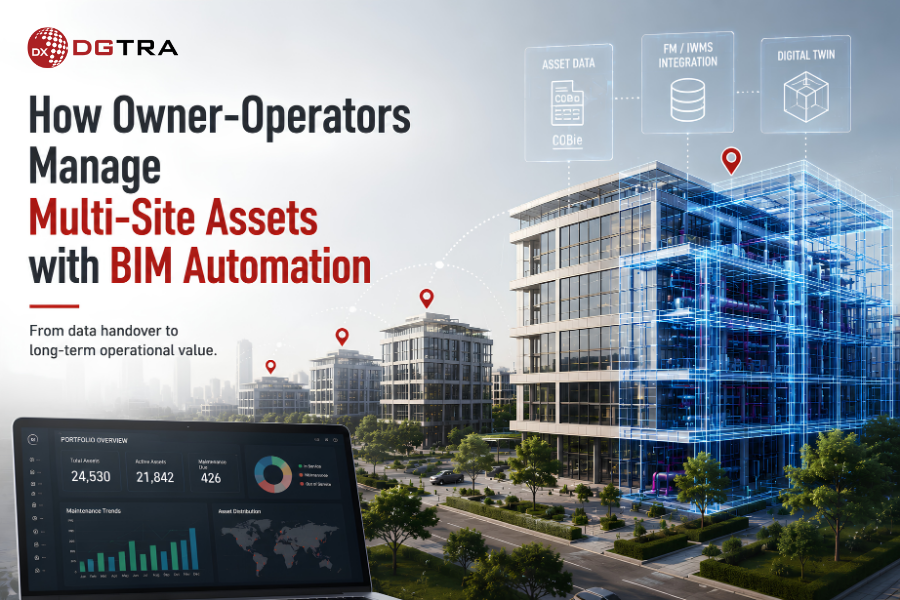
For real estate directors and institutional owner-operators managing multi-site portfolios, post-construction handover has traditionally resulted in the loss or underutilization of asset data.
At project completion, general contractors typically deliver a large set of disconnected PDFs, manual operation binders, and static as-built models. The internal operations team must then manually extract and enter data from these unlinked files to populate Computerized Maintenance Management Systems (CMMS) or Integrated Workplace Management Systems (IWMS), resulting in significant time and cost.
By the time asset data is manually entered, it is often already outdated.
According to global research by KPMG, leading organizations are no longer treating digital asset data as a peripheral post-project afterthought. Instead, a permanent shift is occurring, with forward-thinking facility owners scaling integrated data frameworks to secure long-term operational efficiency. Furthermore, a landmark study by the National Institute of Standards and Technology (NIST) discovered that inadequate software interoperability and fragmented handovers cost capital facility owners billions annually in baseline management friction. Crucially, the study noted that owners and operators bear two-thirds of these efficiency-loss costs during the ongoing operations and maintenance phase.
To address these financial losses, leading owner-operators are adopting BIM-based automation pipelines that convert static design files into dynamic asset management tools.
The Automated COBie Cleanse: Standardizing Across Portfolios
The main challenge in portfolio-wide asset management is data inconsistency. Varying contractor naming conventions result in unstandardized data across buildings.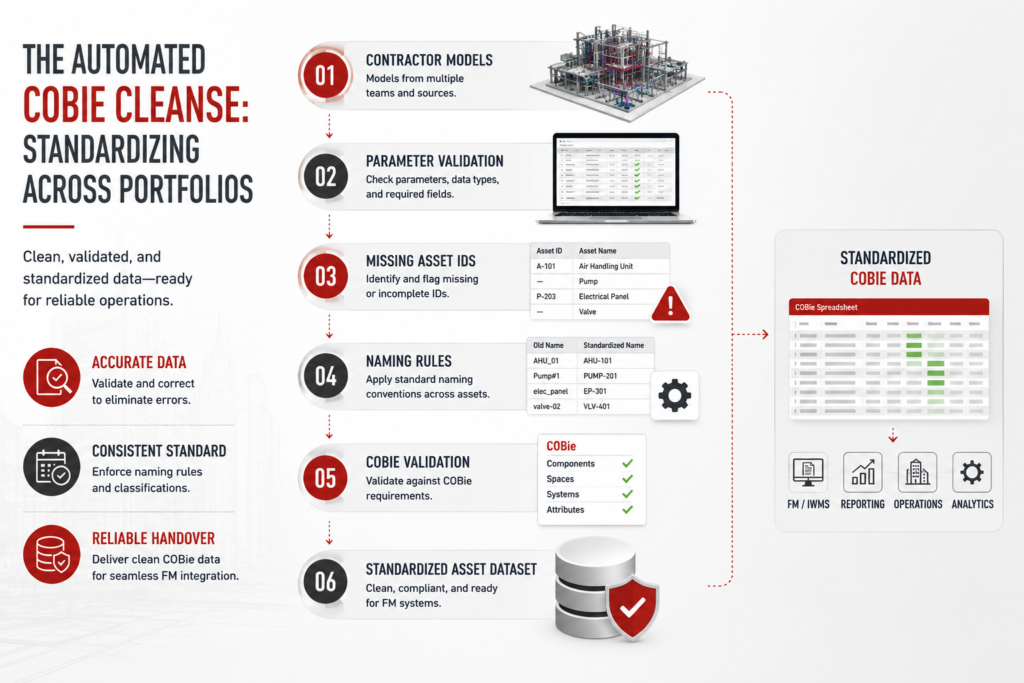
Although Construction Operations Building Information Exchange (COBie) provides a universal standard for asset data delivery, manually verifying thousands of data fields across multiple models is not feasible.
BIM automation solves this through rule-based data mapping scripts.
Before handover, automated validation pipelines scan contractor models to identify missing asset parameters, flag incorrect serial formats, and extract fully compliant COBie datasets. This process ensures that all assets across the portfolio follow a consistent, searchable digital blueprint.
Instant FM Handover: Eradicating the Data-Entry Mountain
Traditionally, integrating a new facility into operational management systems can take months. During this period, preventative maintenance tracking is unavailable, increasing the risk of equipment warranty lapses.
By leveraging custom API integrations, owners connect the BIM environment directly to operational software.
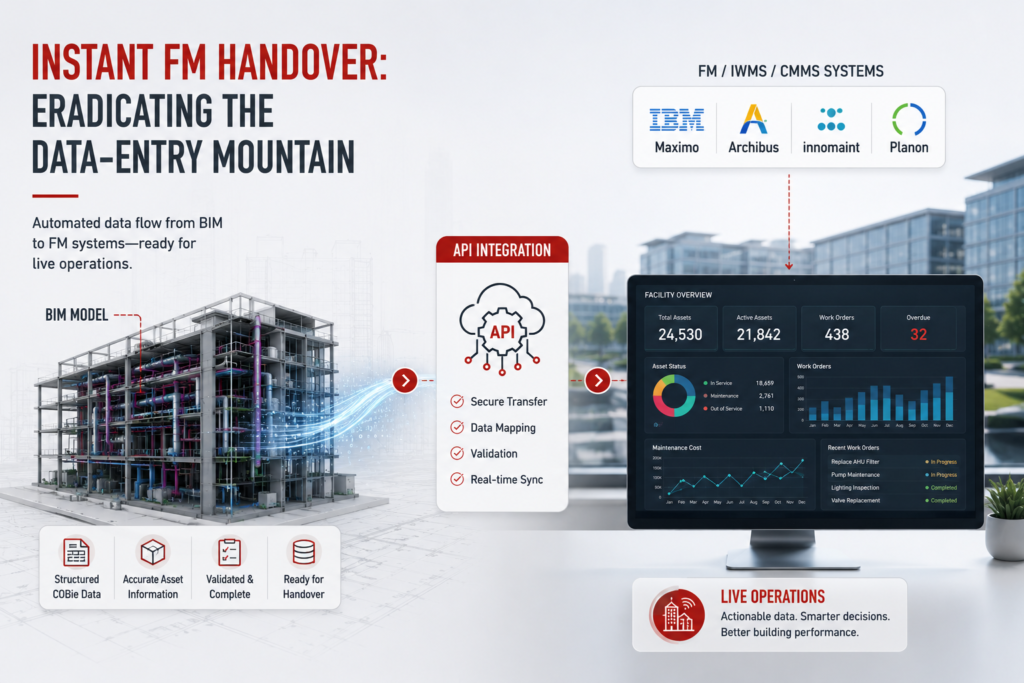
Automated scripts extract spatial coordinates, equipment classifications, warranty schedules, and parts lists from model metadata. This data is then automatically transferred into systems such as Maximo, Archibus, or proprietary databases.
The result is a significant reduction in handover cycles, from months to a single afternoon. Buildings become operational in dashboards immediately, protecting warranties and enabling instant maintenance visibility.
Automated Digital Twin Population: Fueling Smart Operations
A static 3D model shows only the building’s design. A true digital twin reflects current building performance.
Multi-site operators face the challenge of integrating IoT sensors, building management systems (BMS), and automated sub-meters into a cohesive system without custom-coding each asset connection.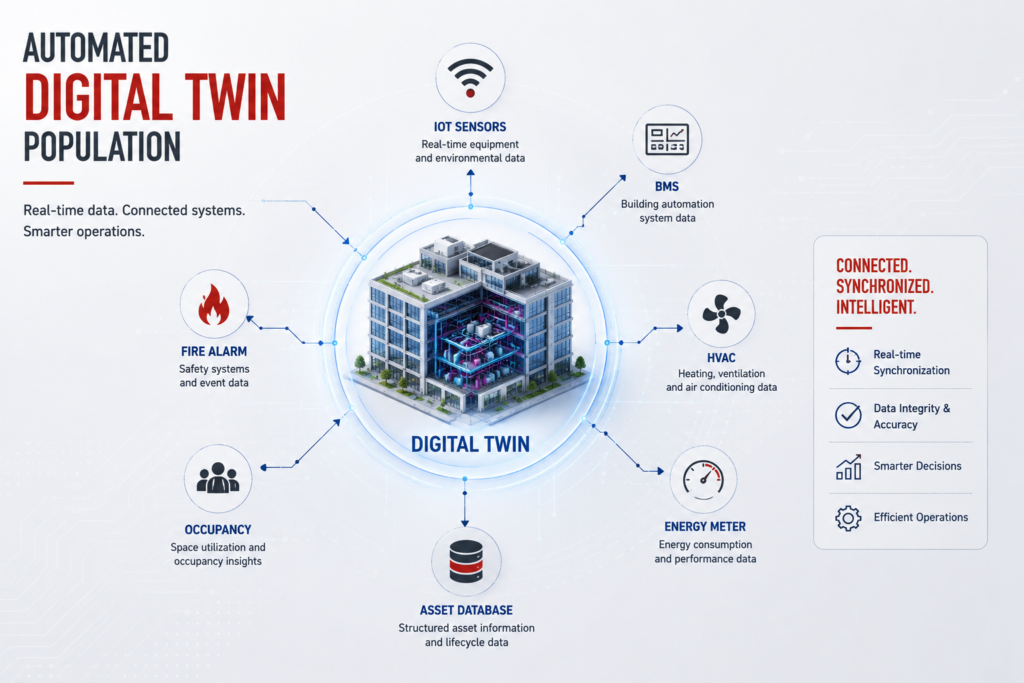
Automation pipelines serve as the connection point. Using open streaming data protocols, automation scripts dynamically link unique asset identifiers in the BIM model to the physical MAC addresses of real-time IoT sensors in the field.
When an automated script pairs a physical air handling unit with its digital counterpart, the digital twin becomes operational. Leadership gains a unified dashboard for predictive anomaly detection and automated energy optimization across millions of square feet.
The Strategic Bottom Line: Protecting Lifecycle Value
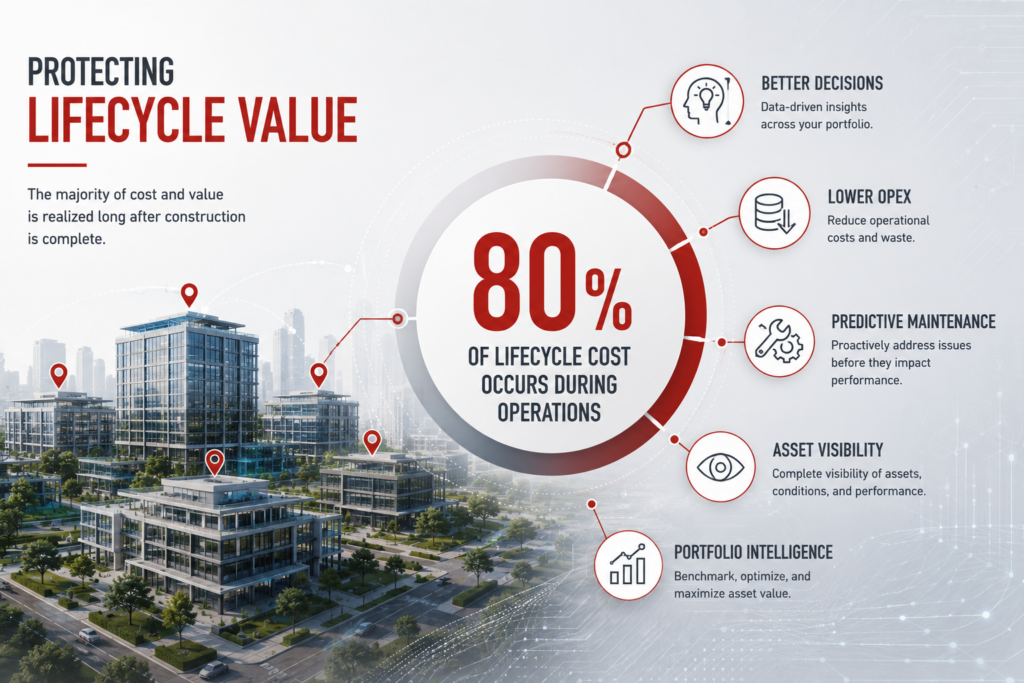
Up to 80% of a facility’s total lifecycle cost occurs during its operational phase, not construction. Treating a BIM model as only a construction deliverable overlooks its greatest financial value.
BIM automation enables owner-operators to control their data, reduce operational overhead, and make capital expenditure decisions based on live, aggregated portfolio data rather than guesswork.
At DGTRA Consultancy, we serve as dedicated owner-side digital delivery partners. We develop automation frameworks, define client information requirements, and engineer custom BIM Consulting & Management Solutions to convert construction handovers into operational digital assets.
Is your organizatioIs your organization still allowing asset data to remain trapped in static drawings?
DGTRA team today to establish an automated digital asset strategy for your real estate portfolio.
About DGTRA
DGTRA Consultancy Private Limited is a specialist digital engineering and BIM consulting company. We help owners, consultants, contractors, and EPC organizations improve project delivery through structured digital workflows and information management.
Our expertise includes BIM consulting and management, BIM automation, ISO 19650 information management, Common Data Environment (CDE) implementation, digital project delivery, scan-to-BIM, digital twins, and project controls.
We work across buildings, infrastructure, transportation, industrial facilities, healthcare, energy, data centres, and other complex engineering projects. Our goal is to help organizations strengthen collaboration, improve information quality, and build scalable digital delivery capabilities throughout the project lifecycle.