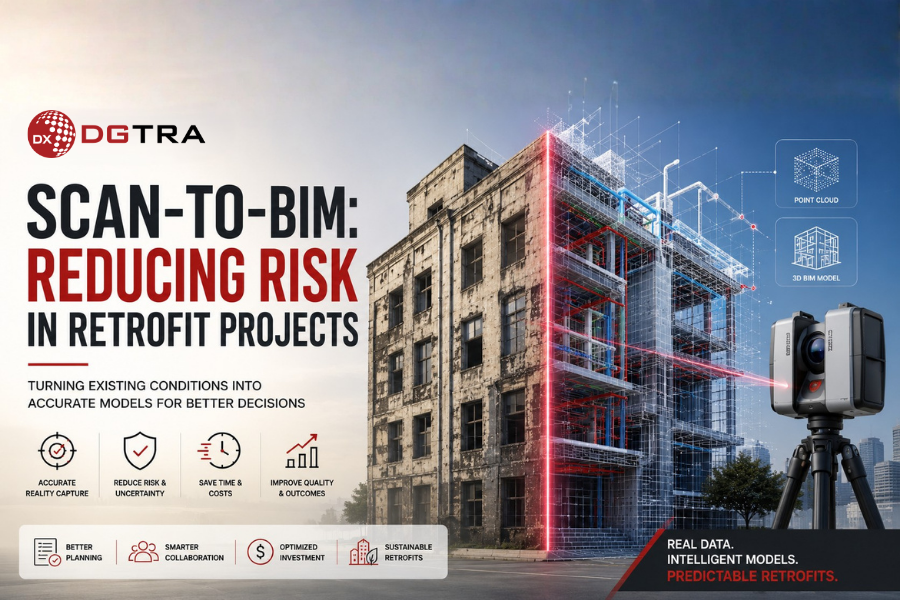
Reimagining an existing building is one of the most rewarding endeavors in modern architecture. Across major metropolitan hubs in India, historic quarters in the UK, and rapidly modernizing districts in the Middle East, retrofit projects represent a powerful intersection of heritage, sustainability, and technological innovation. When we choose to update and revitalize an established structure, we breathe new life into carbon-heavy assets, turning legacy materials into modern, high-performance environments.
In our previous discussion on Why Renovation Projects Excel with Accurate As-Built Data, we established that establishing an undeniable spatial baseline is the key to bypassing coordination friction. For complex retrofits, the next step is building a structured reality-capture framework that turns structural and MEP unknowns into precise engineering assets. Operating with this heightened level of physical certainty allows developers, design-build teams, and contractors to protect project margins, streamline compliance, and execute complex modernizations with complete peace of mind.
The Strategic Alignment of Retrofit Modernization
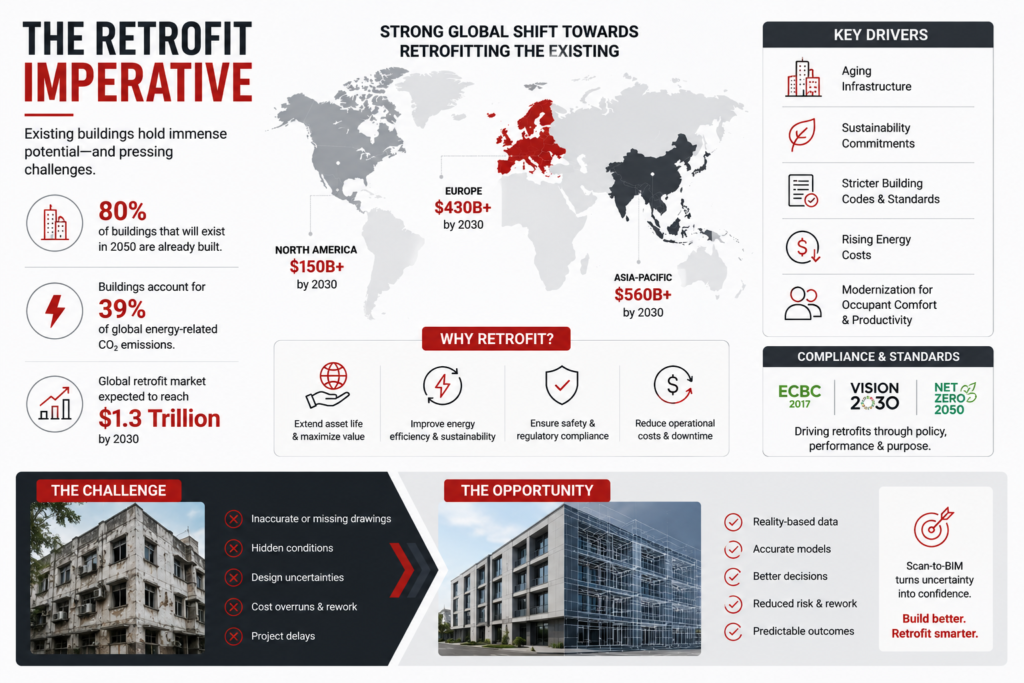
The global drive toward high-performance building upgrades are accelerating rapidly. According to the UNEP Global Status Report for Buildings and Construction 2025-2026, nearly half of the buildings that will exist in 2050 are already built, highlighting building renovation and energy-efficient retrofitting as major pillars of global urban resilience. At the same time, regional market dynamics—such as compliance demands under India’s evolving Energy Conservation Building Codes (ECBC) and Saudi Arabia’s ambitious Vision 2030 digital construction mandates—are encouraging AECO leaders to upgrade older structural envelopes into smart, energy-efficient spaces.
In this context, relying on speculative paper archives or unverified CAD files introduces avoidable execution variance. Buildings naturally settle over decades, structural columns deflect under load, and previous operational upgrades are rarely documented with millimetre accuracy.
By integrating modern BIM Consulting & Management early in your pre-construction phase, you transition from guesswork to mathematical precision. A 2026 market evaluation by Fortune Business Insights indicates that integrating cloud-based BIM systems with active design validation improves multidisciplinary coordination efficiency by upwards of 25%, allowing project teams to allocate resources with perfect clarity.
The De-Risking Pipeline: Elevating Brownfield Delivery
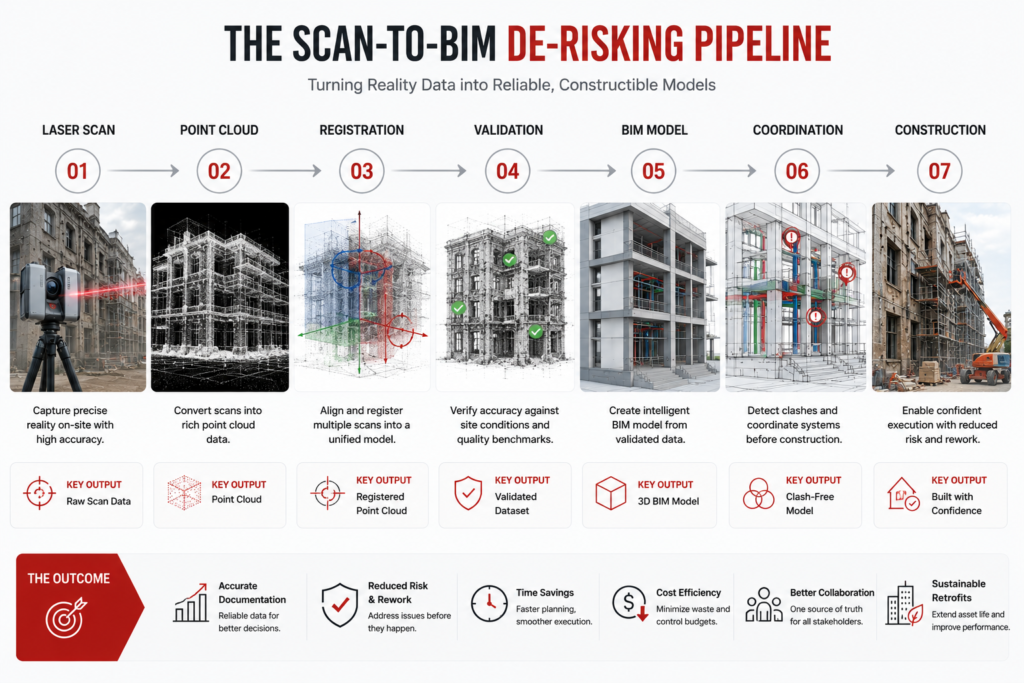
De-risking a complex retrofit is not about reacting to physical challenges as they appear on-site; it is about establishing a systematic, multi-stage data verification process. When we map building realities before finalizing design details, we replace uncertainty with actionable insights.
The structured Scan-to-BIM pipeline below shows how leading delivery teams align legacy conditions with modern digital requirements:
Enabling Seamless Prefabrication and Quality Assurance
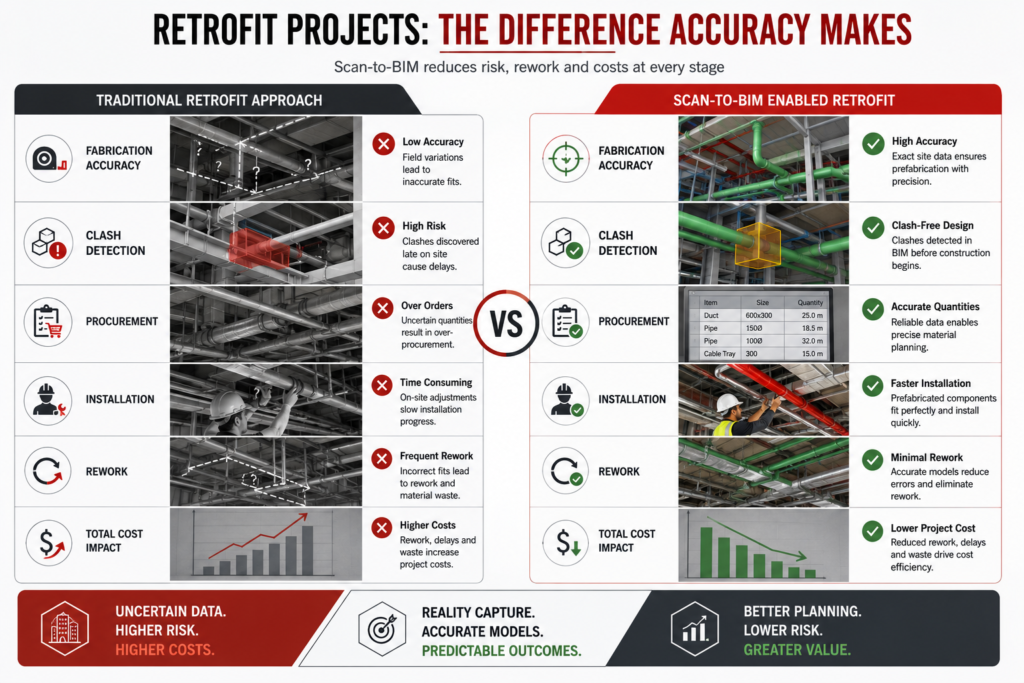
Starting your retrofit with high-accuracy spatial coordinates drastically improves procurement speed and offsite construction efficiency. In modern developments, pre-fabricating complex mechanical modules, structural reinforcement brackets, or custom facade panels offsite saves substantial time and minimizes material waste.
When your fabrication drawings are driven directly by a millimeter-accurate Scan-to-BIM model, you can proceed with the certainty that every component will install smoothly on-site.
This coordinated process ensures that multidisciplinary teams—from structural consultants to specialty HVAC installers—work from a single, verified data source. To explore how standardized information management frameworks streamline complex handovers across international borders, view our resource library on the DGTRA Insights Portal.
Linking Real-World Assets to Digital Twin Operations
Beyond the immediate advantages during design and construction, a precise Scan-to-BIM model serves as the digital bedrock for long-term operational excellence.
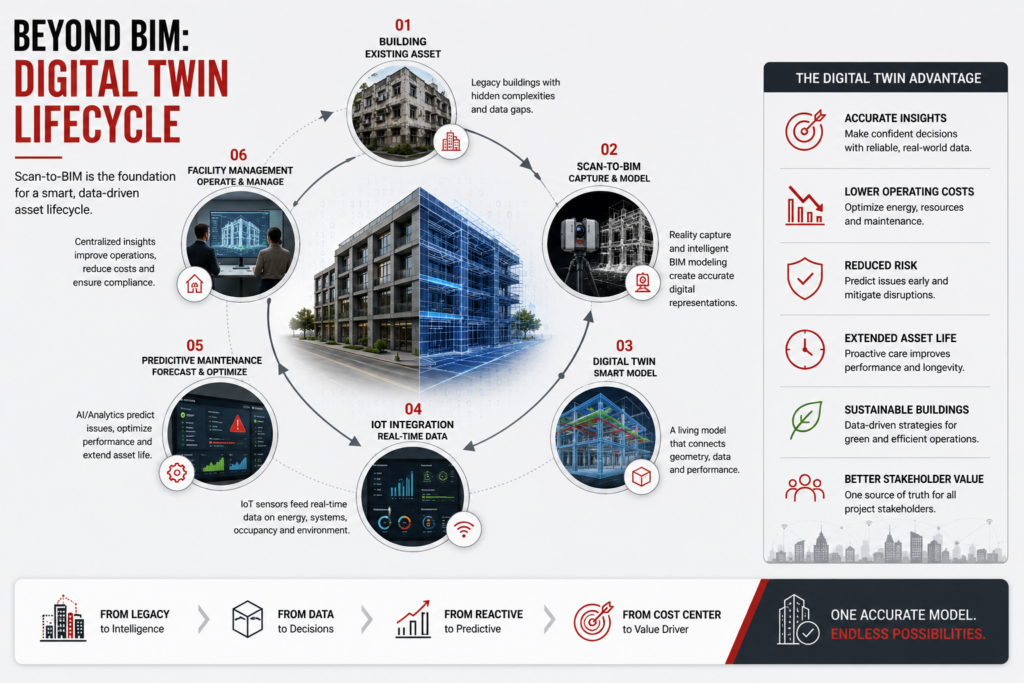
When the retrofit is complete, the as-built model transitions into a highly reliable database for Digital Twin Solutions. By linking real-world IoT sensor networks with the spatial architecture of your BIM model, asset managers can monitor energy consumption, track building occupant patterns, and perform predictive maintenance with maximum ease.
Register for Our Upcoming Technical Session
Ready to see how Scan-to-BIM workflows are implemented on active brownfield sites to optimize project margins? Register for our upcoming live webinar:
“What’s Hiding Behind Your Existing Drawings? How Scan-to-BIM Reduces Renovation Risk, Rework, and Costly Surprises.”
Learn directly from our senior digital engineers as they present real-world case studies on streamlining spatial validation and maximizing procurement margins.