
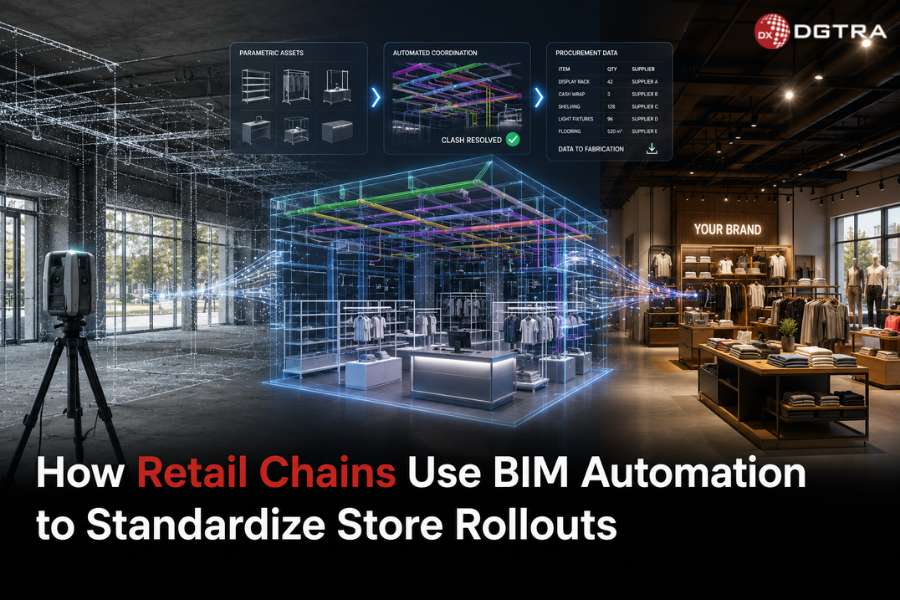
Automated MEP coordination for retail stores

From Common Data Environments to Connected Data Ecosystems
Previously, we discussed how Digital Twins, AI, and VDC are reshaping project delivery by protecting capital project margins through a continuous digital thread. Establishing this thread requires a fundamental change in how the AECO sector structures its data. The Common Data Environment (CDE) has long served as the single source of truth for design and construction documents. However, standard CDEs often remain isolated from broader enterprise systems, limiting their effectiveness. As asset portfolios become more complex, leading owner-operators are moving beyond static document hubs. The industry is shifting from traditional CDEs to integrated, dynamic Connected Data Ecosystems. 1. The CDE Evolution: Breaking the File-Centric Barrier Traditional CDEs were designed to manage files such as PDFs, 3D models, and spreadsheets. While effective for design coordination, this approach creates significant information bottlenecks during construction handover. Transitioning to a Connected Data Ecosystem shifts the focus from file management to managing individual data elements. Data is organized into structured, accessible points rather than isolated folders. This enables broader collaboration and allows the digital asset model to interact directly with external corporate software in real time. 2. Platform Interoperability: ERP, GIS, BMS, and CMMS Integration A connected data ecosystem eliminates silos between engineering data and enterprise systems. When BIM models integrate seamlessly with operational technology, the business value of digital data increases significantly. ERP Integration (Enterprise Resource Planning): Linking structured model components to financial tracking tools enables asset managers to compare planned lifecycle costs with real-time procurement and supply chain metrics. GIS Integration (Geographic Information Systems): Overlaying BIM assets onto spatial maps provides infrastructure operators with essential local context for transit, utility, and civil portfolios. BMS & CMMS Integration: Integrating data from Building Management Systems and Computerized Maintenance Management Systems enables facility teams to monitor real-time asset health within the 3D environment. 3. Information Governance: The Foundation of Digital Trust An ecosystem is only as reliable as its data. Without strict quality controls, a connected network can quickly propagate poor data. Robust information governance ensures all stakeholders follow automated data standards before information enters the ecosystem. This discipline relies on international benchmarks such as ISO 19650. Enforcing strict naming conventions, status codes, and automated validation rules transforms your environment into a reliable data gatekeeper. This governance removes subjective interpretation from data validation, ensuring only compliant information proceeds. 4. Designing a Capital Enterprise Data Strategy Transitioning to a modern data ecosystem means treating information as a valuable corporate asset, not just a project byproduct. A successful enterprise data strategy is built on three core principles: Strategic Pillar Focus Area Expected Outcome Open Standards Adopting vendor-neutral schemas like IFC and COBie Eliminates long-term proprietary software lock-in Automated Validation Deploying rule-based data checks inside the CDE Ensures absolute model accuracy before field execution Lifecycle Architecture Mapping operational needs during preconstruction Delivers a data ecosystem ready for operations on Day 1 Aligning engineering metrics with long-term operational goals helps your digital infrastructure protect project delivery margins and maximize facility value over its lifecycle. Build Your Connected Ecosystem with DGTRA Moving from a standalone file repository to a fully integrated data ecosystem requires specialized expertise. DGTRA Consultancy supports global AECO organizations in designing and deploying enterprise-grade information pipelines. From advanced CDE software advisory and implementation to robust data architecture for owner-operator digital solutions, we ensure your project data continuously maximizes asset predictability and value. Contact the DGTRA team today to transition your capital portfolio into an optimized, connected data ecosystem. Frequently Ask Quetions (FAQ) What is the difference between a CDE and a Connected Data Ecosystem? A traditional CDE focuses on centralizing and organizing static files (like PDFs and 3D models) during design and construction. A Connected Data Ecosystem links that structured model data directly to live enterprise systems like ERP, GIS, and facility management platforms, creating a dynamic, continuous loop of information. Why is ISO 19650 compliance critical for enterprise data integration? ISO 19650 provides the global blueprint for information governance. It defines exactly how data containers must be named, categorized, and validated. Adhering to these strict standards eliminates the risk of corrupted or disorganized data entering your broader enterprise ecosystem. Does a connected data ecosystem require replacing our existing corporate software? No. A proper ecosystem uses secure APIs and open data standards (like IFC) to bridge your existing platforms. DGTRA maps your structured construction model data directly to your current ERP, BMS, and CMMS tools, maximizing your current IT investments without disrupting daily operations. A traditional CDE focuses on centralizing and organizing static files (like PDFs and 3D models) during design and construction. A Connected Data Ecosystem links that structured model data directly to live enterprise systems like ERP, GIS, and facility management platforms, creating a dynamic, continuous loop of information. ISO 19650 provides the global blueprint for information governance. It defines exactly how data containers must be named, categorized, and validated. Adhering to these strict standards eliminates the risk of corrupted or disorganized data entering your broader enterprise ecosystem. No. A proper ecosystem uses secure APIs and open data standards (like IFC) to bridge your existing platforms. DGTRA maps your structured construction model data directly to your current ERP, BMS, and CMMS tools, maximizing your current IT investments without disrupting daily operations.
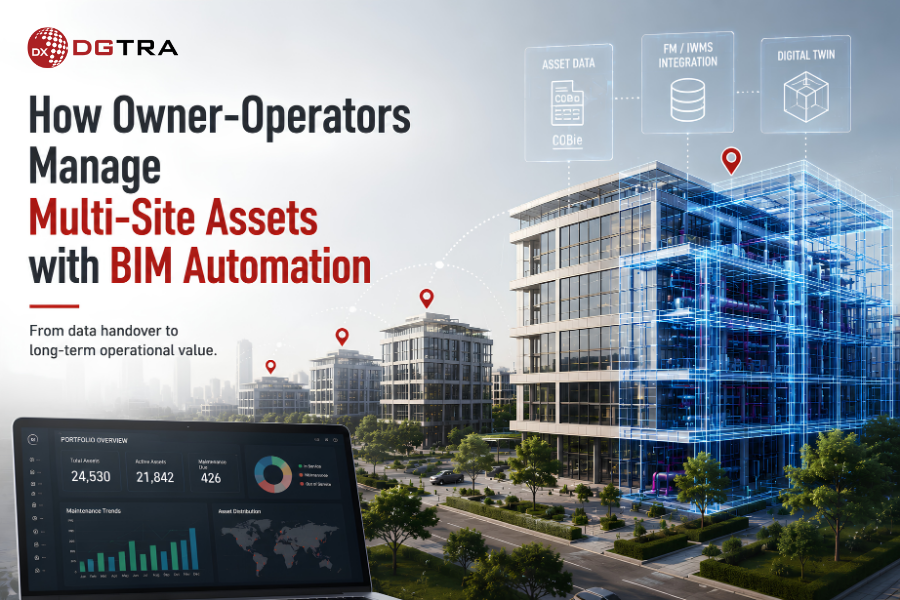
How Owner-Operators Manage Multi-Site Assets with BIM Automation
For real estate directors and institutional owner-operators managing multi-site portfolios, post-construction handover has traditionally resulted in the loss or underutilization of asset data. At project completion, general contractors typically deliver a large set of disconnected PDFs, manual operation binders, and static as-built models. The internal operations team must then manually extract and enter data from these unlinked files to populate Computerized Maintenance Management Systems (CMMS) or Integrated Workplace Management Systems (IWMS), resulting in significant time and cost. By the time asset data is manually entered, it is often already outdated. According to global research by KPMG, leading organizations are no longer treating digital asset data as a peripheral post-project afterthought. Instead, a permanent shift is occurring, with forward-thinking facility owners scaling integrated data frameworks to secure long-term operational efficiency. Furthermore, a landmark study by the National Institute of Standards and Technology (NIST) discovered that inadequate software interoperability and fragmented handovers cost capital facility owners billions annually in baseline management friction. Crucially, the study noted that owners and operators bear two-thirds of these efficiency-loss costs during the ongoing operations and maintenance phase. To address these financial losses, leading owner-operators are adopting BIM-based automation pipelines that convert static design files into dynamic asset management tools. The Automated COBie Cleanse: Standardizing Across Portfolios The main challenge in portfolio-wide asset management is data inconsistency. Varying contractor naming conventions result in unstandardized data across buildings. Although Construction Operations Building Information Exchange (COBie) provides a universal standard for asset data delivery, manually verifying thousands of data fields across multiple models is not feasible. BIM automation solves this through rule-based data mapping scripts. Before handover, automated validation pipelines scan contractor models to identify missing asset parameters, flag incorrect serial formats, and extract fully compliant COBie datasets. This process ensures that all assets across the portfolio follow a consistent, searchable digital blueprint. Instant FM Handover: Eradicating the Data-Entry Mountain Traditionally, integrating a new facility into operational management systems can take months. During this period, preventative maintenance tracking is unavailable, increasing the risk of equipment warranty lapses. By leveraging custom API integrations, owners connect the BIM environment directly to operational software. Automated scripts extract spatial coordinates, equipment classifications, warranty schedules, and parts lists from model metadata. This data is then automatically transferred into systems such as Maximo, Archibus, or proprietary databases. The result is a significant reduction in handover cycles, from months to a single afternoon. Buildings become operational in dashboards immediately, protecting warranties and enabling instant maintenance visibility. Automated Digital Twin Population: Fueling Smart Operations A static 3D model shows only the building’s design. A true digital twin reflects current building performance. Multi-site operators face the challenge of integrating IoT sensors, building management systems (BMS), and automated sub-meters into a cohesive system without custom-coding each asset connection. Automation pipelines serve as the connection point. Using open streaming data protocols, automation scripts dynamically link unique asset identifiers in the BIM model to the physical MAC addresses of real-time IoT sensors in the field. When an automated script pairs a physical air handling unit with its digital counterpart, the digital twin becomes operational. Leadership gains a unified dashboard for predictive anomaly detection and automated energy optimization across millions of square feet. The Strategic Bottom Line: Protecting Lifecycle Value Up to 80% of a facility’s total lifecycle cost occurs during its operational phase, not construction. Treating a BIM model as only a construction deliverable overlooks its greatest financial value. BIM automation enables owner-operators to control their data, reduce operational overhead, and make capital expenditure decisions based on live, aggregated portfolio data rather than guesswork. At DGTRA Consultancy, we serve as dedicated owner-side digital delivery partners. We develop automation frameworks, define client information requirements, and engineer custom BIM Consulting & Management Solutions to convert construction handovers into operational digital assets. Is your organizatioIs your organization still allowing asset data to remain trapped in static drawings? DGTRA team today to establish an automated digital asset strategy for your real estate portfolio. About DGTRA DGTRA Consultancy Private Limited is a specialist digital engineering and BIM consulting company. We help owners, consultants, contractors, and EPC organizations improve project delivery through structured digital workflows and information management. Our expertise includes BIM consulting and management, BIM automation, ISO 19650 information management, Common Data Environment (CDE) implementation, digital project delivery, scan-to-BIM, digital twins, and project controls. We work across buildings, infrastructure, transportation, industrial facilities, healthcare, energy, data centres, and other complex engineering projects. Our goal is to help organizations strengthen collaboration, improve information quality, and build scalable digital delivery capabilities throughout the project lifecycle. Frequently Ask Quetions (FAQ) Does COBie require a 3D BIM model to work? No. COBie is purely data, not geometry. While it is usually exported directly from software like Revit, you can technically build a COBie sheet in Excel by hand. It cares about what the equipment is and where it is, not what it looks like in 3D. If it’s just an Excel sheet, why can’t we just make our own? Because custom spreadsheets lack a unified schema. COBie’s strict, standardized column headers and tab structures are universally readable. Because it follows an exact international standard, major facility management platforms (like Maximo or Archibus) can ingest it automatically with zero custom mapping. Who is actually responsible for entering the COBie data? It’s a relay race. Designers populate spatial data (floors, spaces, types) during design. Contractors fill in the dynamic asset metadata (serial numbers, installation dates, warranties) during construction. The BIM manager or VDC consultant typically orchestrates the final verification. What is the difference between COBie and IFC? IFC (Industry Foundation Classes) handles everything in a building model, including complex 3D shapes, walls, and geometry. COBie is a subset of IFC that completely strips away the heavy 3D visuals, focusing strictly on the lightweight text and numbers needed to run operations. Why do so many COBie handovers fail if it’s standardized? Because of “garbage in, garbage out.” If drafting teams don’t populate the parameters inside Revit correctly during design, the automated COBie export
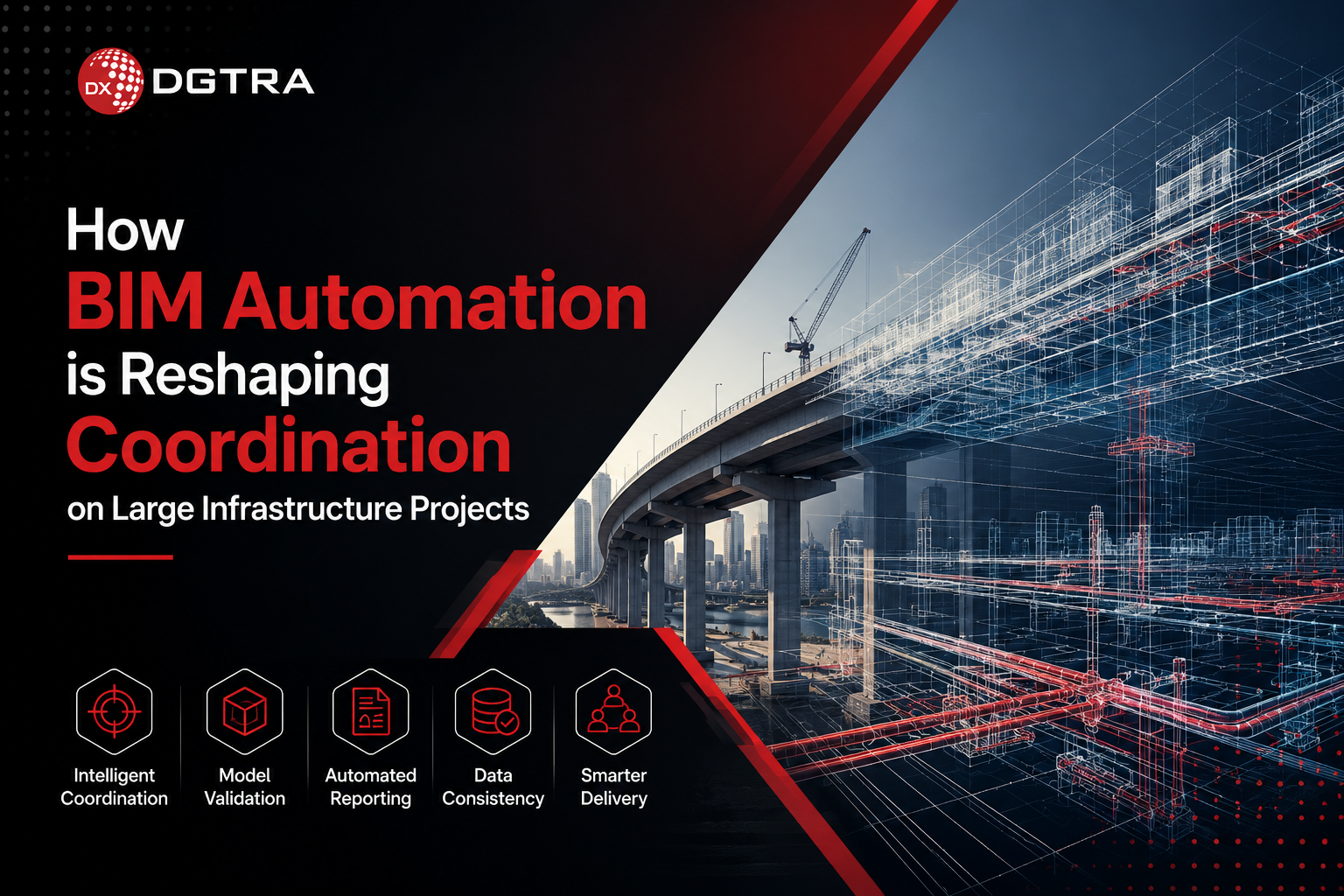
How BIM Automation is Reshaping Coordination on Large Infrastructure Projects
Large-scale infrastructure projects are highly complex, requiring ongoing coordination and structured information management across transit networks, utilities, structural systems, and multidisciplinary teams. However, many teams still face a common issue: skilled engineers spend significant time on repetitive coordination tasks rather than addressing engineering challenges. For Engineering, Procurement, and Construction (EPC) leaders, traditional coordination cycles often create operational bottlenecks. Teams may spend days or even weeks reviewing clashes, validating models, preparing reports, and managing information across stakeholders, which can delay project schedules and affect delivery performance. According to the RICS Global Construction Productivity Report, improving productivity remains one of the industry’s biggest priorities, encouraging organizations to rethink how engineering workflows are executed rather than simply adding more resources. Similarly, McKinsey & Company highlights that sustainable performance gains come from simplifying processes, improving organizational coordination, and strategically applying automation—not from technology alone. Leading infrastructure organizations are embedding BIM automation into digital delivery workflows. By using model checking, automated reporting, computational design, and intelligent coordination, teams reduce manual effort and improve consistency, information quality, and project delivery. Moving Beyond Manual Clash Detection Traditional clash detection is labor-intensive. Typical workflows require running a matrix in Navisworks, generating a large backlog of conflicts, and spending days manually distinguishing critical structural clashes from minor geometric overlaps, such as a small pipe intersecting a planned wall sleeve. Automation introduces intelligent filtering within the model environment. Using custom Dynamo scripts, Python automation, or Revit APIs, teams can automatically filter false positives based on project-specific design tolerances and object attributes. Instead of requiring coordinators to manually review and assign each conflict, custom logic groups issues by element ID, priority, or subcontractor trade, and routes actionable information directly to the relevant design teams. The result is not only faster clash detection but also a shift in coordination meetings from data review to engineering decision-making. Model-Checking Scripts: Guarding Data Integrity An infrastructure model’s value depends on the quality of its underlying information. Missing Asset IDs or critical metadata for transportation assets or utilities reduce the model’s usefulness well before handover. Manual validation of hundreds of thousands of model elements is neither efficient nor scalable. Modern project teams use automated model-checking scripts to continuously verify model health, parameter completeness, object classification, naming conventions, and compliance with project standards. When scripts detect missing parameters or inconsistencies, they flag them immediately in the BIM environment, enabling design teams to resolve issues before they affect downstream processes. This approach aligns closely with the evolving principles of ISO 19650, where structured information management is becoming just as important as model geometry. Learn more about our BIM Consulting & Management services: BIM Automation Is Also Information Management The discussion around BIM automation is evolving. Automation now extends beyond model creation and repetitive drafting. It is increasingly used to improve information quality, standardize workflows, and support structured digital delivery throughout the project lifecycle. This reflects the broader direction of the upcoming ISO 19650 revisions, which place greater emphasis on information management, connected workflows, and lifecycle thinking rather than BIM deliverables alone. As organizations advance digitally, automation becomes essential for consistent information management, not just engineering efficiency. Automated Report Generation: Closing the Communication Loop On large infrastructure projects, the main challenge is often not identifying design issues but communicating them efficiently across multiple stakeholders. Manually capturing screenshots, updating issue logs, preparing coordination reports, and distributing updates consumes valuable engineering hours. Automated reporting addresses this by connecting live BIM models with project management platforms using APIs and workflow automation. A single workflow enables teams to generate structured coordination reports, assign issues automatically, update dashboards, and notify responsible disciplines. Everyone receives the same information at the same time. By reducing communication delays, automation strengthens project governance and supports more effective project control management throughout delivery. Measuring the Value Beyond Automation The success of BIM automation should not be measured by the number of scripts created. It should be measured by business outcomes. The greatest value lies in enabling engineering teams to focus more on design coordination, technical decision-making, and project optimization. Engineering Time Is Too Valuable to Waste In major infrastructure projects, each coordination cycle affects schedule, cost, and delivery certainty. BIM automation is not about replacing engineering expertise. It is about eliminating repetitive digital tasks so engineers can address complex project challenges, improve constructability, and deliver higher-quality outcomes. Contractors and EPC organizations implement practical BIM automation strategies through custom workflows, Revit API development, Dynamo scripting, Information Management, and BIM Consulting & Management services that align with long-term digital delivery objectives. As infrastructure projects become more complex, organizations that automate routine processes and enable engineering teams to focus on higher-value work will gain a competitive advantage. About DGTRA DGTRA Consultancy Private Limited is a specialist digital engineering and BIM consulting company. We help owners, consultants, contractors, and EPC organizations improve project delivery through structured digital workflows and information management. Our expertise includes BIM consulting and management, BIM automation, ISO 19650 information management, Common Data Environment (CDE) implementation, digital project delivery, scan-to-BIM, digital twins, and project controls. We work across buildings, infrastructure, transportation, industrial facilities, healthcare, energy, data centres, and other complex engineering projects. Our goal is to help organizations strengthen collaboration, improve information quality, and build scalable digital delivery capabilities throughout the project lifecycle. Are you looking to optimize your BIM workflows? From BIM Automation to ISO 19650, DGTFrom BIM automation to ISO 19650, DGTRA helps organizations enhance digital project delivery. Which BIM workflows should organizations automate first? Start with repetitive, rule-based tasks such as clash detection, model validation, coordination reporting, and parameter verification. These typically deliver the quickest operational gains. How does BIM automation improve project coordination? Automation streamlines model reviews, standardizes reporting, and reduces manual coordination tasks, allowing project teams to focus on technical decisions rather than administrative work. Can BIM automation support ISO 19650 implementation? Yes. Automated workflows help maintain consistent information, validate project standards, and improve structured information management throughout the asset lifecycle. Which technologies are commonly used for BIM automation? Organizations commonly use Dynamo, Revit APIs, Python, Autodesk Platform Services (APS), and CDE integrations to automate engineering workflows. Is BIM automation only valuable for large infrastructure projects? No. While large projects benefit significantly, any organization with repetitive BIM workflows can improve efficiency, consistency, and
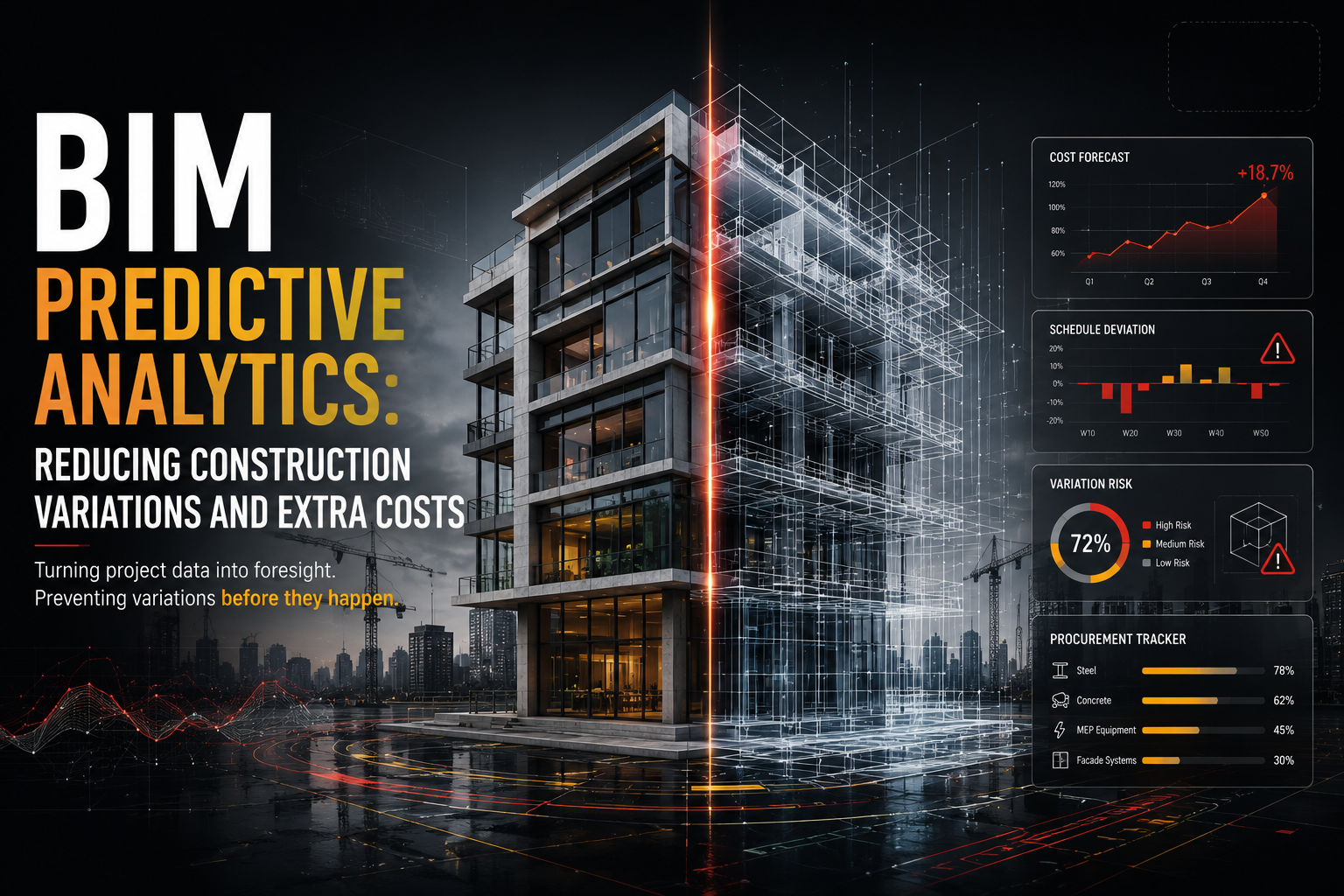
BIM Predictive Analytics: Reducing Construction Variations and Extra Costs
The Variation Was Written into the Project Three Months Before Anyone Saw It. That is the uncomfortable truth most construction cost control processes are not designed to surface. By the time a variation instruction lands on a project manager’s desk, the decision that caused it was made weeks — sometimes months — earlier. A structural system chosen without full constructability validation. An MEP routing was approved against an incomplete federated BIM model. A procurement timeline set without scenario analysis against the construction sequence. The variation was not a surprise. It was a predictable outcome of a decision made without the right data at the right time. This is what BIM predictive analytics is designed to solve. Not by catching problems faster — but by building the data visibility that makes those decisions differently in the first place. This blog builds on the frameworks explored in How AI Is Reshaping BIM Workflows for AEC Firms, BIM 6.0: Why Sustainability Is the New Sixth Dimension of Construction, and How to Move Your AEC Team Toward Integrated Delivery Maturity — bringing predictive analytics to bear on one of the most persistent and costly challenges in AEC project delivery. Why Traditional Cost Control Is Structurally Limited Most construction cost management frameworks share a common architecture — they measure what has happened and report it. Budget versus actual. Planned versus earned. Forecast at completion based on current burn rate. These are all retrospective instruments. They describe the past with varying degrees of accuracy. And they consistently fail to answer the question that matters most on a live project — what is about to happen, and what can we do about it right now? Research validating an integrated 4D/5D Digital Twin framework for predictive construction control found that industry data shows consistent average cost overruns above 20% and schedule deviations approaching 30% — with traditional deterministic CPM and document-based estimating identified as key contributors, as these approaches seldom reflect the uncertainty and interdependence of modern projects once execution begins. (Source: arXiv, 4D/5D Digital Twin Predictive Control 2025 →) Taylor & Francis Online Those numbers — 20% cost overrun, 30% schedule deviation — have been consistent across the industry for decades. The tools have changed. The outcomes have not. Because the tools have been getting better at describing the problem rather than preventing it. BIM predictive analytics is a distinct capability category. It is not a better version of cost reporting. It is fundamentally different from the relationship between project data and project decisions. The Distinction That Changes Everything Here is the framing most blogs on this topic miss. Predictive analytics is not about having more data. Every large AEC project generates enormous volumes of data — model files, RFIs, variation logs, progress reports, procurement records. The data has never been the problem. The problem is that most of that data sits in disconnected silos — the BIM model in one environment, cost data in another, schedule data in a third, procurement in a fourth. None of them talks to each other in real time. And none of it is structured in a way that allows patterns to be identified before they become problems. BIM predictive analytics works by connecting those silos — through a well-governed Common Data Environment and a 4D/5D BIM workflow that unifies model, cost, and schedule data — and then applying statistical and machine learning models to that dataset to identify leading indicators of cost variance and variation risk. The output is not a better report. It is earlier, more precise decision-making — at the point in the project where decisions are still affordable to make. Where Predictive Analytics Delivers Its Highest Value Early in Design — When Carbon and Cost Decisions Are Still Reversible The highest-leverage application of BIM predictive analytics is the one most teams skip entirely — early-stage design cost modeling. Research published in Scientific Reports on BIM-integrated neural network cost prediction 2025 found that AI-powered models can forecast material price fluctuations across different construction seasons — enabling procurement teams to optimize timing and contingency allocation, and effectively control hidden cost overrun risks before they surface during construction execution. When machine learning cost models are trained on structured historical project data and integrated with the BIM model from the earliest design stage, structural system selection, envelope specification, and MEP strategy decisions all carry predicted cost consequences — visible before they are committed. This is also where BIM predictive analytics intersects most directly with the 6D BIM sustainability framework explored in BIM 6.0: Why Sustainability Is the New Sixth Dimension of Construction. When cost prediction and embodied carbon tracking run from the same model at the same stage, the team makes genuinely integrated decisions rather than optimizing one dimension at the expense of another. During Pre-Construction — When Sequencing Locks In Risk 4D BIM construction sequencing is one of the most underutilized tools for variation prevention available to delivery teams. When the construction program is simulated against the federated model before mobilization, the conflicts that generate variations — spatial clashes, trade sequencing dependencies, access constraints, and procurement lead-time misalignments — are visible before the site team encounters them. The key technical distinction — and the one most implementations miss — is that 4D simulation is only as reliable as the model it runs on. A sequencing simulation built on a model with LOD mismatches, incomplete MEP coordination, or unresolved structural interfaces does not predict site conditions. It predicts an idealized version of the project that does not exist. This is why DGTRA’s Constructability Reviews validate models for buildability and sequencing logic before 4D predictive simulation runs — and why How to Validate BIM Models Before Construction Begins is a foundational read before any organization invests in 4D predictive planning. During Construction — When Variation Risk Is Highest The most immediate and operationally valuable application of BIM predictive analytics is live scenario analysis during construction — using the model to quantify the cost and schedule impact of emerging variations before a response decision is made. When a design change is proposed, a procurement delay surfaces, or a site condition differs from design assumptions, BIM-based what-if modeling allows the project team to evaluate multiple response paths simultaneously —
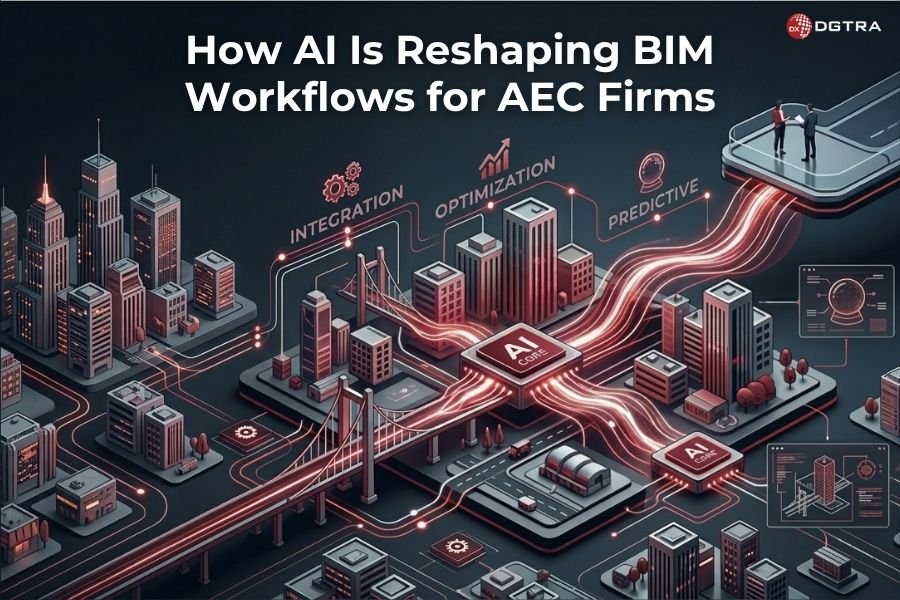
How AI Is Transforming BIM Workflows and AEC Competitive Advantage
How AI Is Reshaping BIM Workflows for AEC Firms The Model Has Always Been Smarter Than the Workflow Around It. For years, BIM models have contained more data than project teams could leverage. Geometry, specifications, quantities, schedules, and costs have been available in the federated model, but lacked a process to unlock their full value. Artificial Intelligence now provides that process. AI is not about replacing people. It is about elevating project delivery by aligning model intelligence with equally intelligent workflows. In our previous blog — BIM 6.0: Why Sustainability Is the New Sixth Dimension of Construction — we established that forward-looking delivery organizations are embedding new dimensions of intelligence into their models. AI is the engine that makes those dimensions actionable. What the Research Tells Us Performance data on AI-BIM integration is increasing, and the trends are consistent across studies. A systematic review published in Applied Sciences analyzing 1,212 studies on AI-BIM integration between 2022 and 2025 identified five primary BIM application domains where AI is delivering measurable outcomes — BIM modeling, 4D/5D planning, CDE management, clash detection, and Digital Twin development — with machine learning and deep learning emerging as the most impactful AI families across all five. (Source: Applied Sciences, MDPI — AI-BIM Systematic Review 2025 →) Research published in the Journal of Umm Al-Qura University for Engineering and Architecture examining AI-BIM integration found significant improvements across construction methodologies — including enhanced design automation, measurable reductions in coordination conflicts, and improved construction scheduling outcomes — with buildingSMART International identified as a key body for developing standardized AI-BIM validation protocols. The research is clear: AI in BIM delivers measurable improvements, but only when model data, workflow standards, and process foundations are structured to support it. Five Areas Where AI Is Reshaping BIM Delivery Intelligent Clash Detection and Coordination Traditional clash detection is reactive, performed after modeling and generating large reports that require extensive human review. AI-powered clash detection shifts this approach, enabling more efficient and targeted coordination. Research published in ScienceDirect on automating clash relevance filtering using machine learning found that AI-enhanced coordination systems — built on Navisworks and trained on historical project data — can autonomously classify, prioritize, and filter clashes by relevance, reducing the volume requiring human review and enabling coordination teams to focus on genuinely complex interface decisions that require strategic resolution. AI clash detection performance depends on the quality of the model’s data. Poor LOD alignment, inconsistent classification, or incomplete semantic data lead to weak AI outputs. Investing in model quality and classification consistency through a clear BIM Execution Plan is essential to realize the full value of AI-powered coordination. This connects directly to the coordination maturity framework in How to Move Your AEC Team Toward Integrated Delivery Maturity. DGTRA’s Design & Trade Coordination service is built around exactly this principle. 2. Generative Design and Early-Stage Optimization Generative design uses parametric optimization and AI algorithms to evaluate many design options against defined objectives such as cost, space efficiency, structural performance, and energy use. This process operates at a speed that manual workflows cannot match. Research presented at the 2025 ACM Computers and People Research Conference found that generative design tools analyze site conditions, zoning regulations, and project requirements to produce multiple optimized design options in parallel — significantly compressing early design timelines and reducing downstream coordination conflicts. The quality of generative design outputs depends on how precisely the delivery team defines objective functions from the start. Including embodied carbon targets in a 6D BIM workflow ensures that early-stage sustainability decisions are made based on data, not assumptions. This aligns with the principles outlined in BIM 6.0: Why Sustainability Is the New Sixth Dimension of Construction. 3. Predictive Analytics and Risk Management AI-powered predictive analytics provides project teams with early visibility into risk by leveraging machine learning models trained on structured historical project data. This approach identifies warning signals before they impact the schedule or cost. Research published in Applied Sciences found that AI-driven real-time predictive analytics significantly reduces the risk of project delays — and, separately, that AI-IoT sensor integration in site safety monitoring reduced workplace accidents by 30% across monitored construction environments. (Source: Applied Sciences, MDPI — AI in BIM Transformation 2025 →) The safety outcome specifically relates to AI-IoT site monitoring, which is separate from BIM-based predictive analytics, though both are part of the broader AI-construction ecosystem. For BIM-based risk analytics, value increases with the quality and structure of historical project data used for model training. Organizations with well-governed Common Data Environments and consistent data standards are better positioned to realize this capability. DGTRA’s BIM Project Management service embeds data-driven governance into live project delivery — building the data foundation that makes predictive analytics increasingly valuable over successive project cycles. 4. Automated Quantity Take-Off and Cost Intelligence AI-driven QTO delivers quantity extractions and cost projections faster and more consistently than manual estimation. Outputs are not dependent on individual estimator experience and update automatically as the model evolves. The accuracy of AI-generated quantity extractions depends directly on model LOD consistency and alignment with classification systems, such as Uniclass, OmniClass, or project-specific systems. A well-classified model at the right LOD produces reliable AI-driven QTO. A model without those foundations produces outputs that require significant manual correction. With a strong data foundation, cost intelligence shifts from a periodic milestone to a live design input. This enables real-time cost comparison across design options, which manual estimation cannot sustain over multiple iterations. 5. AI-Powered Digital Twins for Operations The most comprehensive application of AI in BIM is the intelligent Digital Twin — where the model becomes a live operational asset that learns and adapts based on real-time sensor data throughout the building’s operational life. It is important to clarify this transition. The construction BIM model and the operational Digital Twin are different assets. Moving from one to the other requires deliberate data preparation at handover, including LOD adjustment, asset data structuring, and integration with building management systems. A well-configured CDE and clearly defined Asset Information Requirements are critical at this stage. Research published in Applied Sciences found that, in the operational phase, AI enables intelligent building management through predictive analysis, operational scenario simulation, and energy performance optimization, transforming the static handover model into a continuously improving operational
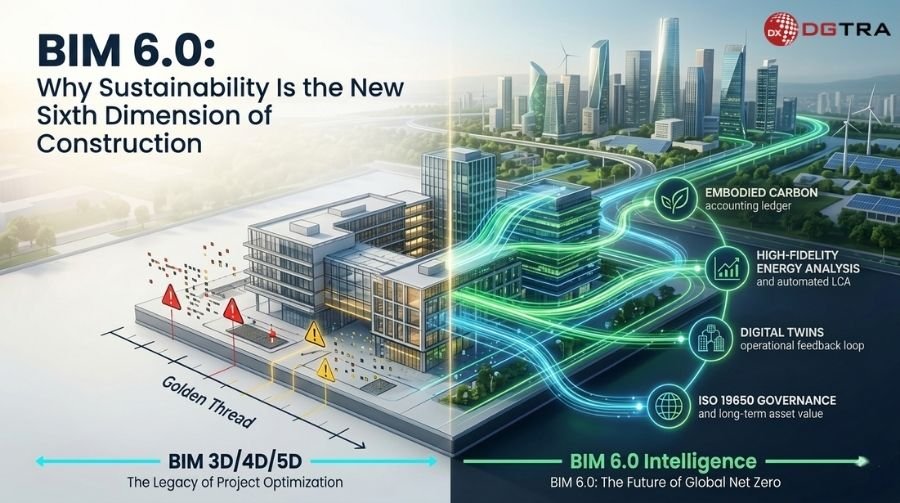
BIM 6.0: Why Sustainability Is the Sixth Dimension of Construction
For decades, the construction industry viewed sustainability as a “nice-to-have” or, worse, a regulatory hurdle to be cleared at the lowest possible cost. We mastered 3D geometry, integrated 4D schedules, and optimized 5D costs. Yet, as the global built environment remains responsible for nearly 40% of energy-related carbon emissions, the industry has reached an inflection point. The transition from BIM 5D to 6D BIM is not merely a numerical increment; it is a fundamental shift in the DNA of project delivery. Sustainability is no longer a post-script—it is the Sixth Dimension, a digital imperative that weaves environmental performance into the very fabric of the Building Information Model. It’s about intelligently orchestrating life-cycle data to ensure the structures we build today are future-ready and thrive in a climate-conscious economy through 2030 and beyond. The Market Mandate: Data-Driven Decarbonization The shift toward BIM 6.0 is fueled by more than just environmental altruism it is driven by aggressive market forces and evolving global standards. According to recent industry analysis by Grand View Research, the global green building market is projected to reach approximately $529.5 billion by 2030, growing at a CAGR of 10.3%. This growth is underpinned by the “Green Premium,” in which sustainable assets command higher valuations and lower insurance premiums. Furthermore, the International Energy Agency (IEA) emphasizes that to reach Net Zero by 2050, all new buildings and 20% of the existing building stock must be zero-carbon-ready by 2030. This requires precise management of complex project data. BIM 6.0 provides a framework for Life Cycle Assessment (LCA, a process evaluating environmental impacts across a building’s lifespan) and Energy Analytical Models (EAM, tools for forecasting and measuring building energy use). These are incorporated in the federated model, allowing real-time carbon accounting during design rather than as an afterthought. This is precisely why DGTRA integrates sustainability thinking into its BIM Consulting & Management and Integrated Project Delivery services because environmental performance embedded in delivery is the standard the market is moving toward. Beyond Geometry: The Mechanics of BIM 6.0 In the BIM 6.0 paradigm, the model becomes a living simulation. It’s no longer just about where a pipe goes, but what that pipe is made of, the carbon footprint of its transport, and its thermal contribution to the building’s efficiency over 50 years. Integrated Life Cycle Assessment (LCA) BIM 6.0 enables experts to automate embodied carbon calculations. Embodied carbon is the environmental impact of materials used in construction. By linking Material Take-Offs (MTOs, itemized lists and quantities of materials) directly to environmental product declaration (EPD) databases—EPDs are reports detailing materials’ environmental effects—BIM managers can run comparative analyses of structural systems within the native modeling environment. Operational Energy Simulation The “6D” aspect integrates building performance analysis (BPA, a method for simulating a building’s energy use) into the early design stages. By using detailed weather data and occupancy-tracking sensors, the 6.0 model predicts energy consumption patterns. This “Digital Twin” approach—where a virtual model mirrors the real building—ensures that the “as-built” energy performance matches “as-designed” expectations. Circularity and the “Building as a Material Bank.” Sustainability in 6.0 extends to deconstruction. By embedding metadata on material recyclability (the ability to reuse or recycle materials) and disassembly procedures (the steps to take apart a building), we are essentially creating a “Material Passport,” a digital record of the materials used and their reuse potential. When a building reaches the end of its life, the BIM 6.0 model serves as a ledger for the circular economy, keeping resources in use. This is the kind of delivery infrastructure DGTRA helps organizations build through Strategic BIM Roadmap and BIM Maturity Audits — identifying where the current workflow sits and what specifically needs to change to support 6D sustainability integration. Why BIM Experts Must Lead the 6.0 Transition The transition to BIM 6.0 requires a sophisticated understanding of interoperability, which means different software tools must exchange information seamlessly. It’s about the flow of data between the BIM environment and specialized simulation engines such as EnergyPlus (a tool for modeling building energy use) or One Click LCA (a software for assessing lifecycle impacts). As a leading BIM services provider, we recognize that the challenge isn’t just software—it’s the Information Requirements (EIR, the data needed for project delivery). We must advocate for “Sustainability Information Requirements” at the project’s start. If the data isn’t structured for 6D analysis from Stage 1, opportunities for significant carbon reduction are often lost by Stage 4. For context on how model quality and delivery readiness connect to this challenge, see: Why Your BIM Models Don’t Match Site Reality and How to Validate BIM Models Before Construction Begins. The Strategic Value of 6D Implementation Risk Mitigation: With the rise of ESG (Environmental, Social, and Governance) reporting, developers are increasingly liable for the carbon footprint of their portfolios. BIM 6.0 provides the audit trail required for compliance. Operational Excellence: 6D models transition seamlessly into Facility Management (FM), which encompasses systems for maintaining and operating built assets. An energy-optimized model enables predictive maintenance, anticipating and resolving issues before they cause problems, reducing long-term OPEX (operational expenses) for the owner. Regulatory Readiness: As global building codes tighten, BIM 6.0 is the only reliable way to ensure a project remains “future-proof.” FAQs: Navigating the 6th Dimension How does BIM 6.0 differ from 7D BIM? While BIM 6. focuses specifically on Sustainability, including energy analysis, Life Cycle Assessment (LCA), and carbon tracking, 7D BIM is traditionally associated with Facility Management (FM, the operation and maintenance of buildings) and ongoing operations. In modern workflows, these two dimensions are becoming integrated. Can BIM 6.0 be applied to renovation projects? Absolutely. In fact, BIM 6.0 is critical for “Deep Retrofits,” comprehensive updates that significantly reduce carbon emissions. By creating a BIM model of an existing structure through Point Cloud-to-BIM (converting laser scans into 3D models), experts can simulate various retrofit strategies to determine the most cost-effective path to decarbonization. What are the primary software tools for BIM 6.0? The core modeling happens in platforms like Revit or OpenBIM environments (such as IFC, a model exchange standard), but the “6D” intelligence comes from integrations with tools like Insight 360, Covetool, and specialized building performance simulation (BPS) plugins. Is BIM 6.0 only for LEED or BREEAM certification? No. While BIM 6.0 significantly simplifies the process for certifications such as LEED (Leadership in Energy and Environmental Design) or BREEAM (Building Research Establishment Environmental Assessment Method), its primary goal is to deliver high-performance buildings