ISO 19650 CDE Architecture: Moving Beyond Software Deployment
Procuring enterprise platform licenses is straightforward. Establishing a rigorous, audit-safe digital delivery environment is not.
Across major capital projects, digital delivery teams often treat software procurement as the finish line. They deploy cloud environments, hand out user credentials, and assume their project operates under a compliant Common Data Environment (CDE).
Reality sets in quickly. Without structured governance, files pile up in disorganized directories. Subcontractors pull geometry from unverified folders. Information managers spend hours chasing missing parameters across disparate submittals.
Achieving true ISO 19650 alignment requires much more than an active software subscription. It requires explicit information container states, strict metadata gateways, and disciplined workflow design.
The Core Distinction: Cloud Storage Versus Information Architecture
Most projects make a fundamental error early on. They treat a CDE as a shared network drive with better web access.
Storage platforms simply hold files. A true ISO 19650 CDE workflow governs how information moves from initial creation through formal authorization.
When a project relies on manual folder management, information maturity remains ambiguous. Teams do not know if a model is an exploratory draft or an authorized construction deliverable.
Implementing structured information management replaces ambiguity with operational control. Information containers move through defined lifecycle gates. Task teams verify their own work before sharing it with other disciplines. Lead appointees review and authorize data before it enters construction or asset operations.
Why Basic Platform Deployments Fall Short
Renting cloud space without defining information protocols leaves projects exposed to recurring friction points.
Ungoverned Ingress
Without automated naming filters, files enter the project register with inconsistent nomenclature. Searching for specific revisions across thousands of unmanaged deliverables slows down coordination.
Missing Metadata Attributes
Files dropped into generic folders lack mandatory attributes like Suitability Codes and Revision Numbers. Without these parameters, automated quality checks cannot run effectively.
Bypassed Review Gates
When access permissions are too loose, trade partners bypass internal task team checks. They upload fabrication models straight into shared coordination zones, introducing unverified geometry into federated models.
Building the Four Information States
An audit-safe CDE relies on strict separation between four primary information container states defined in ISO 19650-2:
- Work in Progress (WIP): Reserved for individual task teams. This data remains private and unverified, shielding other disciplines from premature design iterations.
- Shared: Files that have passed internal checks. Other disciplines access this zone for multi-disciplinary coordination and spatial clash resolution.
- Published: Information authorized by the lead appointee for construction execution, manufacturing, or asset management.
- Archive: An immutable, timestamped record of every historical shared and published container. This repository preserves the exact project timeline for future audits.
Enforcing these states requires platform-level workflow configurations. Users cannot simply drag and drop files across state boundaries without triggering formal review assignments.
Enforcing Naming Conventions and Metadata Gateways
Manual file naming is prone to human error. Compliant CDE architectures enforce standardized naming schemas automatically upon upload.
Every container name must follow a predictable structure:
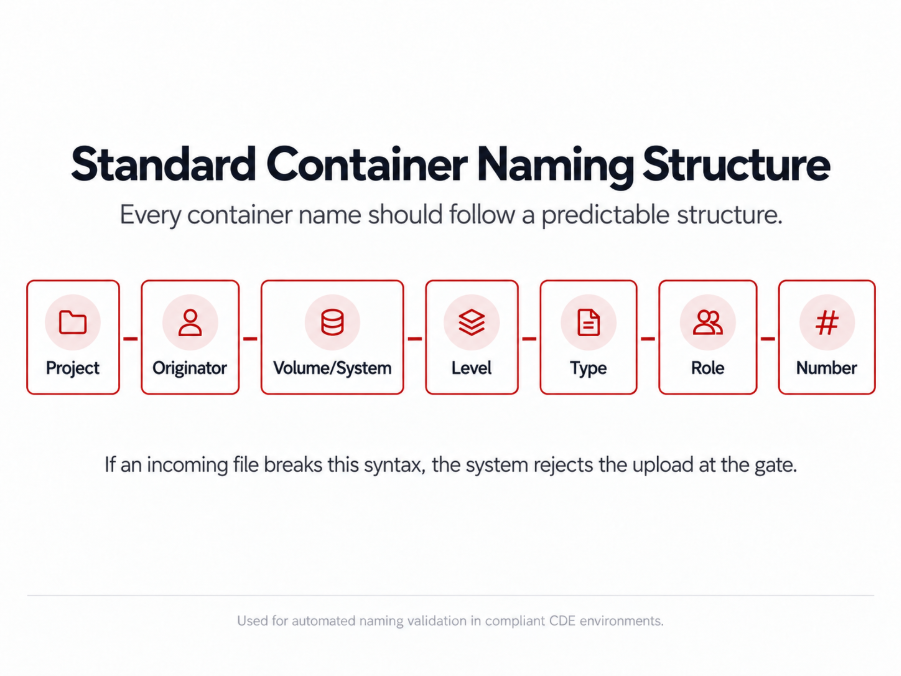
If an incoming file breaks this syntax, the system rejects the upload at the gate.
Beyond file names, modern digital delivery relies heavily on metadata. Rather than burying files in deep folder hierarchies, a mature CDE uses metadata parameters to dictate status. Every container in the shared or published environment must carry clear attributes:
- Revision Codes: Tracking whether a file is preliminary or contractual.
- Suitability Codes: Designating whether data is meant for coordination, review, or construction execution.
- Status Codes: Capturing formal technical review outcomes.
Site engineers can filter project views to display only files marked with construction-ready suitability codes. This eliminates guesswork on site.
Automated Validation via buildingSMART IDS
Traditional information delivery requirements (EIR and AIR) often lived in static text documents that teams rarely checked until project closeout.
Today, digital delivery utilizes buildingSMART Information Delivery Specifications (IDS). IDS is a machine-readable XML schema that defines exact data requirements for model elements.
Integrating IDS rules into your CDE environment automates quality control. When a trade partner uploads a model container, automated scripts parse the file against the project IDS criteria.
If required parameters—such as acoustic ratings, thermal properties, or equipment serial numbers—are missing, the CDE flags the submittal immediately. This stops incomplete data from reaching coordination meetings.
Practical Steps Toward CDE Maturity
Elevating your digital delivery environment from basic file hosting to governed ISO 19650 compliance requires a deliberate, phased approach:
- Define Exchange Requirements Early: Outline precise Exchange Information Requirements (EIR) and Asset Information Requirements (AIR) during pre-design planning.
- Configure Platform Workflows: Set up container states, metadata fields, and review gateways inside your software platform before onboarding trade partners.
- Train Task Team Leads: Ensure subcontractor leads and VDC managers understand naming rules, metadata tagging, and review protocols.
- Audit Data Quality Continuously: Run automated health checks at every milestone to maintain consistent metadata accuracy across all disciplines.
When engineered correctly, a CDE shifts from an administrative burden into a powerful risk-mitigation tool. It protects project margins, accelerates multi-trade coordination, and ensures seamless handovers.
Summary
Adopting enterprise cloud software is only the first step. Layering it with ISO 19650 information governance turns software tools into predictable execution engines. By enforcing structured metadata, automated validation, and clear container states, project teams can eliminate rework and achieve reliable capital asset delivery.
About DGTRA
DGTRA is a global technology consultancy and solutions firm specializing in end-to-end BIM consulting, ISO 19650 compliance, Virtual Design & Construction (VDC), and Project Control Management for asset owners, EPC contractors, and real estate developers. Operating as an independent digital engineering advisor, DGTRA helps enterprise teams establish audit-safe data governance, streamline multi-trade coordination, and optimize digital delivery workflows.
 To optimize your organization’s CDE architecture or establish audit-safe information governance, explore DGTRA’s BIM Consulting Services or Schedule an ISO 19650 Advisory Review.