Why Earned Value Management Fails Without 5D BIM Integration
Most project controls are still playing catch-up. Estimators lock down numbers in spreadsheets, schedulers update baselines in Primavera P6, and engineering teams push revisions through native 3D authoring tools. Everyone works hard, but they work in silos.
By the time monthly Earned Value Management reports hit an executive desk, the data is typically thirty days old.
For project directors and EPC leads, running a major capital build on disconnected spreadsheets is essentially conducting a historical autopsy. When a design modification drops, the cost ripples across trade packages long before it registers on a monthly dashboard.
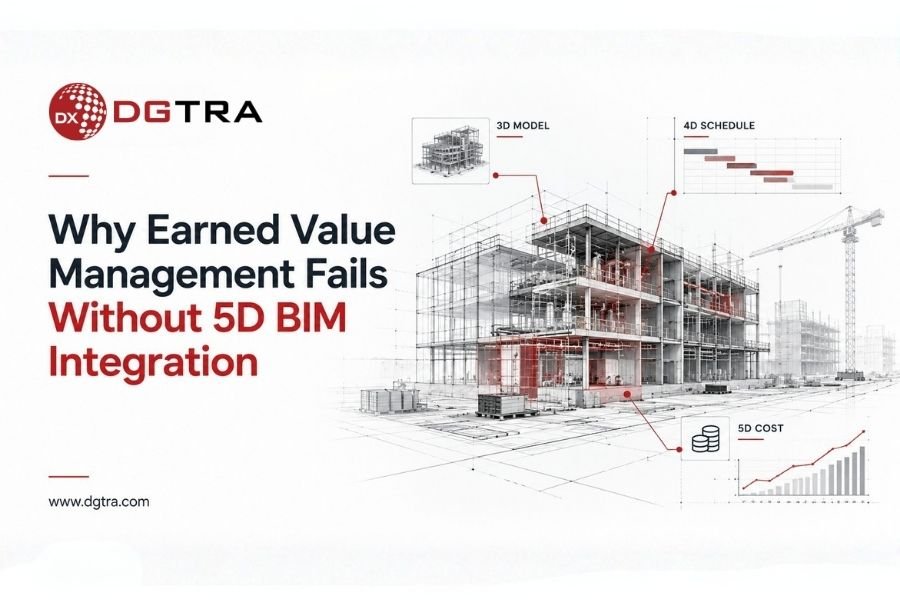
Bridging the gap requires tying model geometry directly to 5D cost codes and 4D schedule logic. That is how you turn project controls from passive accounting into actual risk management.
The Blind Spots of Standalone Cost Logs
Earned Value Management is supposed to measure performance by tracking planned work against actual progress. But when EVM sits entirely outside the 3D model environment, predictable fractures appear across the workflow:
- Disconnected Quantities: Manual takeoff routines create an inevitable lag between engineering adjustments and cost updates.
- Late Discoveries: Scope creep usually surfaces only after trade subcontracts are locked in, quietly draining contingency reserves.
- Orphaned Revisions: A geometry shift in Revit does not automatically ripple into cost allocations or schedule logic without explicit integration.
Without real-time financial tracking tied directly to the design, overruns pile up silently across multiple trades until they trigger a margin crisis.
Moving Beyond Thirty-Day Cost Lags
Integrating 5D BIM parameters with enterprise project controls changes how teams handle scope changes.
Instead of relying on manual takeoffs and isolated spreadsheets, an integrated environment maps model components straight to cost codes. Every element carries specific cost attributes tied to recognized breakdown structures.
This setup changes day-to-day execution in three notable ways:
- Dynamic Estimates at Completion
Waiting for month-end reconciliation is a gamble. When 5D parameters are linked directly to the model, any change in geometry or quantity recalculates the Estimate at Completion on the spot. Project managers see cost exposure before they sign off on a variation.
- Automated Quantity Take-Offs
Manual measurement is prone to human error and eats up valuable estimation cycles. When an engineer adjusts a structural element, the underlying quantities update automatically across the entire cost database.
- Rigorous Change Impact Analysis
Merging 4D time sequencing with 5D cost attributes allows teams to run a proper change management impact analysis. You can model the exact cost and schedule fallout of a design revision before issuing instructions to the field.
Securing Margins Through Early Constructability
Connecting cost codes to uncoordinated geometry only accelerates bad estimating.
Before tying any cost data to a model, rigorous constructability reviews are essential. The geometry has to reflect actual installation tolerances, trade clearances, and real-world site constraints. Catching a spatial clash virtually is infinitely cheaper than arguing over a variation claim on site.
Frequently Asked Questions (FAQs)
What is the core difference between 4D and 5D BIM?
4D BIM links 3D elements to schedule logic and time parameters. 5D BIM layers cost data on top of that, enabling live budget tracking, automated take-offs, and cash flow forecasting.
Can 5D BIM connect with legacy corporate accounting systems?
Yes. Enterprise 5D platforms interface directly with ERP systems like SAP or Oracle via APIs, ensuring model quantities map cleanly to internal cost structures.
How does 5D BIM change variation management?
Because geometry links straight to unit rate assemblies, any model update instantly recalculates financial impact, letting teams evaluate variations before authorizing work.
Summary
Relying on historical cost reports gives leadership a false sense of security. Tying 5D BIM directly into project controls provides the real-time visibility needed to protect margins and deliver complex builds predictably.
About DGTRA
DGTRA is a digital engineering consultancy for the built environment. We work with real estate, construction, infrastructure and manufacturing clients across India, the US, the UK and Australia. Our teams cover BIM and VDC delivery, ISO 19650 information management, project controls, digital twins and design automation. We support complex project delivery from pre-construction planning through sequencing, prefabrication coordination and commissioning handover. DGTRA holds ISO 19650 certification from BSI.
👉 To optimize your project controls framework or implement 5D BIM cost management, explore DGTRA’s Project Control Management Services or Schedule a 5D Controls Advisory Session.