Late constructability reviews lead to costly rework. Discover how early 4D VDC and ISO 19650 reviews protect capital project budgets and schedules.

Is Your Common Data Environment Actually Improving Collaboration?
Late constructability reviews lead to costly rework. Discover how early 4D VDC and ISO 19650 reviews protect capital project budgets and schedules.
Creating Effective EIR: Turning Goals into Measurable Outcomes
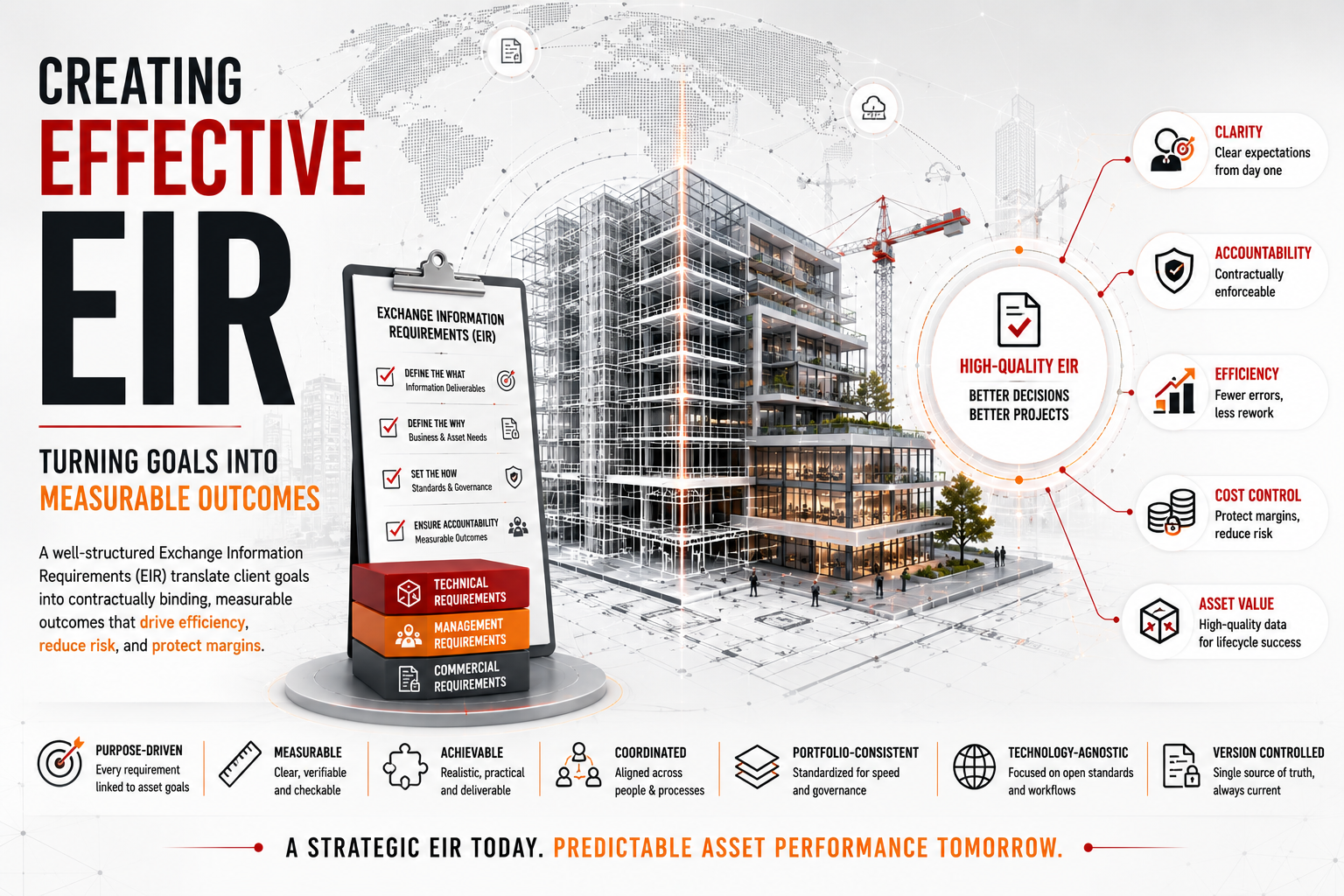
Exchange Information Requirements (EIR) sit at the center of project governance. Within a modern AECO framework, the EIR is a contractually binding document. It translates high-level business goals into precise mandates for the delivery team. A well-structured EIR is a powerful risk-management tool. A poor one creates immediate ambiguity, widespread model rework, and expensive commercial disputes. Most project delivery bottlenecks do not stem from software limitations. Instead, they trace back to unclear, unmeasurable, or unrealistic information requirements. An effective EIR brings predictability and accountability to complex project environments. It defines exactly what information is required, why it is needed, and how teams must validate it. What an EIR Is Many industry teams mistakenly treat the EIR as an exhaustive technical manual. They pack it with arbitrary modeling instructions and outdated standards copied from older projects. An elite EIR is completely different. It serves as a strategic brief, a performance specification, and a legally binding compliance baseline. The EIR establishes project expectations rather than software instructions. The EIR defines the “what” and the “why.” The actual delivery strategy belongs entirely within a well-structured BIM Execution Plan. The EIR dictates final asset goals, and the supply chain responds with the execution methodology. The Three Pillars of an Effective EIR A high-quality EIR categorizes project expectations into three clear, interconnected groups: 1. Technical Requirements Technical requirements define the literal anatomy of the digital assets. They must be specific and measurable. Key elements include: Precise model deliverables across project dimensions (3D, 4D, and 5D) The exact Level of information needed for specific milestones Strict project-wide naming conventions and metadata standards Unified classification systems and required asset data attributes Comprehensive COBie or equivalent operational data compliance matrices 2. Management Requirements Management requirements outline the digital governance structure. They specify how information moves across the building lifecycle. This pillar defines approval workflows, delivery milestones, team roles, information security protocols, and independent review procedures. It ensures data remains reliable from conceptual design through construction. 3. Commercial Requirements Commercial requirements transform the EIR into an enforceable legal instrument. This section outlines tender submission formats, strict acceptance criteria, intellectual property clauses, and data ownership rights. High-performing asset owners tie vendor payment structures directly to the successful clearance of these data deliverables. This approach ensures financial accountability across the supply chain. The 7 Characteristics of a High-Quality EIR An effective EIR must exhibit seven distinct characteristics to drive genuine asset value: Characteristic Operational Impact Purpose-Driven Every data requirement maps directly back to strategic asset needs (OIR, AIR, and PIR). No data points exist without a clear operational purpose. Measurable Every parameter is programmatically verifiable. Vague phrases are eliminated and replaced with explicit, checkable data points to reduce disputes. Achievable Demands remain realistic. Setting unachievable data targets erodes supply chain trust and leads to widespread non-compliance in the field. Coordinated The document stays perfectly aligned with downstream responses. The EIR establishes expectations, while the BEP delivers the tactical response. Portfolio-Consistent Standardizing requirements across an owner’s portfolio accelerates procurement, minimizes onboarding friction, and strengthens governance. Technology-Agnostic The mandates focus strictly on information processes, open data standards, and structured workflows—never on proprietary software brands. Version Controlled Rigorous version control protects the document’s legal integrity, ensuring the entire supply chain works from a single source of truth. Why EIRs Fail: Common Mistakes in the Industry Global capital projects frequently run into identical, predictable failure points during procurement: Copying and pasting text from unrelated legacy projects Overloading documents with restrictive modeling instructions that suffocate vendor workflows Demanding dense asset data that fails to link back to a real asset management strategy Failing to outline clear, unambiguous acceptance criteria for milestone handovers Imposing unrealistic tracking schedules that exceed the digital maturity of the supply chain These systemic failures trigger a quick chain reaction. Unclear contractual expectations produce flawed digital submissions. This lack of data integrity leads to geometric clashes, project delays, and expensive on-site rework. A Proven Framework for Developing an Effective EIR Forward-thinking organizations follow a highly disciplined, repeatable framework to author and enforce their information requirements: Anchor to Core Operational Needs: Trace every requirement back to the business’s organizational and asset management goals. Isolate High-Risk Deliverables: Focus structural enforcement on critical-path information. Avoid overloading the supply chain with low-value data requirements. Define Digital Acceptance Criteria: Establish clear, binary checklists and automated status codes to remove subjective interpretation from reviews. Enforce Governance via the CDE: Move review workflows entirely into a centralized Common Data Environment. This ensures file compliance is audited at the gate. Pilot Test with Sample Deliverables: Instruct bidding teams to submit small sample digital deliverables early in the procurement phase to verify that criteria are realistic. Maintain as a Living System: Refine requirements continuously based on live project feedback loops. An effective EIR adapts to evolving project realities. The Executive Impact of a Strong EIR Investing in a robust EIR is a major commercial differentiator. For asset owners and C-suite leaders, a high-quality EIR pays immediate dividends. It slashes design rework, minimizes contractual disputes, and drives down tender ambiguity. It ensures the facility management team receives a pristine, verified Asset Information Model at handover. This rich data foundation accelerates operational readiness, powers advanced Digital Twin configurations, and enables profitable lifecycle decision-making. About DGTRA DGTRA is a premier digital transformation partner and process-driven management consultancy operating at the global forefront of the AECO industry. Backed by an elite team of over 100 specialized professionals, we bridge the gap between complex digital technology and practical, profitable execution across India, the UK, and the Middle East. We work directly with asset owners, Tier-1 contractors, and leading design firms to architect robust, forward-thinking digital roadmaps. Our deep domain expertise spans advanced open BIM implementation, strategic asset information modeling, customized CDE orchestration, and the practical deployment of operational Digital Twins. At DGTRA, our core guiding principle remains absolute: we engineer the digital processes that bring total predictability, structural transparency, and financial certainty to the world’s most ambitious construction programs. Ready to build complete predictability across your
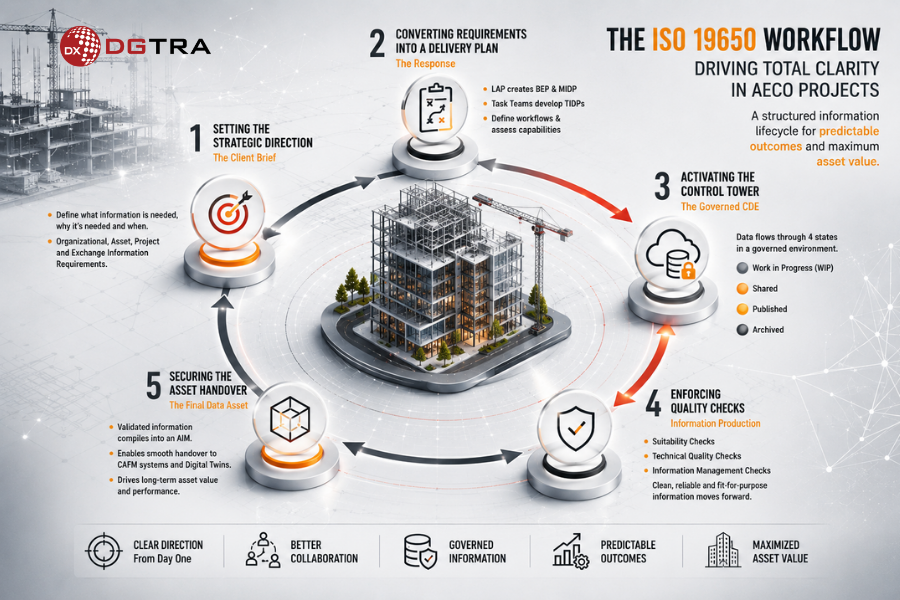
The ISO 19650 Workflow Driving Total Clarity in AECO Projects
In our previous article, Executive Guide to ISO 19650 Driving Predictable AECO Projects, we established that this international standard stands as a premier business governance framework designed to maximize asset value. Now, let’s explore exactly how this framework delivers outstanding performance on a live capital project through a highly optimized information lifecycle. The secret to superior large-scale infrastructure delivery lies in absolute alignment of communication. Complex projects thrive when information flows seamlessly, datasets remain completely consistent, and goals are perfectly synchronized among clients, lead consultants, and trade contractors. ISO 19650 provides this industry excellence by introducing a structured, end-to-end information workflow. This sequence functions as the advanced operating system for project data governance. For leaders managing high-value programs across India, the UK, and the Middle East, mastering this workflow serves as your primary accelerator for driving predictable asset outcomes and maximizing operational efficiency. The Five Stages of the ISO 19650 Workflow To establish a highly collaborative, productive, and reliable project environment, the standard defines a visible, repeatable lifecycle for data production. Setting the Strategic Direction (The Client Brief) The information workflow begins with the Appointing Party (the client or asset owner). Before procurement begins, the client establishes a strong foundation by defining exactly what information is needed, why it is required, and precisely when it must be delivered. This is accomplished by authoring clear criteria, including Organizational, Asset, Project, and Exchange Information Requirements. This strategic brief empowers delivery teams with immediate clarity, ensuring optimal deliverables and excellent handover quality from day one. Converting Requirements into a Delivery Plan (The Response) Once the client issues the information requirements, the supply chain outlines the exact path to successful execution: The Lead Appointed Party (LAP): Typically, the main contractor or lead consultant, the LAP coordinates the entire tier-2 supply chain. They author the Post-Contract BIM Execution Plan (BEP) and the Master Information Delivery Plan (MIDP). Individual Task Teams: Each specific discipline (architectural, structural, MEP) maps out its own Task Information Delivery Plan (TIDP), workflow procedures, and resource capability assessments.In short: The client defines the strategic goals, while the delivery teams provide the exact execution strategy. Activating the Control Tower (The Governed CDE) The Common Data Environment (CDE) serves as the powerhouse of the ISO 19650 workflow. A compliant CDE is a disciplined protocol that guides every single model, drawing, and dataset through four productive states: Work in Progress (WIP): Focused data utilized internally by a specific task team. Shared: Validated data released to other disciplines for collaborative coordination. Published: Authorized data approved for active construction or manufacturing. Archived: A complete, traceable digital ledger of all historical transactions. By ensuring controlled transitions with explicit status codes and metadata, executives maintain total transparency over data maturity. Enforcing Quality Checks (Information Production) ISO 19650 elevates standard project delivery by introducing a highly disciplined verification process. Before any information container leaves the WIP state and enters the Shared environment, it passes through a thorough three-tier gateway: Suitability Checks: Confirming the data is ideal for its intended purpose. Technical Quality Checks: Verifying geometric accuracy and code compliance. Information Management Checks: Confirming perfect alignment with naming conventions and metadata rules. This systematic validation ensures the shared environment remains completely clean, reliable, and optimized for project efficiency. Securing the Asset Handover (The Final Data Asset) The ultimate value of the workflow is realized at project completion. Validated project information compiles beautifully into an Asset Information Model (AIM)—a highly structured, actionable dataset optimized for long-term operations and maintenance. Because the data undergoes progressive validation at every milestone, the owner receives a pristine, queryable asset dataset. This clean lineage plugs directly into CAFM platforms and powers operational Digital Twins, unlocking decades of predictive maintenance capability and long-term asset value. About DGTRA DGTRA is a digital transformation partner and process-driven consultancy operating at the absolute forefront of the global AECO industry. Backed by an elite team of over 100 specialized professionals, we bridge the gap between complex digital technology and practical, on-site execution across India, the UK, and the Middle East. We specialize in high-impact, tailored digital solutions. We work directly with asset owners, tier-1 contractors, and leading design firms to design and implement robust, forward-thinking digital roadmaps. Our deep domain expertise spans advanced BIM implementation, comprehensive ISO 19650 advisory services, customized CDE setup, and the strategic development of operational Digital Twins. At DGTRA, our core guiding principle remains clear: we engineer the digital processes that bring complete predictability, transparency, and financial certainty to the world’s most ambitious construction programs. Connect with Our Experts TodayEstablishing a transparent, end-to-end information workflow is the most powerful action an executive can take to protect project margins and elevate organization-wide delivery standards. Transitioning to this international standard replaces traditional data silos with a highly coordinated, profitable, and digitally mature delivery ecosystem. DGTRA possesses the exact process engineering expertise required to embed these international standards seamlessly into your supply chain.[Click here to schedule a strategic consultation with a DGTRA Process Specialist.] Let’s optimize your current information pathways, establish a high-performance governance model, and turn your project delivery into a highly controlled, predictable digital asset. Frequently Asked Questions (FAQs) Who monitors the day-to-day enforcement of this workflow? While the framework is established contractually by the client, the day-to-day governance, CDE tracking, and information validation are championed by specialized Information Managers or BIM Implementation leads within the Lead Appointed Party. How does the CDE workflow ensure contractor alignment? Because the ISO 19650 workflow is fully embedded into contract documents via the EIR and BEP, compliance is a core project requirement. Data must successfully clear the verification gateways to reach the “Published” state, ensuring only fully authorized information is utilized for active on-site construction. Does this workflow optimize the design and construction timeline? Yes. By proactively identifying data variations, spatial clashes, and misaligned definitions early within the controlled digital environment, this workflow saves thousands of hours of field adjustments and maximizes operational efficiency on the construction site. How does the workflow manage updates or revisions to approved models? When a
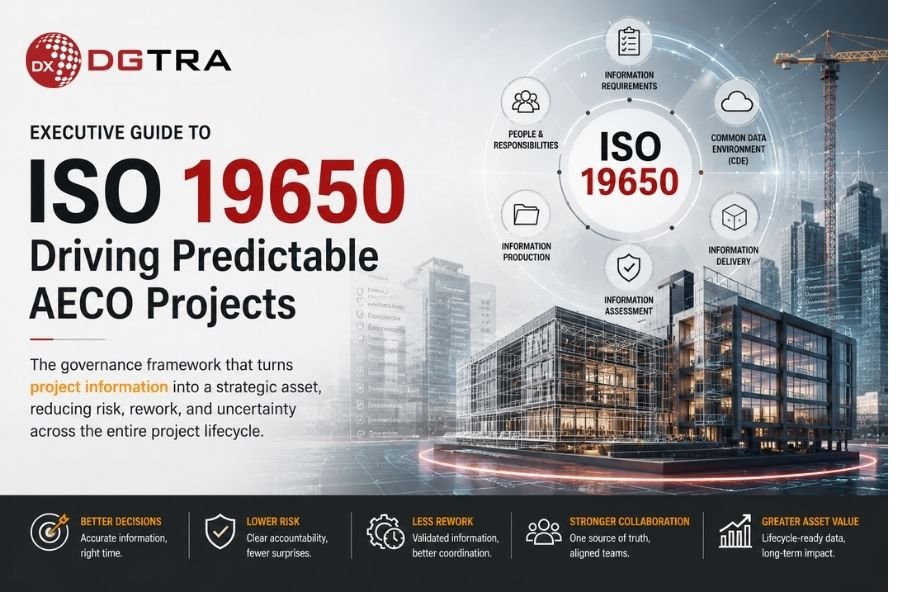
Executive Guide to ISO 19650 Driving Predictable AECO Projects
Our previous article, AECO Data Shift Why Information Management Rules Project Success, demonstrated that project outcomes now depend on effective data management, not just drawings. Achieving predictability on site requires applying the same discipline to data as to physical materials. This shift makes ISO 19650 the operational standard for modern project delivery. ISO 19650 is often labeled as a technical standard for digital modeling, but this is inaccurate. It is an executive governance framework designed to transform fragmented project data into a reliable, risk-managed business asset. For executives managing high-capital programs, this guide explains what ISO 19650 delivers, why it is essential, and how it safeguards project outcomes and financial performance. The Strategic Purpose: Driving Better Decisions Traditional document management is breaking under the weight of modern infrastructure demands. When teams rely on disconnected spreadsheets, unvetted PDFs, and fragmented communication, project execution suffers. ISO 19650 introduces process discipline to replace fragmented digital practices. Its core objective is to ensure that accurate information is delivered by the appropriate team, in the correct format, at the required time, enabling informed decision-making. Applying this standard across a capital program establishes a unified approach to information management. Asset owners receive the required deliverables, contractors reduce uncertainty, and consultants operate with clear expectations. The Core Architecture of ISO 19650 The international standard covers several components, but its logic is straightforward. It manages the digital lifecycle of a project through five operational steps: Defining the Information Brief The client defines project expectations by documenting clear information requirements. This foundation, structured in four layers, removes uncertainty from the supply chain before procurement starts. Formulating the Execution Response In response to the client’s brief, lead contractors and design partners develop a detailed BIM Execution Plan (BEP). This is not a boilerplate compliance document; it is an active operational manual proving that the delivery team has the exact resource capacity, workflows, and protocols required to execute the mandate. Activating the Common Data Environment (CDE) A compliant Common Data Environment (CDE) provides strict workflow control, managing how files move between four defined states: Work in Progress, Shared, Published, and Archived. Data is only used on-site after systematic checks, reviews, and approvals. Structuring Governed Packages Unorganized file submissions are eliminated. Information is produced and exchanged in coordinated information containers, with all models, datasets, and documents following unified naming conventions, metadata rules, and status codes. Securing the Lifecycle Asset Model At handover, verified project data is compiled into a structured Asset Information Model (AIM). The asset owner receives a dataset ready for integration with facility management systems and digital twin solutions. It Is About Process, Not Software The most common question executives ask is: “Which software platform do we need to purchase to become ISO 19650 compliant?” The real question should be: “Do we have the process governance to manage our information effectively?” ISO 19650 is technology-agnostic and does not prescribe specific tools or platforms. Technology enables the process, but cannot replace disciplined workflows. The standard prioritizes accountability, data validation, and risk mitigation. Moving From Modelling to True Data Governance ISO 19650 is not limited to producing 3D models. The commercial value is in the data linked to the geometry and the auditable digital record of creation, verification, and approval. A unified governance structure reduces project risk. Teams can identify and address information errors in the digital environment before they impact the job site. About DGTRA DGTRA is a digital transformation partner and process-driven consultancy serving the global AECO industry. With a team of over 100 specialized professionals, we connect digital technology with practical on-site execution in India, the UK, and the Middle East. We work directly with asset owners, tier-1 contractors, and design firms to design and implement effective digital roadmaps. Our expertise includes advanced BIM implementation, ISO 19650 advisory, customized CDE setup, and development of operational Digital Twins. Our focus is on engineering digital processes that deliver predictability, transparency, and financial certainty for complex construction programs. Connect with Our Experts Today Transitioning to an ISO-compliant framework is a strategic business decision to reduce operational uncertainty. DGTRA provides the framework to move beyond ad-hoc digital practices and establish predictable digital delivery. Our advisory team supports the development of information strategies for capital programs and audits of supply chain digital maturity. Click here to connect directly with a DGTRA Information Governance Consultant. Let’s map your current process workflows, close the digital maturity gap, and turn your Frequently Asked Questions Is ISO 19650 compliance expensive to implement? The initial investment is focused on process engineering, team training, and setting up structured workflows. However, this cost is quickly offset by the massive reduction in site rework, procurement errors, and schedule delays caused by uncoordinated project data. Can we implement ISO 19650 on mid-sized projects, or is it only for mega-projects? The standard is entirely scalable. While the governance principles remain identical, the complexity of the requirements and the structure of the Common Data Environment can be tailored to match the specific scale, risk profile, and needs of any project. Who is responsible for setting up the ISO 19650 framework on a project? The ultimate responsibility begins with the asset owner (the Appointing Party), who must define their specific information requirements. However, experienced digital transformation partners are typically retained to design the roadmaps, author the briefs, and audit supply chain compliance. How does ISO 19650 support long-term facility management? Instead of receiving static, unverified PDFs at project handover, the owner receives a fully validated Asset Information Model (AIM). This data is structured to plug directly into asset management software, drastically reducing onboarding times and operational maintenance costs. Does our supply chain need to be fully certified to work on an ISO 19650 project? Not necessarily. While corporate certification demonstrates maturity, the project framework primarily requires that teams possess the verified capability, resource capacity, and willingness to follow the standardized workflows outlined in the project’s BIM Execution Plan. The initial investment is focused on process engineering, team training, and setting up structured workflows. However, this cost is quickly offset by the massive reduction in site rework, procurement errors, and schedule delays caused by uncoordinated project data. The standard is entirely scalable.
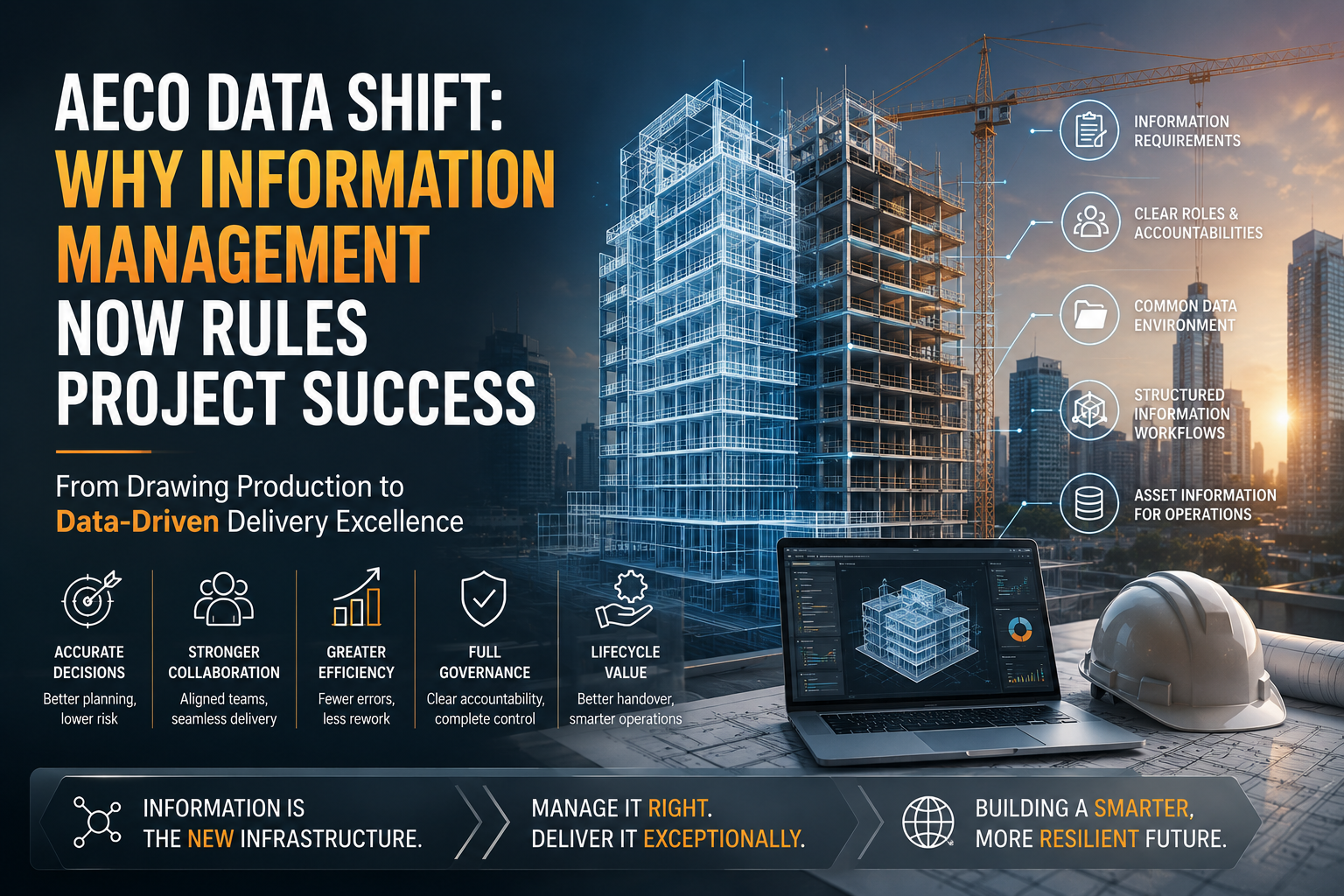
AECO Data Shift: Why Information Management Now Rules Project Success
For years, the AECO industry measured progress by the volume and quality of project drawings. Today, project success is determined by how effectively organizations manage and leverage project information. As infrastructure projects increase in scale and complexity, data has become the most valuable and often the most mismanaged asset in the built environment. Leading organizations recognize that structured information management is essential for controlling costs, ensuring governance, and maximizing long-term asset value. ISO 19650 has emerged as the global standard for delivering these outcomes. The True Engine of Project Performance Modern construction economics demand precision. Margins are tight, supply chains are unpredictable, and stakeholders require traceable, auditable project records. In this environment, the quality of digital data drives four key areas of execution: Cost and schedule accuracy Team collaboration effectiveness Digital delivery maturity Asset operations and lifecycle value We have reached a critical tipping point where errors in data definitions carry far heavier financial consequences than simple errors in a sketch. A single misaligned asset attribute code can cascade into widespread procurement delays, expensive on-site rework, and decades of operational headaches. Moving your organization from basic “drawing production” to true digital information management is no longer a technical option handled by a single department. It is a core corporate strategy. ISO 19650 serves as the operational playbook that turns this strategy into a repeatable day-to-day capability. Why ISO 19650 is a Board-Level Priority ISO 19650 has rapidly evolved from a technical framework used by digital teams into a key governance tool for high-value capital programs across India, the UK, and the Middle East. It introduces three core pillars that are reshaping modern project delivery: Information as a Managed Asset Data is treated with the exact same strict discipline as physical building materials. It must be structured, thoroughly validated, strictly version-controlled, and completely secure from concept to handover. Radical Accountability Across the Delivery Chain The standard eliminates room for error by defining clear, measurable responsibilities for every project tier. It explicitly outlines the boundaries between the Appointing Party (the client), the Lead Appointed Party (the tier-1 contractor or consultant), and individual Task Teams. Repeatable, Predictable Project Flows By standardizing how information requirements are set, how approvals are managed, and how files are named, the framework systematically eliminates unnecessary variability—the single biggest driver of project risk. The AECO Industry Maturity Gap While leading global firms have fully embraced structured information governance, a significant maturity gap still splits the industry. Many project teams remain trapped in outdated, document-heavy delivery habits that actively drain profit margins. Take a look at how lagging practices contrast against an optimized, standardized workflow: Outdated Delivery Habits (High Risk) ISO 19650 Governance (Predictable Outcomes) Designing systems without clear, documented information requirements. Standardized EIR and AIR documents set before procurement begins. Creating a BIM Execution Plan (BEP) as a generic, check-the-box text document. Living, operational BEPs tied directly to resource capacity and risk matrices. Using a Common Data Environment (CDE) as a basic, unmanaged file warehouse. A strictly governed CDE workflow managing WIP, Shared, and Published states. Treating handover data as an unvetted, post-project afterthought. Progressive data validation ensuring a lifecycle-ready Asset Information Model (AIM). This industry maturity gap has become a massive competitive differentiator. Organizations that master structured information management consistently outperform their peers by securing lower rework rates, higher planning accuracy, fewer contractual disputes, and far better handover data for long-term operations. Moving Beyond Simple 3D Modelling The biggest misconception in the AECO space is that digital transformation begins and ends with a 3D model. In reality, physical geometric modelling is just one small component of the overarching data ecosystem. The real business value of modern digital workflows lies in establishing strict data requirements, enforcing structured data exchanges across different disciplines, and validating information inside a secure environment before it hits the field. It is not about generating more complex models; it is about producing the right data so your entire supply chain can make faster, smarter decisions. About DGTRA DGTRA is a digital transformation partner and process-driven consultancy operating at the absolute forefront of the global AECO industry. Backed by an elite team of over 100 specialized professionals, we bridge the gap between complex digital technology and practical, on-site execution across India, the UK, and the Middle East. We avoid generic software solutions. Instead, we partner with asset owners, contractors, and design firms to deliver robust digital roadmaps. Our expertise covers advanced BIM, ISO 19650 advisory, customized CDE setup, and operational Digital Twins. Our focus is on engineering digital processes that deliver predictability, transparency, and financial certainty for complex construction programs. Connect with Our Experts Today Let’s discuss your current digital maturity level, evaluate your project workflows, and build an unshakeable information infrastructure that guarantees long-term asset value. Get your project data right, and operational excellence will inevitably follow. Frequently Asked Questions What is the main difference between traditional BIM and ISO 19650 information management? Traditional BIM often focuses heavily on the technical creation of 3D geometric models. ISO 19650 shifts the focus to corporate governance, process discipline, and standardizing how data is requested, produced, validated, and handed over across the entire lifecycle of an asset. Why are drawings no longer enough for modern capital projects? Drawings represent a static snapshot of a design, often trapped in isolated PDF or paper formats. Modern projects require live, queryable data to feed automated cost estimation, scheduling tools, procurement platforms, and long-term facility management systems without manual data re-entry. What is a Common Data Environment (CDE) in an ISO context? An ISO-compliant CDE is not just a cloud storage platform like Google Drive or Dropbox. It is a highly governed workflow engine that strictly controls how information containers move through specific states: Work in Progress (WIP), Shared, Published, and Archived, using standardized status codes and metadata. How does poor information management impact project costs? When data is unstructured, different teams (structural, MEP, architectural) work off unverified versions. This leads directly to spatial clashes, procurement errors, scheduling delays, and expensive physical demolition and rework on the construction site. What is an Asset Information Model (AIM)? The AIM is the compiled, fully validated dataset handed over to the client upon project completion. Unlike a massive dump of unorganized files, an AIM is structured specifically to integrate directly into Computer-Aided Facility Management (CAFM) systems and power real-time Digital Twins. Traditional BIM often focuses heavily on
The Rise of Information Management in AECO
Why Data, Not Drawings, Now Determines Project Success Why ISO 19650 Has Become the Strategic Backbone of Modern AECO Delivery In the last decade, the AECO industry has undergone a profound shift. Capital projects are no longer defined by how well teams can produce drawings—they are defined by how well organizations manage information. As global projects grow in scale, complexity, and scrutiny, information has quietly become the most valuable—yet the most mismanaged—asset in the built environment. Today, leading owners and delivery partners increasingly recognize that effective information management is the foundation of predictable outcomes, robust governance, and long-term asset value. This is the fundamental context in which ISO 19650 has emerged as the global standard for structured information delivery. Information is the New Driver of Project Performance The economics of construction have changed. Margins are tighter, supply chains are constrained, and stakeholders now demand traceable, auditable project data. In this environment, the quality of project information directly determines: Cost and schedule accuracy Collaboration effectiveness Digital delivery maturity Asset operations and lifecycle value Errors in information now carry far greater consequences than errors in drawings. A single misaligned data definition can trigger procurement delays, costly rework, and long-term asset performance issues. Organizations that rely on unstructured documents and disconnected systems inevitably absorb this risk. The industry is shifting from “drawing production” to information management as a strategic capability. ISO 19650 is the playbook that operationalizes that shift. Why ISO 19650 Is Becoming a Board-Level Priority ISO 19650 has rapidly evolved from a technical framework into a governance tool for high-capital-value programs. The standard establishes three core concepts reshaping delivery models: 1. Information as a Managed Asset Information is treated with the same discipline as physical assets—structured, validated, version-controlled, and secure. 2. Clear Accountability Across the Delivery Chain Appointing Parties, Lead Appointed Parties, and Task Teams have defined roles and measurable responsibilities. Ambiguity is replaced with accountability. 3. Repeatable, Predictable Information Flow Standardized information requirements, workflows, approvals, and naming conventions reduce variability—the single biggest contributor to project risk. For organizations delivering portfolios across India, the UK, and the Middle East, ISO 19650 provides the governance framework needed to align diverse contractors, technologies, and processes under one unified strategy. The Growing Maturity Gap in the Industry While leading firms have embraced structured information management, many project teams remain trapped in outdated delivery practices: Designs developed without clear Information Requirements BEPs created only as check-the-box documents CDEs used as file warehouses instead of workflow engines Data inconsistently structured across disciplines Asset information treated as an afterthought This maturity gap is now a competitive differentiator. Organizations with strong information management capabilities consistently deliver: Lower rework Higher planning accuracy Fewer disputes Stronger compliance Better handover data Higher-performing assets ISO 19650 provides the methodology; execution of excellence determines the value. The Strategic Case for Information Management Leadership In an industry under pressure to deliver more with less, governing information effectively is not optional—it is a strategic mandate. Executives increasingly expect BIM Implementation teams to: Establish robust information governance models Define and enforce Information Requirements Build scalable CDE ecosystems Align delivery methods with digital strategy Convert project data into lifecycle-ready Asset Information Models Enable Digital Twins and future AI/ML use cases This is the leadership paradigm of modern AECO delivery. Information is no longer a by-product of design; it is the infrastructure on which every design, construction, and operations decision depends. What Comes Next in This Series This series will demonstrate how ISO 19650 transforms scattered project data into a structured, high-value information asset. In the next article — “ISO 19650 Explained — A Clear, Strategic Guide for Busy AECO Leaders” — we break down the standard in simple, strategic terms, clarifying how it works and why it is essential for predictable digital delivery. For teams looking to strengthen BIM maturity and governance, remember the core principle: “Get the information right, and everything else follows.” Partner with Experts Who Accelerate Your ISO 19650 Journey DGTRA supports organizations in transforming digital project delivery through: Strategic BIM Roadmaps ISO 19650 Advisory Services CDE Setup & Information Governance BIM Execution & Implementation Support Whether you’re just beginning or scaling across projects and regions, our team helps ensure your information flows, governance, data structure, and delivery models align with global best practices and real-world outcomes. 📩 If you’re ready to strengthen digital delivery and build ISO 19650-aligned workflows that work—not just on paper, but in practice—reach out. Happy to guide you forward. Why is information becoming more important than drawings in AECO projects? Because modern delivery relies on accurate, consistent, and accessible data. While drawings show what will be built, information determines how well teams collaborate, govern workflows, avoid errors, and support lifecycle asset management. What problem does ISO 19650 solve in construction delivery? ISO 19650 provides a unified framework for structured information management across projects, teams, software, and regions. It reduces ambiguity, enforces accountability, and ensures organizations produce information that is complete, consistent, and usable across the asset lifecycle. Who benefits the most from adopting ISO 19650? Owners, contractors, consultants, and facility management teams benefit — but the owners see the greatest long-term value because ISO 19650 ensures data is structured, maintained, and ready for handover, operations, and future digital assets like Digital Twins. What are the most common industry mistakes when working without structured information management? Typical issues include unclear requirements, inconsistent data, duplicated file naming, poor approval workflows, CDE misuse, and uncoordinated teams — all leading to delays, rework, disputes, and low-quality handover information. Is ISO 19650 only for organizations already using BIM? No — ISO 19650 is a methodology for managing information, not just a BIM compliance requirement. Even organizations early in digital adoption can use it to create clarity, accountability, and repeatable workflows.

ISO 19650 as a Business Strategy: Managing Information for Maximum Impact
The Hidden Cost of Poor Information Management In construction, engineering, and infrastructure, poor information management is more than an inconvenience — it’s a major drain on profits. A 2020 study by Autodesk and FMI found that faulty or incomplete data accounted for 14% of avoidable rework, totaling US $88 billion globally. Across the industry, fragmented data, versioning errors, inconsistent formats, and missing records were estimated to cost over US $1.8 trillion globally in the same year. In practical terms, poor data management leads to: Project delays and missed deadlines Wasted effort reconciling conflicting documents Costly field rework Poor decision-making Contractual disputes These hidden costs quietly erode margins and client trust, often going unnoticed in standard accounting reports. Why ISO 19650 Matters ISO 19650 is the global standard for information management in the built environment. It provides a structured framework for how information is created, shared, stored, and managed throughout an asset’s lifecycle. By defining: Roles and responsibilities Naming conventions and metadata A common data environment (CDE) ISO 19650 ensures that the right information reaches the right people at the right time. Beyond compliance, it reduces ambiguity and risk, enabling teams — from designers to operators — to work with shared, trustworthy data. How ISO 19650 Provides Strategic Advantage in Information Management ISO 19650 isn’t just about compliance. Its real value lies in strategic differentiation. Key benefits include: Efficiency & cost reduction: Teams spend less time wrestling with data and more time delivering value. Risk mitigation: Miscommunication, omissions, and version conflicts are minimized through clarity and traceability. Better decision-making: Accurate, timely data empowers smarter leadership decisions on design, change orders, and delivery. Competitive positioning: Clients increasingly prefer suppliers who follow recognized information standards. Future readiness & scalability: Firms aligned with ISO 19650 can adopt BIM, IoT, and digital twin technologies faster. Lifecycle value: Handover data is reliable and usable, reducing downstream operational costs and risks. Conclusion: How We Can Help At DGTRA, we help firms adopt ISO 19650 practically and strategically. Our services include: Gap assessments and roadmap design CDE setup and governance support Training and audit compliance Continuous improvement coaching We don’t just aim for certification — we aim for measurable business outcomes: Reduced rework Clearer collaboration Faster project delivery Stronger client confidence If you’re ready to transform information management from a hidden cost into a strategic asset, DGTRA can partner with you every step of the way. Why is ISO 19650 important for construction and infrastructure projects? It provides a structured framework for creating, sharing, and managing project information, reducing errors and inefficiencies. How does poor information management impact project outcomes? Fragmented or inconsistent data leads to delays, rework, increased costs, and weakened client trust. How can DGTRA help firms implement ISO 19650 effectively? DGTRA supports CDE setup, governance, gap assessments, and training to align teams with global information standards. What business benefits does ISO 19650 offer beyond compliance? It enhances decision-making, reduces risks, improves efficiency, and positions firms competitively in the market. How does DGTRA ensure ISO 19650 adoption delivers measurable results? By focusing on practical implementation, DGTRA helps firms minimize rework, improve collaboration, and accelerate project delivery.

The Hidden Cost of Poor Document Control in Construction Projects
When Projects Derail, Poor Document Control Is Often to Blame Delays and rework are costly in construction — but one overlooked culprit is poor document control. Drawings, RFIs, submittals, and change orders are essential for smooth project execution. Yet, when these documents are scattered across emails, local drives, or unstructured systems, chaos follows. Teams waste time searching, verifying, and reconciling versions — leading to: Cost overruns Schedule delays Frustrated stakeholders Fact: Disorganized documentation contributes to over 30% of project cost overruns. The Domino Effect of Version Confusion Working from outdated drawings can trigger a chain reaction of costly mistakes. A contractor using an old floor plan may cause rework that ripples through the entire project — impacting budgets, schedules, and trust among owners, consultants, and contractors. Rework due to documentation errors often represents: 4–6% of total project costs Up to 15% in residential projects Accountability Without Traceability Is Nearly Impossible When disputes arise, proper documentation becomes your strongest defense. Without audit trails or activity logs, accountability disappears: Who approved this drawing? When was the RFI response shared? Which version of the submittal was issued? Data shows: 52% of construction rework stems from miscommunication and inaccurate documentation. Traceability is not optional — it’s essential. Collaboration Bottlenecks in Large Projects Large-scale infrastructure projects — airports, railways, or oil & gas facilities — involve dozens of stakeholders. A single delayed approval or misplaced submittal can hold up entire work sequences. Traditional document handling methods can’t keep up: Manual filing Endless email threads Siloed folder structures Teams waste up to 50% of their time searching for files or fixing avoidable errors caused by poor document management. The Solution: Tech-Enabled Document Control The solution isn’t more people — it’s smarter systems. Centralized, tech-enabled document control brings order and visibility across the entire project lifecycle through: Centralized document repositories Version control and audit trails Role-based access and permissions Automated workflows and notifications Digitizing document workflows can cut rework costs by nearly 50%, saving both time and money while letting teams focus on value-driven tasks. How DGTRA Helps You Build with Confidence Poor document control isn’t just an administrative issue — it’s a major cost and risk factor in construction. At DGTRA, we understand that efficient document management is the backbone of successful construction projects. Our tech-driven solutions streamline: RFIs and submittal workflows Drawing management and approvals Version tracking and compliance As an extension of your project team, DGTRA brings: Structure and consistency Complete traceability Scalable compliance With ISO 19650-certified processes, our approach ensures that your projects: Stay on track Reduce risk Improve efficiency across all stakeholders Build with confidence. Build with DGTRA. Empowering construction teams with smarter, traceable, and tech-enabled document control. Frequently Ask Quetions (FAQ) Why is document control critical in construction projects? Effective document control ensures every stakeholder works with accurate, up-to-date information, preventing costly rework and miscommunication. What are the risks of poor document management in construction? Disorganized documentation often leads to version errors, schedule delays, and disputes — resulting in significant financial and operational setbacks. How does tech-enabled document control improve efficiency? Centralized, automated systems streamline approvals, track versions, and maintain audit trails, reducing rework costs and improving collaboration. How does DGTRA help teams strengthen document control? DGTRA implements digital workflows that bring consistency, traceability, and compliance to complex construction documentation processes. What makes DGTRA’s document control approach stand out? With ISO 19650-certified practices and BIM integration expertise, DGTRA ensures seamless information flow and accountability across all project stages.
DGTRA Enhances BIM Capabilities with ISO 19650 Training by BSI
DGTRA is proud to announce that our team has successfully completed ISO 19650 Standards Training, conducted by the British Standards Institute (BSI). The training was delivered by Mr. Stuart Byford, BIM Global Technical Lead at BSI, and focused on strengthening our expertise in implementing international standards for information management in the built environment. Addressing the Challenges in India’s AECO Industry The Architecture, Engineering, Construction, and Operations (AECO) industry in India is experiencing rapid growth, but it continues to face significant challenges—fragmented project delivery, inconsistent documentation practices, data silos, and inefficiencies in collaboration between stakeholders. These issues often lead to cost overruns, delays, and compromised quality. Why Standardization Matters The ISO 19650 framework provides a structured and internationally recognized way of managing information across the entire project lifecycle. A standardized approach ensures consistency, clarity, and accountability, making collaboration across disciplines seamless. By adopting these processes, organizations can reduce risks, improve efficiency, and deliver projects that are not only on time but also future-ready. DGTRA’s Commitment to Digital Excellence At DGTRA, we believe that digital transformation is the future of the built environment. By investing in advanced training such as ISO 19650, we continue to strengthen our ability to lead with global best practices. Our team is committed to advancing digital excellence and enabling smarter, more efficient project delivery for our clients. Guiding Organizations on Their Digital Journey Whether an organization is already on the path to digital transformation or planning to embark on this journey, DGTRA is the right partner to help navigate this transition. With our expertise in ISO 19650 implementation, BIM maturity assessments, and digital process standardization, we are well positioned to guide clients toward achieving greater efficiency, compliance, and global competitiveness. Frequently Ask Questions (FAQs) Does DGTRA help firms implement ISO 19650? Yes. DGTRA supports end-to-end ISO 19650 implementation—from defining information requirements to setting up Common Data Environments. Can DGTRA train our team on ISO 19650 standards? Absolutely. We provide practical ISO 19650 and BIM training to improve collaboration, data consistency, and delivery quality. How does ISO 19650 improve project collaboration? It standardizes data sharing and documentation, reducing confusion and rework. DGTRA helps teams integrate these practices seamlessly. How does DGTRA help firms achieve BIM maturity? We assess BIM workflows and guide firms toward automation, standardization, and compliance with global best practices. What benefits can ISO 19650 bring to ongoing projects? DGTRA ensures efficient data flow, risk reduction, and better coordination across all project stages.