
Is Your Common Data Environment Actually Improving Collaboration?
Across major capital projects, executive leadership often evaluates digital engineering maturity by checking a procurement box: “We bought an enterprise platform license, so our project has a Common Data Environment.”
Yet, despite multi-year platform subscriptions, project delivery teams continue to face familiar operational problems:
- Uncoordinated trade submittals bypassing official review gates.
- High-value design revisions trapped inside siloed modeling software.
- Commercial scope disputes caused by unverified drawing versions.
- Handover packages consisting of unstructured, unindexed PDF drops.
Treating a Common Data Environment (CDE) as a central cloud drive misses its purpose. On major builds, a CDE is not just a software application—it is an operational data governance framework that determines whether project information can be trusted and used.
The Operational Reality: Passive Repositories vs. Governed CDEs
When a CDE is used merely as a central file directory, it increases administrative effort without improving data reliability.
In a passive setup, information exchanges depend entirely on manual compliance checks. Subcontractors upload geometric models and 2D documentation with inconsistent metadata, missing classification codes, and unverified parameters. The result is administrative bloat—an environment full of files were finding the correct, contractually binding deliverable requires constant cross-referencing.
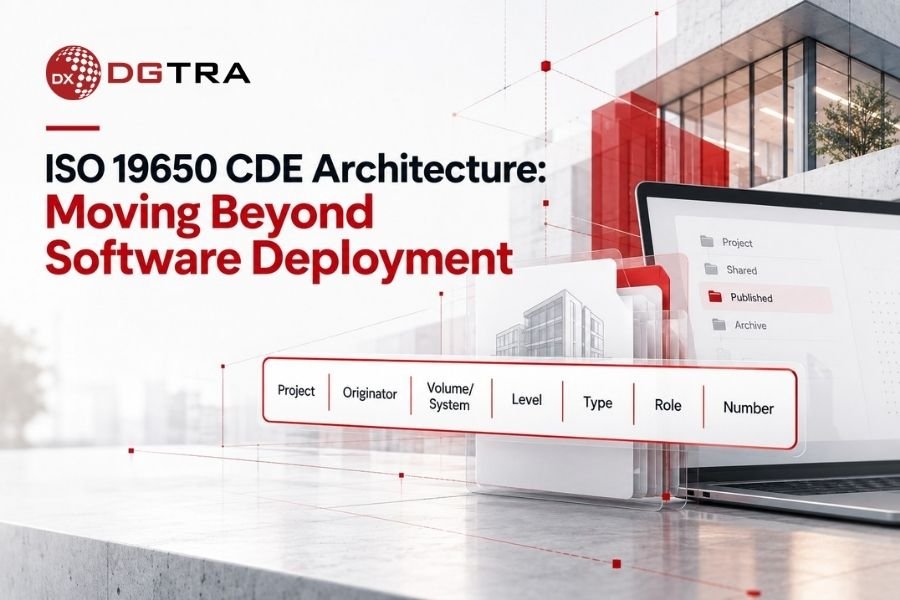
An ISO 19650-aligned CDE shifts the team from passive storage to active information management. The basic unit of exchange is not an unmanaged file, but a structured information container with defined metadata—including suitability codes, revision attributes, classification parameters, and explicit usage authorizations.
When governance processes are enforced, the CDE acts as an information gatekeeper. Trade deliverables pass through validation rules before reaching the shared project environment, helping ensure field teams work from verified models.
Market Dynamics: Information Governance Across the Asset Lifecycle
Global project delivery is shifting from geometric model creation toward structured information management. With international standard updates—including the draft revisions to the ISO 19650 series—and regulatory safety mandates enforcing a traceable “Golden Thread” of information, unmanaged file sharing creates real commercial risk.
To support true digital construction collaboration, modern projects link ISO 19650 workflow states with openBIM® standards:
1. Automated Verification via Information Delivery Specifications (IDS)
Validating whether an incoming model contains the required data historically required tedious manual checks. Using buildingSMART Information Delivery Specifications (IDS), project teams define alphanumeric and classification requirements in a machine-readable format. Automated CDE workflows evaluate incoming openBIM® (IFC) deliverables against these rules upon upload, flagging missing attributes before files enter project coordination.
2. Alignment with Multi-Dimensional Project Controls
A CDE operating separately from project controls creates commercial exposure. When model revisions inside the CDE do not connect to time (4D) and cost (5D) structures, scope changes are evaluated reactively. Linking CDE information containers to live Estimate at Completion (EAC) workflows helps teams evaluate scope changes before signing off on variations.
3. Structured Data for Operational Handover
The practical value of a CDE extends into facility operations. When information governance is maintained during design and delivery, the CDE helps transition the Project Information Model (PIM) into an Asset Information Model (AIM). Structuring standardized equipment metadata within a CDE allows cleaner data ingestion into Facility Management (FM) platforms and digital twins—reducing data loss at practical completion.
The CDE Governance Test: 4 Questions Every Project Leader Should Ask
To evaluate whether your CDE is reducing risk or simply hosting files, project leaders should review these four operational questions:
1. Can unverified information reach the field?
If trade teams can export drawings or access unverified design models without passing explicit, recorded approval gates, the CDE is not protecting site operations. Transitioning files between states (Work in Progress to Shared to Published) must require automated checks and documented sign-offs.
2. Can project information move between platforms without data loss?
Proprietary platform lock-in creates long-term friction for asset owners. Adopting openBIM® standards (such as IFC and BCF) ensures information remains readable across different software tools throughout the building’s lifecycle.
3. Can every critical decision be traced back to its source?
When scope variations or design changes happen in unrecorded email threads, the project audit trail breaks. A governed CDE maintains an immutable record of every model revision, review comment, and formal approval—supporting regulatory compliance and dispute resolution.
4. Is the CDE connected to actual project delivery, controls, and handover?
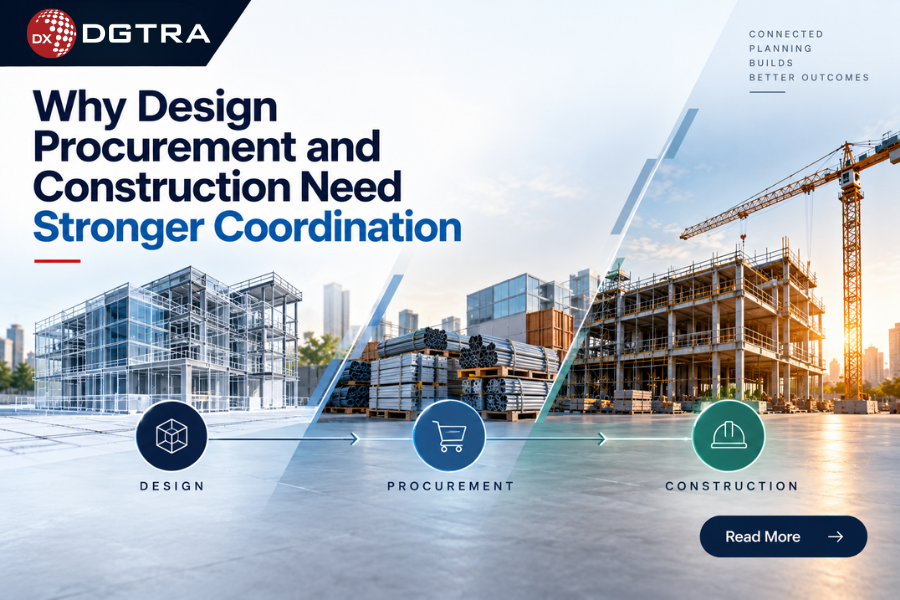
A CDE should not sit in isolation from site execution. Integrating information flows with early Virtual Design & Construction (VDC) workflows ensures that multi-trade spatial coordination occurs inside governed environments before field work begins.
Conclusion: Transitioning from Software Ownership to Information Governance
Deploying a Common Data Environment is only the first step toward modernizing capital project delivery. True collaboration does not occur because project participants share a cloud repository; it happens when information is structured, verified, and governed before it influences commercial or operational decisions. By aligning CDE workflows with ISO 19650 lifecycle gates, buildingSMART openBIM standards, and integrated project controls, project directors and digital engineering leaders can eliminate administrative friction, protect commercial margins, and deliver audit-safe assets ready for long-term operational success.
About DGTRA
DGTRA is a global technology consulting and solutions firm specializing in end-to-end BIM consulting, ISO 19650 compliance, Virtual Design & Construction (VDC), and Project Control Management for asset owners, EPC contractors, and real estate developers. Operating as an independent digital engineering advisor, DGTRA helps enterprise teams establish audit-safe data governance, streamline multi-trade coordination, and bridge the gap between design models and field execution.
Frequently Asked Questions (FAQs)
How does an ISO 19650-aligned CDE differ from standard cloud storage?
Standard cloud storage hosts files without enforcing information rules. An ISO 19650-aligned CDE uses defined lifecycle states (Work in Progress, Shared, Published, Archived), explicit metadata rules, and authorization gates to control how information is checked, shared, and approved.
What is the role of buildingSMART IDS in a CDE workflow?
Information Delivery Specifications (IDS) convert client information requirements into a machine-readable format. When integrated with CDE validation tools, IDS checks incoming openBIM (IFC) models for required parameters automatically, reducing the need for manual data reviews.
How does CDE governance support commercial management?
By ensuring design revisions are coordinated and verified before issue, a governed CDE helps prevent unapproved drawing versions from reaching the field. This improves visibility into design changes and helps reduce unbudgeted variation claims.
Can a CDE support facility operations after construction?
Yes, provided asset information requirements are defined early. When asset parameters are captured systematically during delivery, the CDE supports the creation of an Asset Information Model (AIM) for transfer into maintenance systems.
What is the first step in improving an existing CDE implementation?
The first step is auditing current information management processes. This includes reviewing workflow bottlenecks, information delivery schedules, metadata naming standards, and supply-chain compliance across active projects.
👉 To review your organization’s CDE governance framework or discuss digital engineering workflows, explore DGTRA’s ISO 19650 Consulting Services.