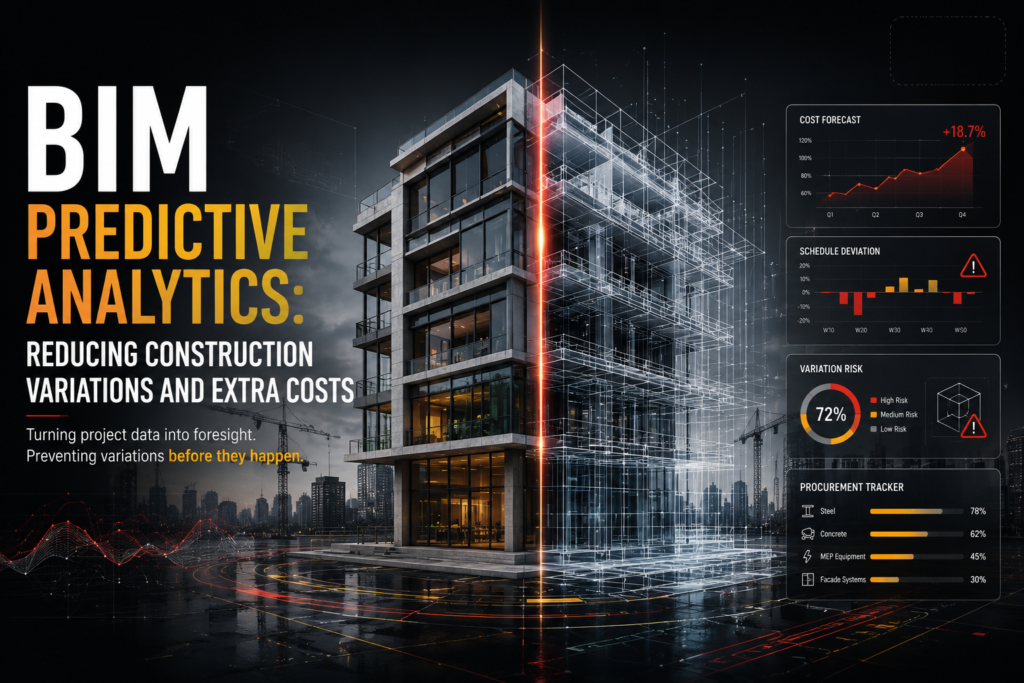
The Variation Was Written into the Project Three Months Before Anyone Saw It.
That is the uncomfortable truth most construction cost control processes are not designed to surface.
By the time a variation instruction lands on a project manager’s desk, the decision that caused it was made weeks — sometimes months — earlier. A structural system chosen without full constructability validation. An MEP routing was approved against an incomplete federated BIM model. A procurement timeline set without scenario analysis against the construction sequence.
The variation was not a surprise. It was a predictable outcome of a decision made without the right data at the right time.
This is what BIM predictive analytics is designed to solve. Not by catching problems faster — but by building the data visibility that makes those decisions differently in the first place.
This blog builds on the frameworks explored in How AI Is Reshaping BIM Workflows for AEC Firms, BIM 6.0: Why Sustainability Is the New Sixth Dimension of Construction, and How to Move Your AEC Team Toward Integrated Delivery Maturity — bringing predictive analytics to bear on one of the most persistent and costly challenges in AEC project delivery.
Why Traditional Cost Control Is Structurally Limited
Most construction cost management frameworks share a common architecture — they measure what has happened and report it. Budget versus actual. Planned versus earned. Forecast at completion based on current burn rate.
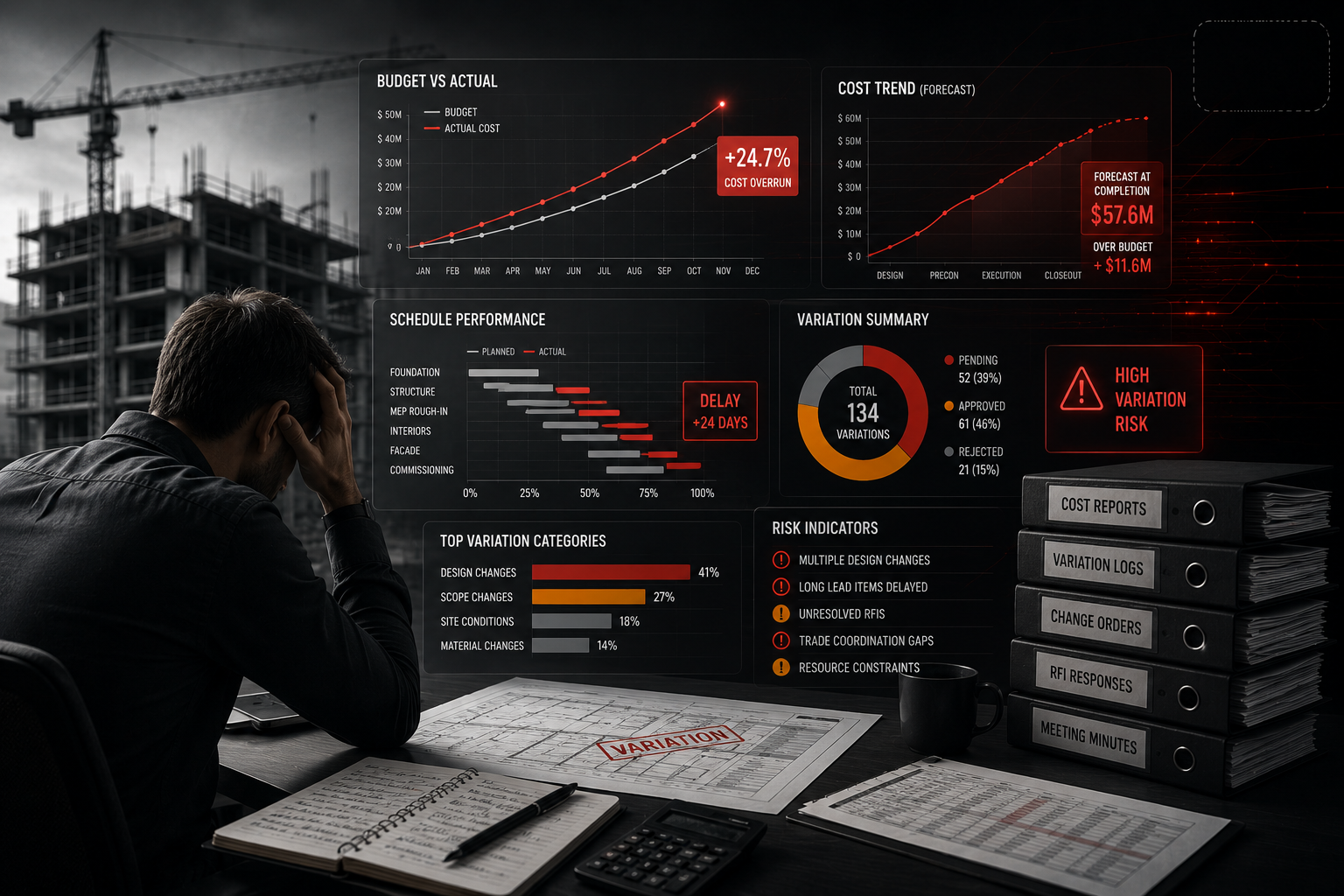
These are all retrospective instruments. They describe the past with varying degrees of accuracy. And they consistently fail to answer the question that matters most on a live project — what is about to happen, and what can we do about it right now?
Research validating an integrated 4D/5D Digital Twin framework for predictive construction control found that industry data shows consistent average cost overruns above 20% and schedule deviations approaching 30% — with traditional deterministic CPM and document-based estimating identified as key contributors, as these approaches seldom reflect the uncertainty and interdependence of modern projects once execution begins. (Source: arXiv, 4D/5D Digital Twin Predictive Control 2025 →) Taylor & Francis Online
Those numbers — 20% cost overrun, 30% schedule deviation — have been consistent across the industry for decades. The tools have changed. The outcomes have not. Because the tools have been getting better at describing the problem rather than preventing it.
BIM predictive analytics is a distinct capability category. It is not a better version of cost reporting. It is fundamentally different from the relationship between project data and project decisions.
The Distinction That Changes Everything
Here is the framing most blogs on this topic miss.
Predictive analytics is not about having more data. Every large AEC project generates enormous volumes of data — model files, RFIs, variation logs, progress reports, procurement records. The data has never been the problem.
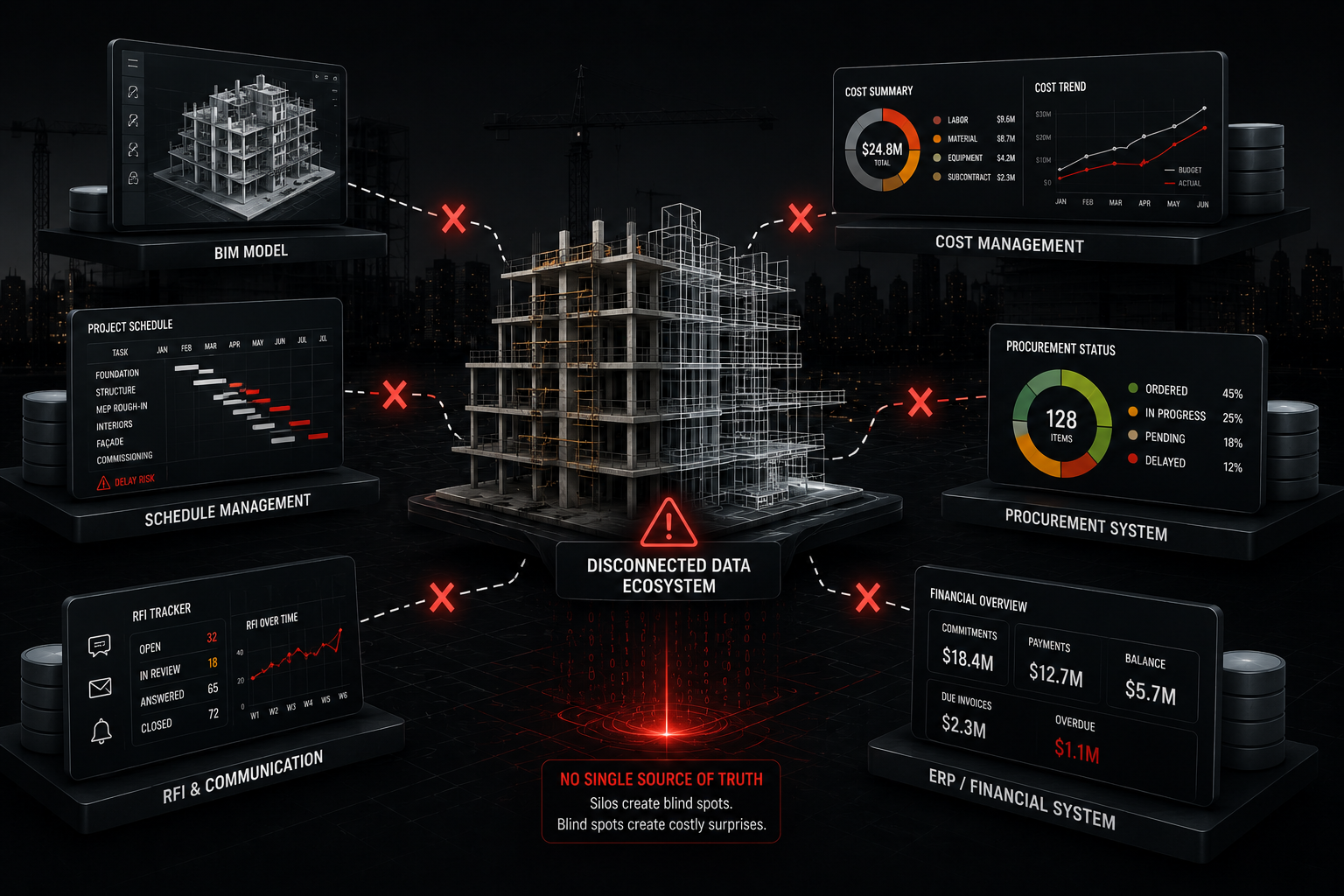
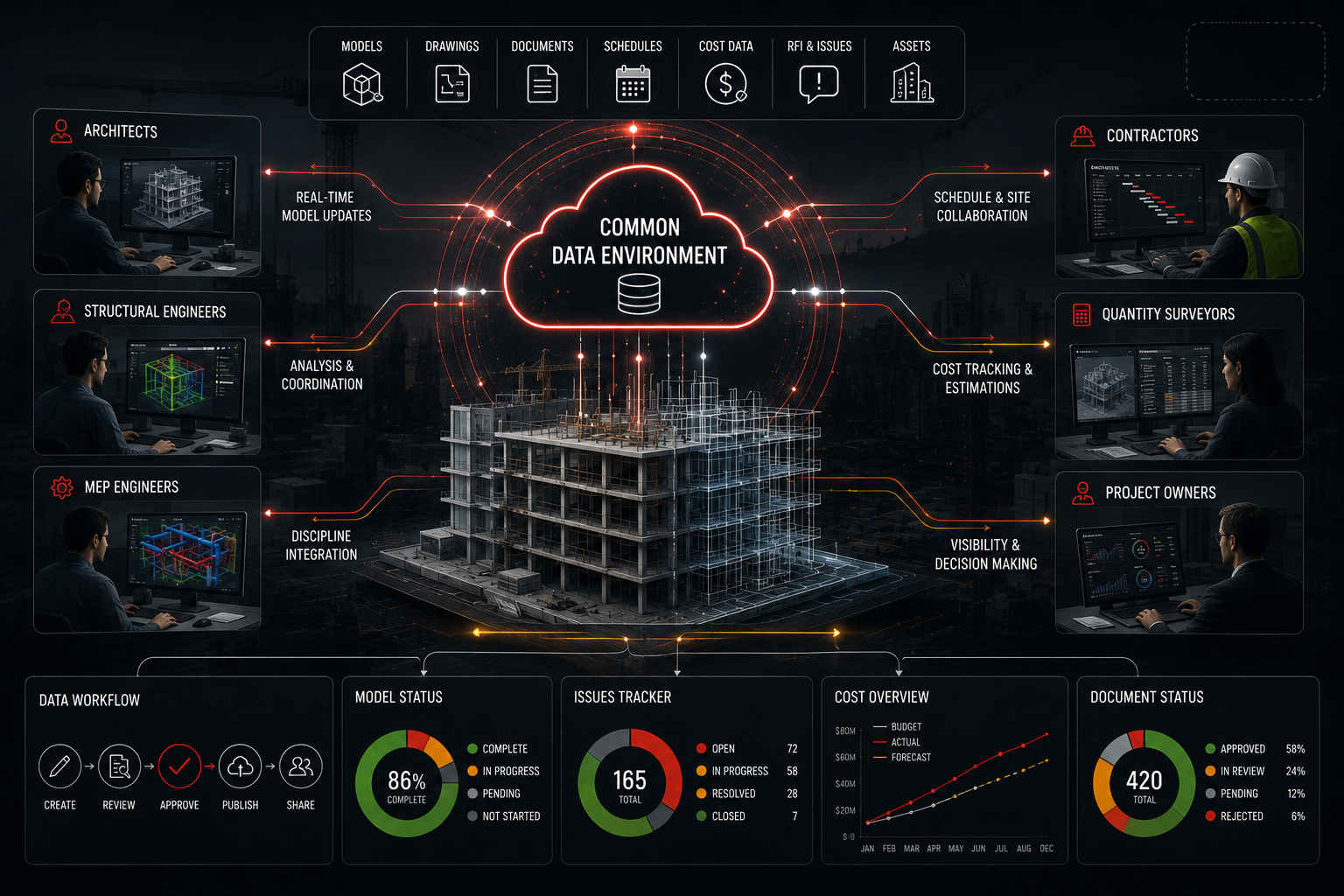
The problem is that most of that data sits in disconnected silos — the BIM model in one environment, cost data in another, schedule data in a third, procurement in a fourth. None of them talks to each other in real time. And none of it is structured in a way that allows patterns to be identified before they become problems.
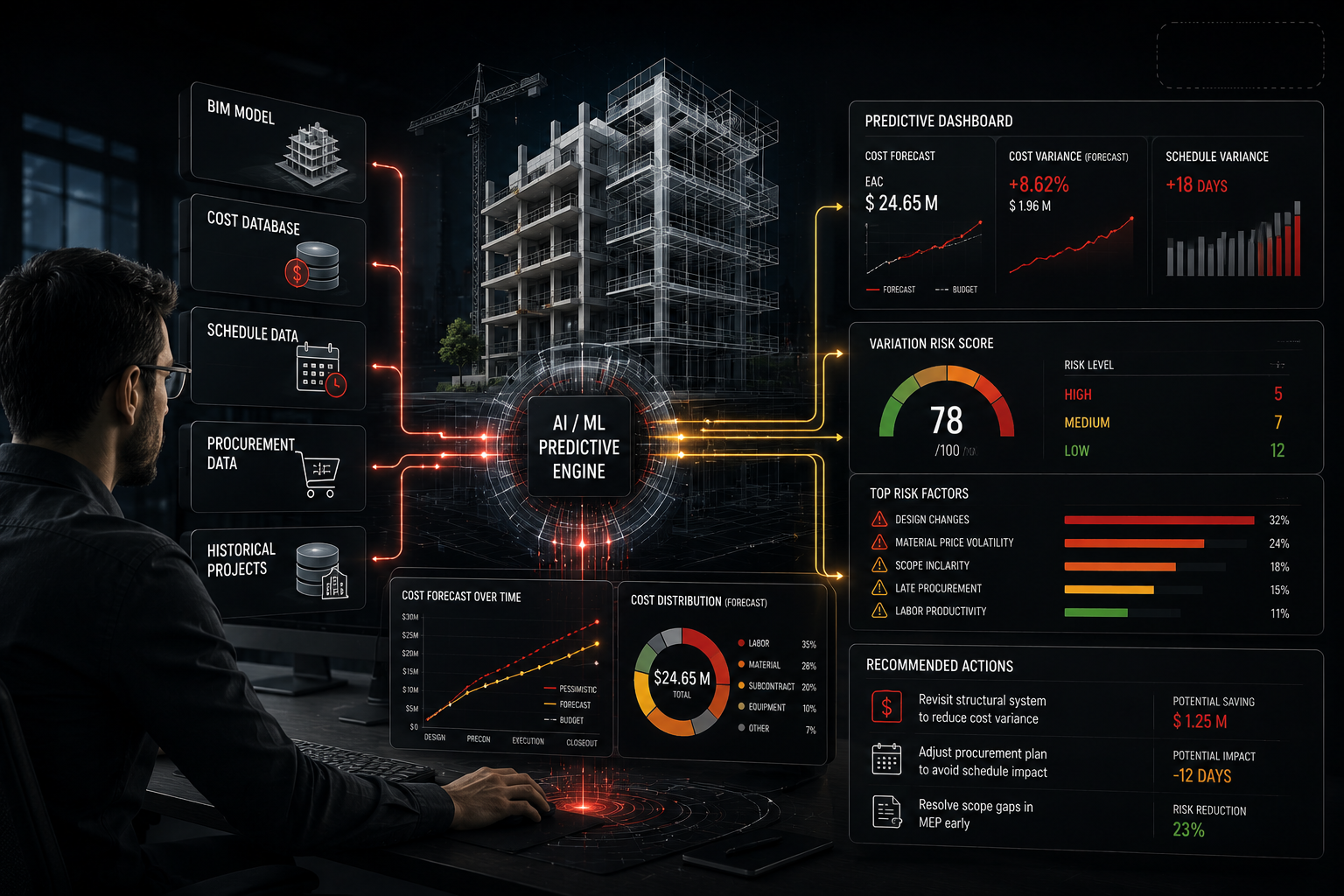
BIM predictive analytics works by connecting those silos — through a well-governed Common Data Environment and a 4D/5D BIM workflow that unifies model, cost, and schedule data — and then applying statistical and machine learning models to that dataset to identify leading indicators of cost variance and variation risk.
The output is not a better report. It is earlier, more precise decision-making — at the point in the project where decisions are still affordable to make.
Where Predictive Analytics Delivers Its Highest Value
Early in Design — When Carbon and Cost Decisions Are Still Reversible
The highest-leverage application of BIM predictive analytics is the one most teams skip entirely — early-stage design cost modeling.
Research published in Scientific Reports on BIM-integrated neural network cost prediction 2025 found that AI-powered models can forecast material price fluctuations across different construction seasons — enabling procurement teams to optimize timing and contingency allocation, and effectively control hidden cost overrun risks before they surface during construction execution.
When machine learning cost models are trained on structured historical project data and integrated with the BIM model from the earliest design stage, structural system selection, envelope specification, and MEP strategy decisions all carry predicted cost consequences — visible before they are committed.
This is also where BIM predictive analytics intersects most directly with the 6D BIM sustainability framework explored in BIM 6.0: Why Sustainability Is the New Sixth Dimension of Construction. When cost prediction and embodied carbon tracking run from the same model at the same stage, the team makes genuinely integrated decisions rather than optimizing one dimension at the expense of another.
During Pre-Construction — When Sequencing Locks In Risk
4D BIM construction sequencing is one of the most underutilized tools for variation prevention available to delivery teams. When the construction program is simulated against the federated model before mobilization, the conflicts that generate variations — spatial clashes, trade sequencing dependencies, access constraints, and procurement lead-time misalignments — are visible before the site team encounters them.
The key technical distinction — and the one most implementations miss — is that 4D simulation is only as reliable as the model it runs on. A sequencing simulation built on a model with LOD mismatches, incomplete MEP coordination, or unresolved structural interfaces does not predict site conditions. It predicts an idealized version of the project that does not exist.
This is why DGTRA’s Constructability Reviews validate models for buildability and sequencing logic before 4D predictive simulation runs — and why How to Validate BIM Models Before Construction Begins is a foundational read before any organization invests in 4D predictive planning.
During Construction — When Variation Risk Is Highest
The most immediate and operationally valuable application of BIM predictive analytics is live scenario analysis during construction — using the model to quantify the cost and schedule impact of emerging variations before a response decision is made.
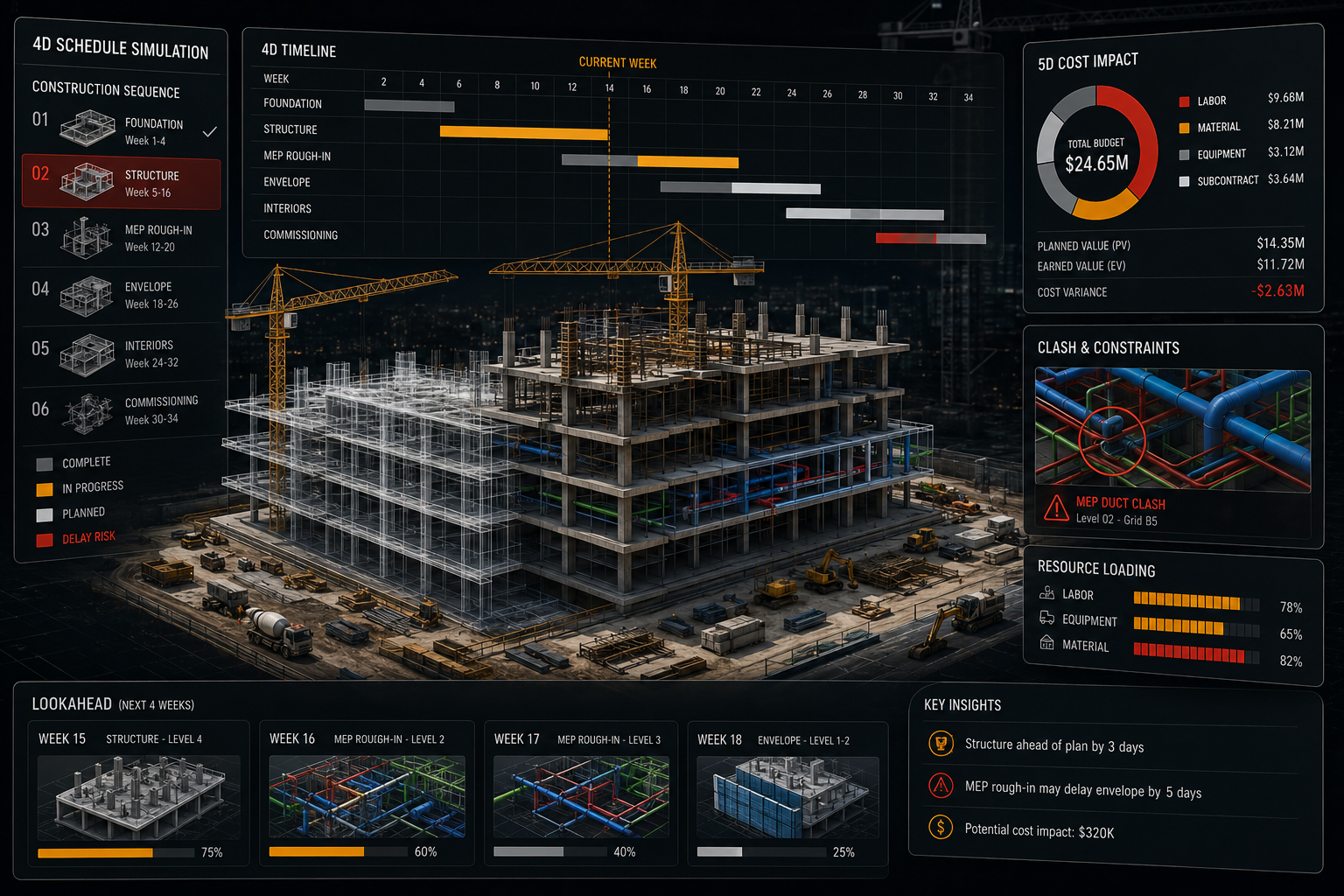
When a design change is proposed, a procurement delay surfaces, or a site condition differs from design assumptions, BIM-based what-if modeling allows the project team to evaluate multiple response paths simultaneously — resequencing, substitution, scope adjustment — and select the option that minimizes cost and schedule disruption before committing.
This transforms construction variation management from a reactive process — receive instruction, assess impact, issue claim — into a proactive one. The variation may still occur. But the team’s response to it is data-driven, faster, and significantly less expensive than one made under time pressure with incomplete information.
DGTRA’s BIM Project Management service embeds this scenario analysis capability into live project governance — giving delivery teams the analytical infrastructure to respond to emerging variations with confidence.
The Data Foundation That Makes It All Work
Every capability described in this blog has the same prerequisite.
BIM predictive analytics performs at its best when the data feeding it is structured, consistent, and governed throughout the full project lifecycle. That means:
Model quality that reflects reality. LOD alignment, classification consistency, and semantic completeness are not administrative standards — they are the foundation that determines whether 4D simulation and cost prediction outputs are trustworthy or theoretical. A model that passes visual review but carries LOD mismatches or unclassified elements is not ready for predictive analytics.
A CDE that captures learning across projects. The machine learning models that drive BIM cost prediction become more accurate with each project cycle — but only if cost outcomes, variation logs, procurement data, and schedule performance are consistently captured in a governed Common Data Environment. Most organizations have the data. Very few have it structured in a way that is usable for model training.
A BIM Execution Plan that defines analytics requirements upfront. Sustainability Information Requirements — as explored in the 6D BIM context — have a direct parallel in predictive analytics. If the data structure required for cost forecasting and variation prediction is not defined at project inception, the opportunity is often lost by Stage 4.
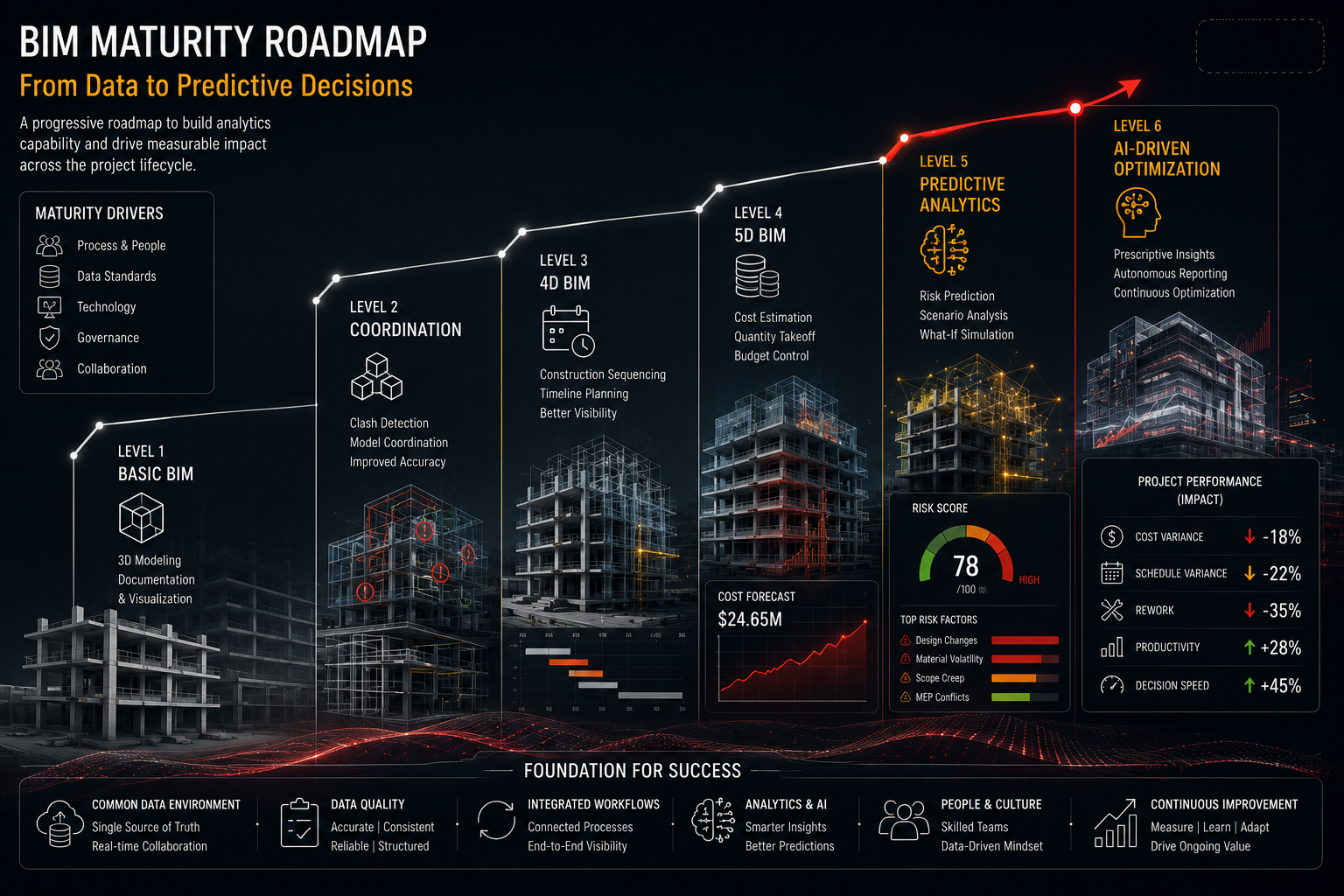
DGTRA helps organizations build this foundation through BIM Maturity Audits and Strategic BIM Roadmaps, and supports structuring your CDE for analytics readiness through CDE Software Implementation. Take the next step: assess your current BIM maturity and start your journey toward predictive project performance.
To further drive coordination and delivery maturity, explore The Hidden Cost of Clash Report Overload in BIM and Beyond Clash Count: BIM Coordination KPIs That Predict Project Performance in 2026. Apply these insights now to transform your project’s outcomes.
The Real Shift Is in How Decisions Get Made
BIM predictive analytics does not eliminate variations. Construction is inherently dynamic — design changes, site conditions, and supply chains fluctuate.
What it changes is the quality of the decision-making around those events. A team with predictive cost visibility responds to an emerging variation with scenario analysis and data. A team without it responds with judgment, experience, and time pressure.
Both teams face the same variation. One of them controls it. The other absorbs it.
The organizations building BIM predictive analytics capability into their standard delivery workflow today are building the decision-making infrastructure that makes project cost control genuinely proactive — project over project, dataset over dataset, as their models get smarter and their data accumulates value.
About DGTRA
DGTRA is a global BIM consulting and digital engineering firm supporting AEC and construction teams across the US, UK, Europe, and India. We specialize in building delivery frameworks — from predictive BIM analytics and 4D/5D cost control to coordination maturity and ISO 19650-aligned workflows — that help organizations take control of cost and schedule performance from the earliest project phase.