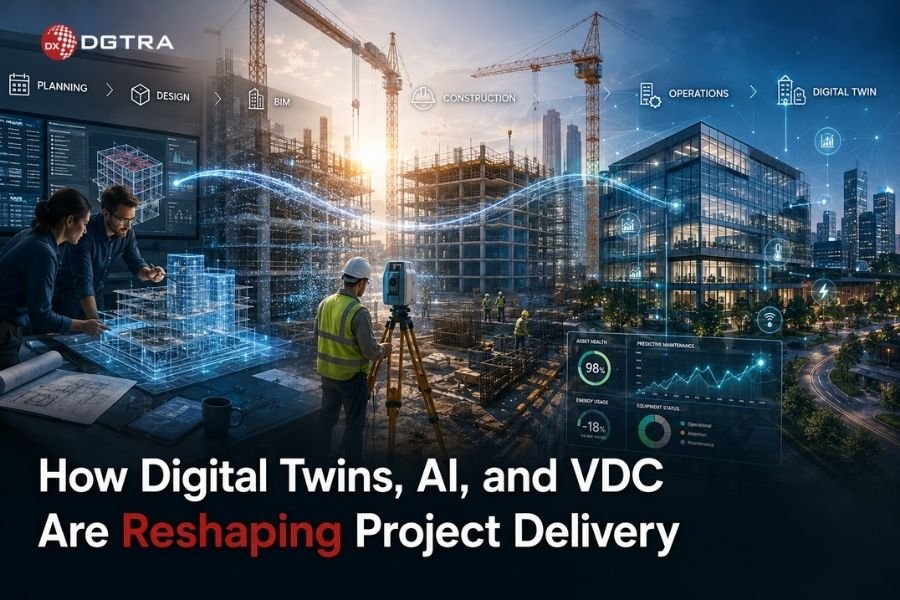
The global architecture, engineering, and construction (AEC) sector is undergoing a significant transformation. Project value now depends on data connectivity, predictive insights, and the integration of physical and digital environments.
Project owners and engineering executives face the challenge of scaling operational intelligence throughout the asset lifecycle. An International Data Corporation (IDC) report notes the AEC sector is moving from fragmented software pilots to robust data governance, organizational enablement, and enhanced decision-making.
By adopting Digital Twins, Artificial Intelligence (AI), and Virtual Design and Construction (VDC) technologies, leading firms are eliminating project disconnects and achieving greater margin predictability.
Executive Summary: The Connected Construction Paradigm
- The Core Shift: Transitioning from isolated, model-based drafting to an integrated digital thread throughout the asset lifecycle.
- The AI Impact: Moving from reactive clash detection to automated, rule-based conflict resolution and predictive analytics.
- The Operational Value: Transforming static as-built deliverables into dynamic, IoT-enabled Digital Twins that significantly reduce lifecycle operating costs.
1. Connected Construction: Building the Digital Thread
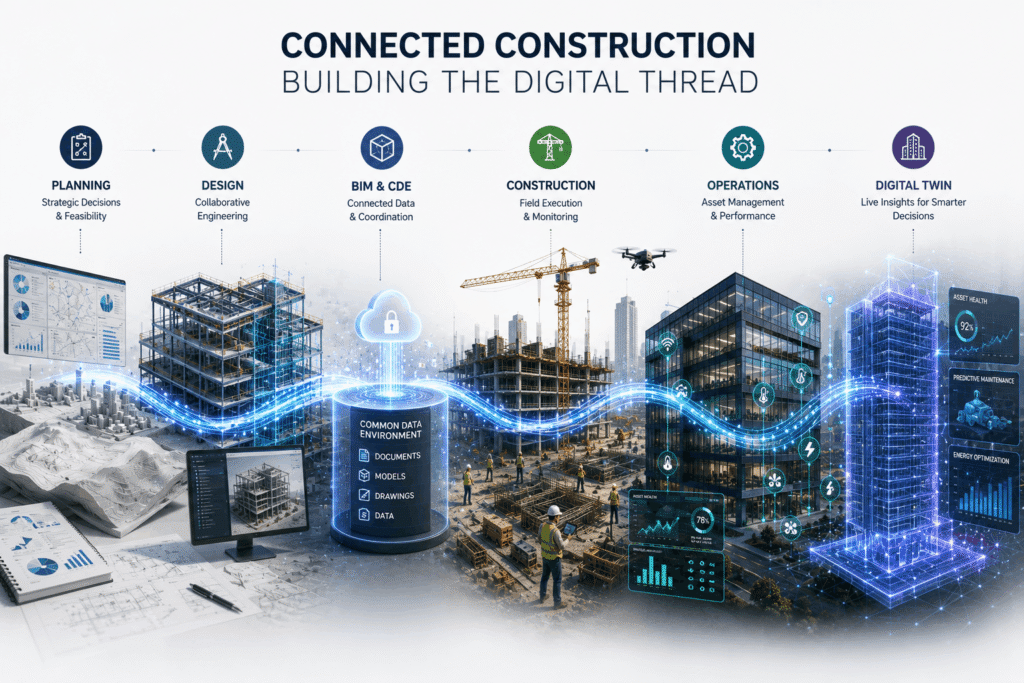
Connected construction is central to modern project delivery, enabling a continuous flow of structured information from early planning to daily facility management. In the past, critical asset data was often lost during fragmented handoffs between designers, contractors, and owners.
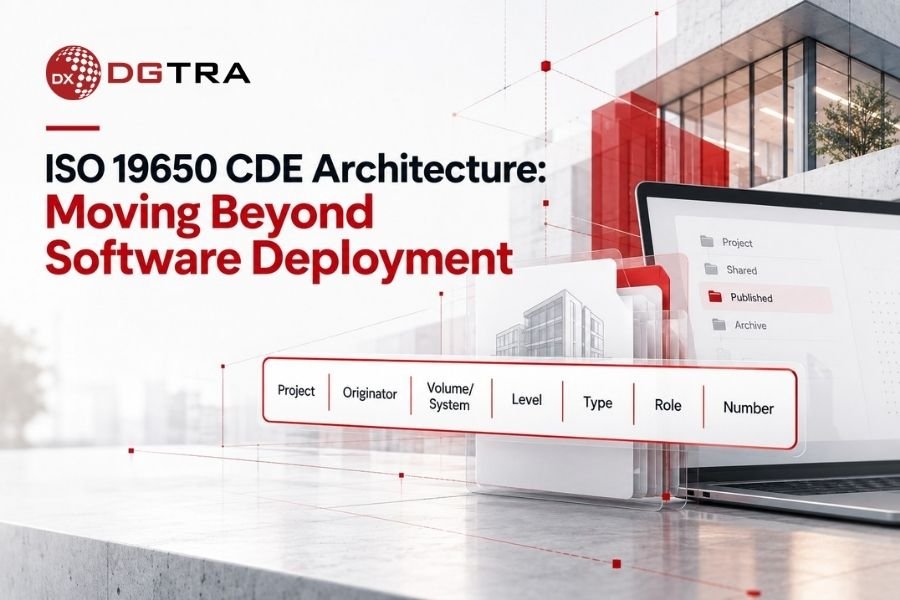
Robust information management frameworks, based on international standards such as ISO 19650, address this data loss. Establishing a unified Common Data Environment (CDE) and strict data schemas enables project teams to create a reliable digital thread.
This connected data foundation ensures that all stakeholders, from field superintendents to asset operators, access a single, reliable source of information in real time.
2. AI-Assisted Coordination & Predictive Analytics
Traditional coordination processes are reactive, requiring design teams to spend significant time manually filtering clash reports or responding to RFIs after issues arise. AI in construction shifts this approach from damage control to proactive prevention.
AI-Assisted Coordination
A global McKinsey & Company analysis notes that advanced organizations are redefining workflows by treating AI as an autonomous teammate rather than a simple tool. In VDC, machine learning algorithms automate administrative tasks in clash resolution. AI routines group geometric conflicts by system or trade, filter out false positives, and route actionable tasks directly to responsible engineers.
Predictive Analytics
By analyzing current model data with historical project performance, predictive models assess schedule risks, anticipate supply chain bottlenecks, and identify potential cost overruns before construction begins. Addressing these issues early allows leadership to mitigate design and logistical risks before they escalate.
3. Reality Capture: The Critical Validation Layer
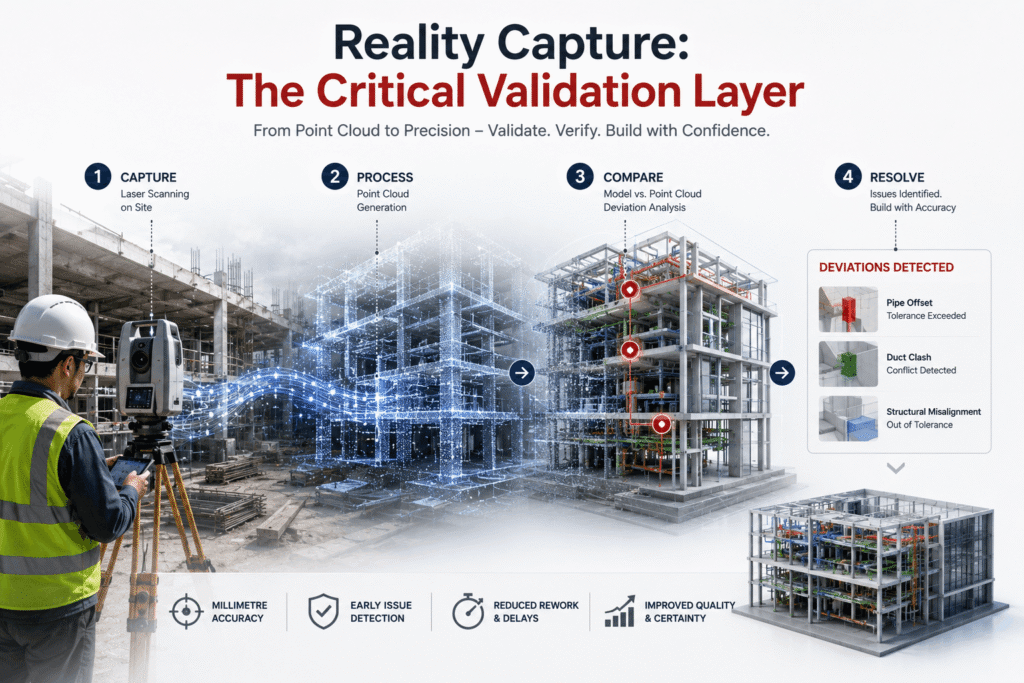
A digital model is valuable only when it accurately reflects site conditions. Modern VDC workflows use advanced reality capture technologies, such as terrestrial laser scanners, drone photogrammetry, and robotic total stations, to continuously audit the physical build.
Point cloud data captured in the field is overlaid on the coordinate model. Automated compliance scripts cross-check tolerances, verify installation accuracy, and identify deviations. This precise validation process removes reliance on subjective field logs, ensuring structural issues are detected and corrected before downstream trades begin work.
4. Digital Twins and Asset Lifecycle Intelligence
The next stage of connected construction is moving from a static as-built model to a dynamic Digital Twin. A digital twin bridges the physical and digital environments by continuously collecting live data from building management systems, IoT sensors, and operational meters.
This shift delivers significant financial and operational benefits. Research published by MDPI shows that advanced digital twin implementations can reduce maintenance costs by 10% to 25% and energy consumption by 15% to 30%.
Capability | Traditional VDC / BIM | AI-Driven Connected Twins |
Data Structure | Static, file-based models (PDFs, native files) | Continuous, live-streaming data architecture |
Coordination | Manual clash matrices and weekly review logs | Automated AI filtering and automated task routing |
Field Verification | Subjective daily logs and manual inspections | Millimeter-accurate laser scanning and reality capture |
Lifecycle Utility | Concludes at the post-construction handoff | Extends indefinitely across the operational lifecycle |
This live integration extends the value of VDC throughout the asset lifecycle. Facility operations teams gain a unified interface to run predictive maintenance, optimize resource use, and significantly reduce operating costs.
About DGTRA Consultancy
DGTRA Consultancy Private Limited is a leading global Digital Engineering and BIM Consulting firm, transforming information management across the Architecture, Engineering, Construction, Infrastructure, and Owner-Operator (AECO) sectors. Based in Pune, India, DGTRA serves as a trusted digital delivery partner for clients in North America, Europe, the United Kingdom, Australia, and the Middle East.
With deep technical expertise and a mature Information Management System, independently re-certified under ISO 19650 by the British Standards Institution (BSI), DGTRA supports complex capital infrastructure projects in commercial developments, data centers, aviation, transit, and healthcare. DGTRA designs and implements custom automation pipelines, end-to-end Common Data Environment (CDE) setups, precise reality capture workflows, and lifecycle-ready Digital Twins, enabling clients to achieve project certainty.
Discover how DGTRA delivers enterprise-grade project certainty through tailored BIM Consulting and Management Services, as well as advanced operational frameworks for Owner-Operator Digital Solutions.