Executive Summary
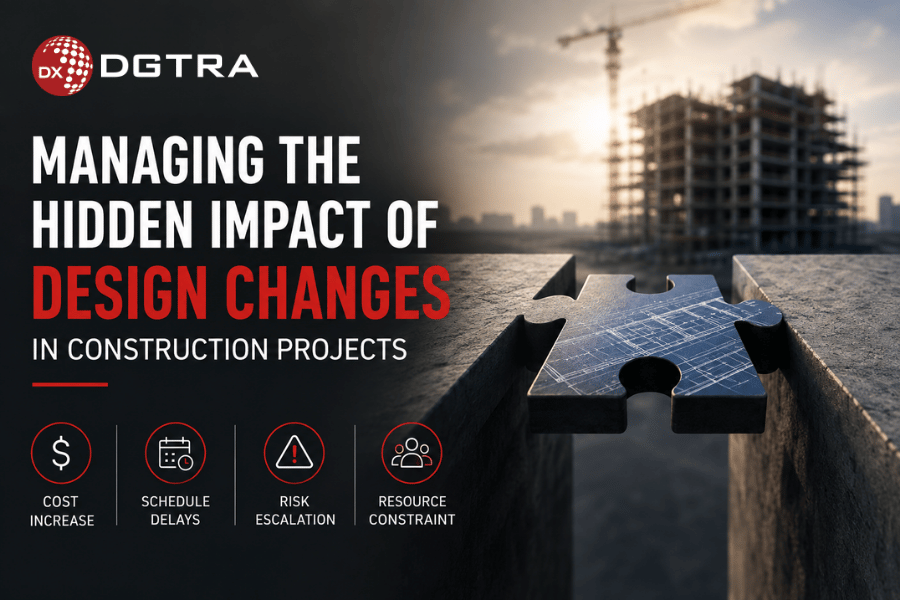
Continuing our focus on front-loading project intelligence—following our analysis on shifting constructability reviews to early schematic design—this article confronts the operational reality every capital project faces design revisions during execution.
While early constructability reviews eliminate foundational errors, project scope inevitably evolves. The critical differentiator between capital projects that protect their margins and those that suffer severe cost overruns is not whether changes occur. Rather, how quickly and accurately teams evaluate their multi-discipline impacts.
This paper outlines why traditional change-tracking mechanisms fail on complex builds and details how structured, multi-dimensional impact analysis—anchored by Change Management & Impact Analysis and ISO 19650 Advisory frameworks—restores financial control, mitigates scope creep, and ensures capital predictability.
The Illusion of the “Minor” Design Adjustment
In modern capital delivery, project budgets rarely collapse under a single catastrophic error. Instead, they erode through quiet attrition: the unanalyzed, incremental design adjustment.
Consider a standard scenario on an industrial or commercial build. An architect shifts an interior partition wall six inches to accommodate an updated equipment spec, or a structural engineer deepens a steel beam profile by two inches to satisfy a localized load recalculation. On paper, these adjustments appear minor. The drafting cost is negligible, the revised sheet is stamped, and the change is logged as routine engineering maintenance.
The hidden danger lies in the silent ripple effects that follow.
A two-inch reduction in ceiling void clearance compresses the dedicated spatial envelope for MEP distribution. The mechanical ductwork, now lacking its designated zone, is rerouted beneath electrical cable trays. By the time installation crews arrive on site, what began as a routine drafting revision has metastasized into physical trade clashes, ruined prefabricated assemblies, emergency Request for Information (RFI) cycles, and standing-time claims.
When design changes are evaluated in isolation, their financial and schedule consequences remain invisible until trade contractors submit field change orders. True cost control requires recognizing that, in complex engineering, no revision exists in isolation.
The Structural Failure of Traditional Change Tracking
For decades, project controls teams have attempted to manage scope revisions using 2D revision clouds, spreadsheet logs, and weekly coordination meetings. While these tools record a change’s existence, they fail to measure its disruption.
Revision Clouds Provide Location, Not Intelligence
A red cloud on a 2D drawing indicates where lines moved. It conveys zero operational intelligence regarding spatial tolerance stack-ups, trade accessibility, material lead-time shifts, or installation sequencing. It informs teams that something changed, but leaves the downstream impact to guesswork.
Siloed Engineering Masks Downstream Risk
Discipline-specific engineering teams naturally evaluate revisions through their own technical lens. An electrical consultant adjusts conduit pathways to solve a local clearance issue, unaware that the new layout blocks critical access panels required for routine mechanical maintenance. Without integrated spatial analysis, cross-discipline conflicts are guaranteed.
Financial Tracking Is Historically Reactive
Traditional project accounting registers budget variance weeks or months after field disruptions occur. Cost reports aggregate past expenditure; they do not predict future liability. Managing project change through financial reporting alone is equivalent to steering a capital project by looking exclusively in the rearview mirror.
The Three Pillars of Multi-Dimensional Impact Analysis
To prevent incremental scope creep from eroding project returns, forward-thinking asset owners and EPC contractors are abandoning manual change logs for structured impact analysis. Before any design modification is formally approved for construction, it must undergo automated, multi-dimensional stress testing across three core vectors:
Spatial & Coordination Integrity (3D VDC)
By running automated model-comparison protocols within a central Virtual Design & Construction (VDC) environment, digital engineering teams instantly visualize geometric shifts. Proposed revisions are overlaid against existing multi-trade coordination models to detect physical clashes, headroom violations, and maintenance access breaches long before drawings are issued to the field.
Schedule & Sequencing Logic (4D Integration)
Design revisions directly alter construction velocity and trade sequencing. By linking revision models directly to master Primavera or MS Project schedules, project controls specialists run delay-impact simulations. This analysis determines whether a design change sits on the critical path, requires altered crane logistics, or compromises long-lead procurement windows.
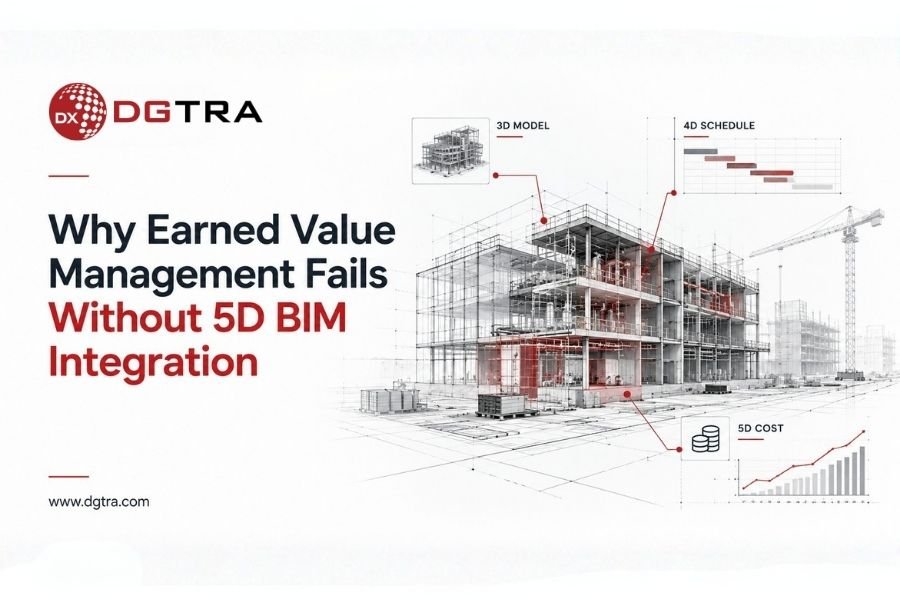
Cost & Quantity Volatility (5DTakeoff)
Automated model takeoffs extract precise volumetric and material variations resulting from geometry shifts. Instead of waiting for contractor claims, project directors instantly quantify delta changes in steel tonnage, concrete volume, or piping runs—enabling real-time cost forecasting and proactive commercial negotiation.
Sector-Specific Operational Risk
The operational sensitivity to unmanaged design changes varies by asset class, but the financial exposure is universally high in complex, system-dense facilities:
Healthcare & Life Sciences:
In hospital environments, altering a single partition wall can disrupt laminar airflow distribution, compromise medical gas pressure drops, or violate radiation shielding mandates. Discovering these conflicts post-installation guarantees regulatory delays and expensive compliance retrofits.
Industrial & Processing Plants:
For industrial retrofits, a minor piping tie-in adjustment can alter fluid dynamics, overload structural equipment pads, or block rigging paths required during future plant turnarounds. Systematic impact analysis validates constructability and long-term operational maintenance before skid fabrication begins.
Data Centers & Mission-Critical Assets:
Driven by aggressive speed-to-market demands, data center construction leaves no margin for schedule slip. Uncoordinated structural or electrical revisions directly threaten commissioning milestones, resulting in substantial liquidated damages and deferred tenant revenue.
The Strategic ROI of Rigorous Impact Analysis
Establishing formal Change Management & Impact Analysis transforms project controls from a reactive dispute-resolution overhead into a strategic value generator:
- Commercial Protection: Quantifying spatial and cost impacts before sign-off prevents unbudgeted subcontractor change orders and eliminates speculative “risk contingency” pricing.
- RFI Suppression: Resolving cross-discipline discrepancies inside the digital environment drastically reduces field-generated Requests for Information, allowing jobsite superintendents to focus on production rates rather than administrative dispute resolution.
- Schedule Defense: Early schedule delay simulations provide project managers with the visibility needed to implement mitigation strategies—such as re-sequencing non-critical path activities—before completion dates are compromised.
- Governance and Claims Defense: Operating within a structured ISO 19650 Common Data Environment ensures an immutable audit trail for every design modification, protecting asset owners against unjustified delay claims.
Key Takeaways for Project Leaders
- Change is compounding: Minor drafting modifications create secondary and tertiary trade disruptions that multiply project costs if left unanalyzed.
- 2D tracking is a liability: Revision clouds state where a line shifted, but offers zero insight into spatial clearances, schedule logic, or cost impacts.
- Impact analysis must be multi-dimensional: Effective change governance requires simultaneous evaluation of 3D spatial coordination, 4D schedule sequencing, and 5D quantity impacts.
- Data governance dictates control: Managing design revisions within an data environment guarantees clear version control, complete auditability, and teamwide operational alignment.
Frequently Asked Questions (FAQs)
What is construction impact analysis?
Construction impact analysis is the technical evaluation of a proposed design or scope change across spatial coordination, budget baselines, construction schedules, and regulatory requirements before the modification is approved and executed on site.
How does VDC technology enhance change management?
VDC technology uses automated digital model comparisons to instantly highlight physical trade clashes, volumetric quantity shifts, and spatial access conflicts caused by design revisions.
What is the difference between scope tracking and delay impact assessment?
Scope tracking measures changes in project deliverables and material quantities, whereas delay impact assessment simulates how those scope changes affect construction sequencing, milestone dates, and the critical path.
Who is responsible for conducting multi-discipline impact analysis?
VDC managers and project controls specialists drive impact analysis in direct collaboration with lead discipline engineers, cost estimators, and general contracting leadership.
About DGTRA
DGTRA Consultancy is an independent digital engineering and technical advisory firm. We specialize in Change Management & Impact Analysis, Virtual Design & Construction (VDC), Project Controls, BIM Consulting, and ISO 19650 Advisory.
DGTRA partners with asset owners, EPC contractors, and design leaders worldwide to institute rigorous digital data governance, eliminate execution surprises, and engineer financial certainty across complex capital portfolios.
Conclusion & Next Steps
Design changes do not have to mean cost overruns. By replacing manual 2D drawing reviews with data-driven impact analysis, project directors replace reactive troubleshooting with absolute commercial control.
Protect Your Project Margins
Partner with DGTRA’s digital engineering and project controls experts to integrate advanced change management protocols into your active capital pipeline.
👉 Contact DGTRA’s Project Controls Advisory Team
👉 Explore DGTRA’s Change Management & Impact Analysis Solutions
👉 Learn More About Our Enterprise Project Controls Services