For over a decade, capital asset owners have mandated Building Information Modeling (BIM) on major capital builds. The promise was clear: 3D coordination, reduced clashes, and a comprehensive digital handoff at practical completion.
Yet, once the construction phase ends, enterprise asset owners frequently encounter a frustrating reality:
- Geometric models delivered in proprietary software formats remain locked inside design departments.
- Equipment metadata is inconsistent, missing, or disconnected from operational asset registers.
- Maintenance teams revert to paper manuals, unindexed PDFs, or legacy Computerized Maintenance Management Systems (CMMS).
- Facility operators spend months manually re-keying equipment data to establish baseline operations.
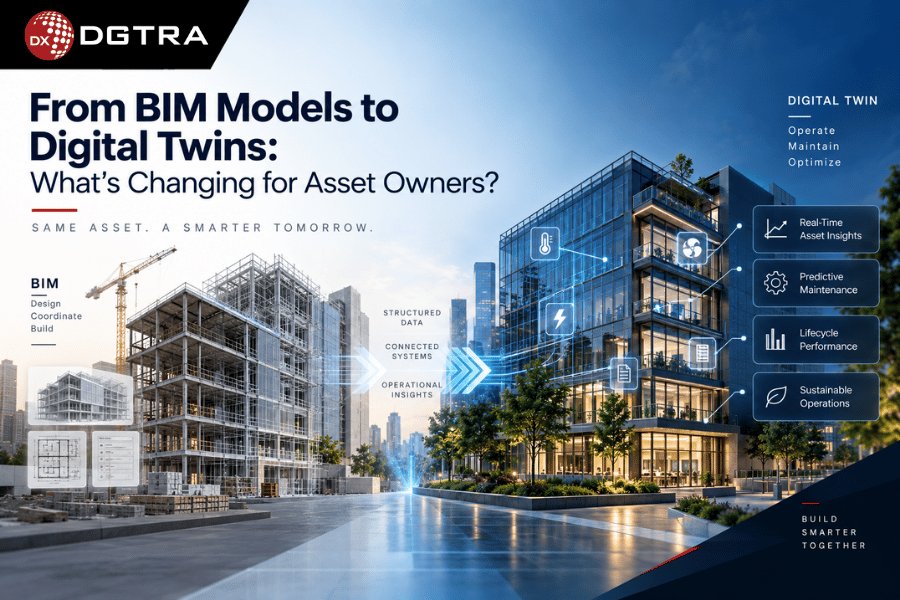
While traditional BIM focuses heavily on design coordination and construction delivery, an Operational Digital Twin bridges the gap between capital expenditure (CAPEX) and operational expenditure (OPEX).
For asset owners, the evolution from static BIM models to dynamic Digital Twins represents a fundamental shift: moving from a design deliverable to a live, data-driven operational asset.
The Core Transformation: Static Geometry vs. Dynamic Operational Intelligence
To understand what is changing for enterprise leadership, it is essential to separate geometric 3D representation from true operational intelligence.
A traditional BIM deliverable is largely a point-in-time snapshot built to optimize design decisions and site assembly. Once construction closes, that model begins to age, quickly becoming decoupled from real-world facility modifications.
In contrast, an Operational Digital Twin combines geometric representation with live operational inputs—integrating Building Management Systems (BMS), IoT sensors, enterprise asset management (EAM) platforms, and maintenance histories. The resulting environment reflects real-time operational status, helping facility directors anticipate performance degradation rather than reacting to equipment breakdowns.
What Is Changing: 3 Market Realities Driving Asset Owner Adoption
Leading enterprise developers, healthcare networks, and infrastructure owners are restructuring their digital engineering strategies around three core operational shifts:
Shift from Proprietary Models to Vendor-NeutralopenBIM®
Proprietary file formats restrict data access across an asset’s 30- to 50-year operational lifecycle. Asset owners are increasingly mandating buildingSMART openBIM® standards—specifically Industry Foundation Classes (IFC)—to prevent vendor lock-in. By requiring vendor-neutral schemas during design and construction, owners ensure their facility data remains readable across any future Facility Management (FM) software.
Transition to Machine-Readable Data via IDS
Historically, validating whether a delivered 3D model contained required equipment parameters (such as serial numbers, maintenance schedules, or warranty dates) required manual visual audits. Using buildingSMART Information Delivery Specifications (IDS), asset owners now define exact Asset Information Requirements (AIR) in a machine-readable schema. This allows automated compliance checking within the project’s ISO 19650 Common Data Environment (CDE) before handover sign-off.
Integration with Multi-Dimensional Controls & Lifecycle Analytics
Digital Twins do not exist in isolation from financial realities. When operational metadata connects back to project controls data, owners gain full visibility into total cost of ownership (TCO). Linking design parameters to long-term lifecycle models builds on principles established during construction, such as those detailed in our guide on predictive project controls and change management.
The Digital Twin Readiness Test: 4 Questions for Asset Owners
To determine whether your organization is building an operational asset or simply collecting unused 3D models, executive leaders should evaluate four strategic questions:
Are your Asset Information Requirements (AIR) defined before design begins?
If asset metadata requirements are introduced at practical completion, it is already too late. Owners must establish clear AIR parameters early so design and trade contractors embed required operational data throughout delivery.
Can your asset data transfer directly into FM systems without manual entry?
If your facility teams must manually extract data from submittals or PDFs to populate your CMMS or EAM, your digital handover is broken. A structured handover transfers the Project Information Model (PIM) cleanly into a functional Asset Information Model (AIM).
Is your asset data readable without proprietary software licenses?
Relying on proprietary software ecosystems exposes owners to long-term licensing costs and file format obsolescence. Enforcing openBIM® schemas guarantees long-term ownership and access to your asset’s digital twin.
Is the digital twin connected to real-time performance systems?
A static model sitting on a server is not a digital twin. True operational twins link geometry with live IoT sensor data, BMS telemetry, and work-order management software—enabling predictive maintenance across the asset lifecycle. See how early spatial coordination enables cleaner digital handovers in our constructability case study on complex commercial builds.

 To evaluate your organization’s digital twin strategy or establish ISO 19650 asset governance, explore DGTRA’s Lifecycle BIM Consulting Services.