Beyond the Hype: Practical AI in Construction Project Controls
Every week there is another headline promising that artificial intelligence will revolutionize capital project delivery.
In executive boardrooms and project trailers, the reality is a lot more grounded. Most teams have experimented with generic text generators to draft email updates or summarize meeting notes. But when it comes to managing multi-million-dollar project contingencies, estimating complex bids, or tracking critical paths, generic AI tools fall flat.
For Project Directors, EPC Leads, and Commercial Managers, the real question is simple: Where does shiny software noise end, and practical decision intelligence begin?
Real AI value in project controls isn’t about generating text. It is about turning the mountains of historical data sitting in your enterprise systems into early warnings you can actually use.
The Shift From Generic Tools to Structured Data Pipelines
The biggest mistake teams make with AI is treating it like a standalone fix. Plugging raw project data into off-the-shelf models usually leads to hallucinated answers, security concerns, or vague advice that doesn’t help on site.
Construction AI depends entirely on data quality. To get meaningful insights, your project controls setup needs a structured information pipeline first.
Leading tech platforms like Autodesk Construction Cloud demonstrate that the real engine behind predictive risk tracking is connected data. When your daily logs, submittals, cost codes, and 3D models feed into a clean environment, algorithms can spot actual operational trends rather than guessing.
Clean data pipelines turn disconnected site reports into actionable forecasting.
Machine Learning for Early Schedule Warnings in Primavera P6
Project schedulers know the limits of traditional Critical Path Method (CPM) tracking. A baseline schedule in Primavera P6 tells you how the project is supposed to run. Actual site progress logs tell you what already broke last month.
Machine learning is changing this by shifting schedule analysis from a historical record into a predictive warning system.
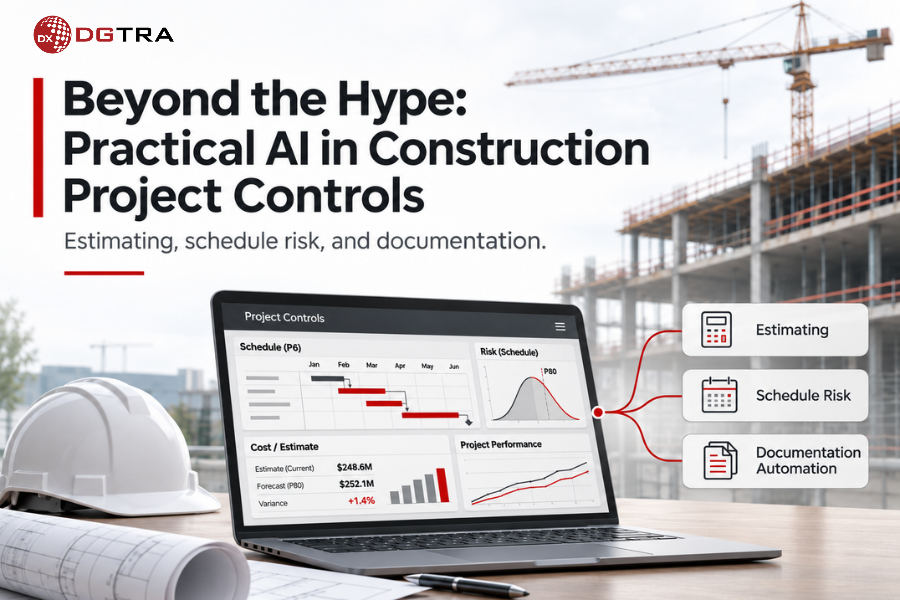
Instead of replacing P6, modern schedule intelligence platforms sit on top of your existing CPM files. These models analyze historical performance across hundreds of completed projects to evaluate your active schedule:
- Identifying Hidden Logic Risks: Algorithms flag aggressive activity durations, logic missing proper ties, or unrealistic trade stacking before work starts on site.
- Predicting Delay Probabilities: Recent industry studies highlight that machine learning models trained on Primavera P6 datasets can forecast schedule delays with over 80% accuracy.
- Evaluating Trade Lead Times: Predictive models compare live procurement schedules against real-world supply chain lead times, giving project leads advance notice before a late delivery hits the critical path.
Catching a potential two-week delay during pre-construction planning is always cheaper than negotiating liquidated damages during execution.
5D Estimating and Automated Risk Benchmarking
Estimating major capital builds has traditionally relied on manual quantity extractions and historical cost sheets. When design changes occur mid-stream, estimators work around the clock to recalculate cost exposure.
Applying machine learning to cost controls helps commercial managers bridge the gap between initial design iterations and budget approvals:
- Automated Bid Analysis: AI tools parse subcontractor proposals to flag missing scope items, unaligned exclusions, or pricing anomalies across complex trade packages.
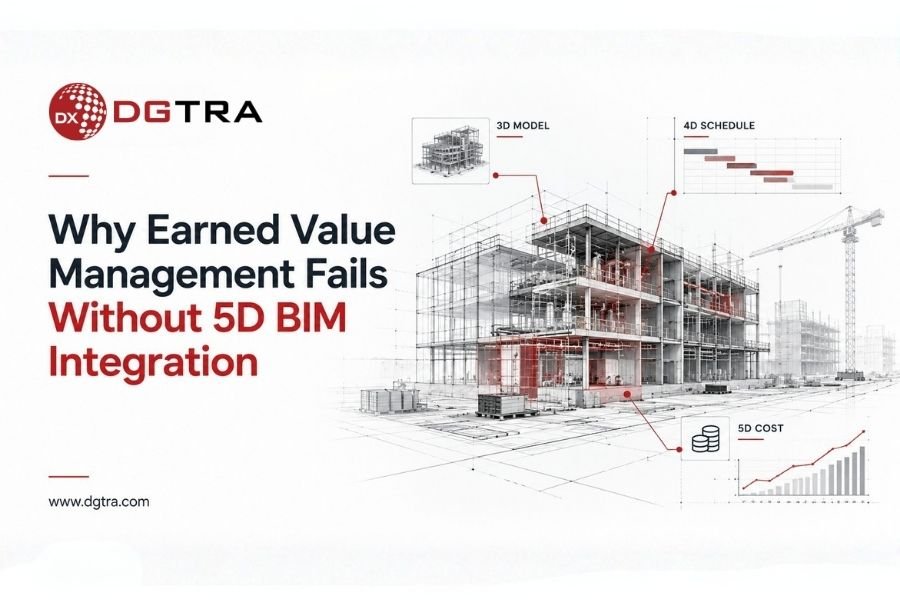
- Model-Based Quantity Verification: Integrating predictive tools with 5D BIM project controls ensures that scope revisions trigger immediate cost code updates, keeping estimate-at-completion forecasts accurate.
- Historical Cost Benchmarking: Advanced algorithms compare current unit rates against legacy project databases, giving estimators clear confidence scores on bid accuracy.
This isn’t about removing estimators from the process. It is about stripping away manual data entry so commercial teams can focus on strategic risk allocation and subcontractor negotiation.
Maintaining Human Engineering Judgment
No matter how advanced an algorithm gets, software cannot replace experienced construction leadership.
A predictive model might flag that a structural steel package has a high risk of slipping based on historical weather patterns and crew sizes. But it takes an experienced Project Director to weigh site access constraints, adjust trade handoffs, or authorize overtime to keep the build on track.
The goal of practical AI is augmentative intelligence. The software surfaces the risk early, quantifies the exposure, and presents options. The human team makes the call.
Practical Steps to Prepare Your Project Controls for AI
If you want to move past AI fluff and build reliable decision intelligence into your delivery framework, start with these four steps:
- Standardize Your Data Fields: Enforce consistent file naming, cost codes, and activity codes across all active builds. AI cannot read chaotic spreadsheets.
- Centralize Your CDE Governance: Implement strict ISO 19650 container states to ensure your underlying data source remains audit-safe and accurate.
- Layer Tools on Existing Platforms: Avoid buying standalone platforms that force your team to leave Primavera P6 or your primary ERP. Look for tools that layer onto your established tech stack.
- Target Specific Operational Friction: Don’t buy AI for “general efficiency.” Pick one concrete problem—like schedule delay prediction or bid variance analysis—and pilot it on a single major build.
Frequently Asked Questions (FAQs)
Does implementing AI mean replacing standard tools like Primavera P6 or MS Project?
No. Machine learning models run on top of standard CPM schedules. They ingest data from P6 files to evaluate logic defects and project delay risks without altering your core scheduling engine.
How does structured information management impact AI performance?
AI algorithms rely on clean, standardized datasets. Setting up a governed Common Data Environment ensures the insights generated by predictive tools are based on accurate site data rather than duplicate or outdated files.
Is enterprise project data secure when using AI in construction?
Yes, provided you avoid public consumer tools. Enterprise-grade construction software platforms use dedicated, secure environments that isolate your company’s proprietary data and intellectual property.
About DGTRA
DGTRA is a digital engineering consultancy for the built environment. We work with real estate, construction, infrastructure and manufacturing clients across India, the US, the UK and Australia. Our teams cover BIM and VDC delivery, ISO 19650 information management, project controls, digital twins and design automation. We support complex project delivery from pre-construction planning through sequencing, prefabrication coordination and commissioning handover. DGTRA holds ISO 19650 certification from BSI.
👉 To optimize your data architecture or implement advanced controls across your capital project portfolio, explore DGTRA’s Project Control Management Services or Schedule a Controls Advisory Session.