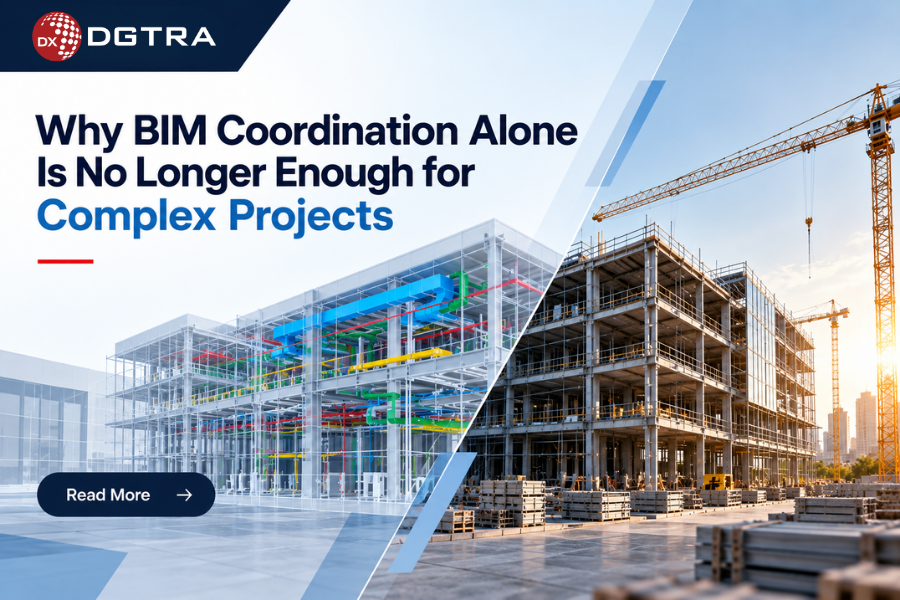
For the past two decades, Virtual Design & Construction (VDC) teams have relied on spatial BIM coordination as the gold standard for pre-construction risk mitigation. Running clash detection algorithms across architectural, structural, and MEP models to resolve spatial hard clashes before trade contractors mobilize was once revolutionary.
Today, on multi-billion-dollar megaprojects, high-density infrastructure developments, and advanced industrial builds, traditional BIM clash detection has reached a ceiling of diminishing returns.
Project Directors and VDC Leads across global EPCs and asset owner organizations frequently encounter a persistent paradox:
Models achieve “zero geometrical clashes” in Navisworks, yet field teams still log hundreds of site Requests for Information (RFIs).
Spatial coordination sign-offs occur on schedule, yet trade contractors submit massive standing-time claims due to sequence out-of-order issues.
Design coordination is formally closed out, yet equipment installation fails due to missing clearance spaces, unverified tolerances, or uncoordinated fabrication sequencing.
Solving spatial geometry without integrating temporal schedules, commercial procurement, and information governance is no longer sufficient. To deliver modern capital builds predictably, digital engineering leaders must transition from traditional, isolated design coordination to holistic, multi-dimensional project control.
The Limitations of Isolated BIM Clash Detection
Traditional multidisciplinary coordination operates under a fundamental misassumption: that resolving spatial overlaps between 3D elements guarantees field constructability.
Spatial clash detection is a static snapshot of geometric relationships. It fails to account for the dynamic environment of physical job sites:
When construction coordination focuses exclusively on 3D geometry, critical non-geometric failure points are missed:
- Time-Space (4D) Conflicts: A structural beam and a duct system may show zero spatial clashes in a static model, but if trade procurement schedules require installing the ductwork before the structural deck is poured, the site experiences immediate standing-time delays.
- Clearance and Maintenance Realities: Automated clash rules easily catch hard structural clashes but routinely miss soft-clashes—such as missing maintenance access clearances, uncoordinated valve reach zones, or dynamic equipment operation radii.
- Data-Siloed RFI Workflows: Resolving a clash geometrically without recording the commercial or contractual impact inside a governed environment leaves project management vulnerable to scope disputes when variations occur.
Expanding Beyond 3D: The 4 Pillars of Modern Digital Engineering
To make project delivery predictable, leading contractors are embedding digital engineering practices that bridge spatial VDC with total capital project controls:
Integrating 4D Time & Construction Sequencing
Spatial coordination must be bound directly to the master Primavera P6 or MS Project schedule. By executing 4D VDC simulations, engineering teams evaluate temporary works, crane lifting radiuses, material laydown logistics, and trade sequencing. This ensures that physical space is coordinated across the timeline of installation, not just in a static, fully built state.
Alignment with 5D Commercial Project Controls
Resolving a design change inside a BIM model without evaluating its commercial impact leads directly to budget overruns. Connecting 3D model geometry to 5D cost databases and Estimate at Completion (EAC) models ensures that design trade-offs are evaluated against live commercial variations. Learn more about linking digital models to financial impact in our analysis on predictive project controls and change management.
Machine-Readable Governance & ISO 19650 Compliance
Spatial models are only as reliable as the data driving them. Coordinating models built with unverified parameters or outdated revisions amplifies site risk. Operating within a governed ISO 19650 Common Data Environment (CDE) ensures that multi-trade coordination occurs strictly on verified, machine-readable information containers—preventing unapproved revisions from entering field production.
Lifecycle Readiness for Operational Digital Twins
Constructability reviews should serve the asset long after physical handover. Structuring asset parameters during coordination ensures that the Project Information Model (PIM) cleanly converts into an Asset Information Model (AIM). Read our detailed insight on openBIM and operational digital twins to see how early model governance simplifies operational handovers for asset owners.
The Constructability Assessment: 4 Questions for Project Directors
To evaluate whether your VDC process is protecting project outcomes or simply running automated checks, project leadership should review these four operational questions:
Does your clash detection process evaluate sequence and time?
If your VDC team signs off on spatial coordination without validating material delivery schedules, trade installation sequences, or temporary equipment space, the project remains exposed to major field delay claims.
Are model coordination decisions linked to commercial change management?
When spatial clashes are resolved by rerouting major MEP runs or altering structural framing, is the cost impact evaluated immediately inside your project control management system before trade sign-off occurs?
Are coordination workflows enforced within a governed CDE?
If trades exchange clash files or design revisions across informal channels outside structured lifecycle states (Work in Progress to Shared to Published), the project audit trail breaks down, leaving teams vulnerable to variation claims.
Is the constructability review conducted with field installation teams?
Spatial coordination should not occur in a vacuum. Integrating trade foremen, site engineers, and procurement managers into early virtual constructability reviews ensures that digital sign-offs translate into practical field execution—as demonstrated in our constructability case study on high-density commercial builds.
Conclusion: Evolving from Spatial Coordination to Integrated Digital Delivery
While BIM clash detection remains an essential baseline for modern AEC projects, relying on spatial coordination alone creates a false sense of security. True constructability requires a broader digital engineering framework that unifies 3D geometry with 4D schedule sequencing, 5D cost management, and rigorous ISO 19650 information governance. By moving beyond isolated geometric checks, EPC leaders and asset owners can suppress site variation claims, maintain tight schedule controls, and achieve predictable capital project delivery.
About DGTRA
DGTRA is a global technology consulting and solutions firm specializing in end-to-end BIM consulting, ISO 19650 compliance, Virtual Design & Construction (VDC), and Project Control Management for asset owners, EPC contractors, and real estate developers. Operating as an independent digital engineering advisor, DGTRA helps enterprise teams establish audit-safe data governance, streamline multi-trade coordination, and bridge the gap between design models and field execution.
👉 To evaluate your project’s constructability framework or upgrade your VDC coordination strategy, explore DGTRA’s Virtual Design & Construction Services.
Frequently Asked Questions (FAQs)
Why does traditional BIM clash detection fail to eliminate site RFIs?
Traditional clash detection focuses on hard spatial overlaps between static 3D elements. It fails to identify temporal clashes (installation sequence errors), missing maintenance access space, fabrication tolerance stack-ups, or uncoordinated trade procurement schedules.
How does 4D BIM improve multidisciplinary coordination?
4D BIM links 3D model geometry directly to the construction schedule. This enables project teams to visualize and resolve time-space conflicts, site logistics issues, crane access limitations, and trade installation sequencing before site mobilization.
What is the difference between BIM coordination and Virtual Design & Construction (VDC)?
BIM coordination is a specific process focused on federating 3D models and identifying geometrical clashes. VDC is a broader operational strategy that integrates BIM, 4D/5D project controls, lean construction workflows, and organization-wide governance to achieve business and project performance targets.
How does ISO 19650 governance impact BIM project delivery?
ISO 19650 establishes standardized processes, lifecycle states, and metadata schemas for managing information. In project delivery, it ensures that coordination occurs on verified, authorized data models, eliminating costly errors caused by working from unapproved revisions.
What is the first step in upgrading from basic BIM clash detection to integrated digital engineering?
The first step is conducting a comprehensive digital engineering maturity audit to evaluate existing coordination workflows, information delivery schedules, software interoperability, and the integration level between VDC teams and project controls.