Asset owners are tired of paying twice for the exact same building data.
For years, the industry pitched digital twins as the ultimate closeout prize. Contractors spent months federating complex 3D models, wrapped them up in a shiny browser-based viewer at practical completion, and handed the keys to facility teams. Six months later, that expensive 3D viewer sat untouched on a shared drive while maintenance crews went right back to clipboards, legacy spreadsheets, and manual work orders.
As capital projects look ahead to 2027, that era of vanity 3D visualization is ending.
Industry research projects the global digital twin market to surpass $73.5 billion by 2027. Yet the organizations capturing a return on that spend are not buying prettier graphics. They are engineering “twin-to-ticket” operational readiness where live building telemetry, asset metadata, and computerized maintenance management systems (CMMS) talk to each other automatically from day one.
Getting there requires abandoning the traditional handover mindset before construction even begins.
Why Pretty Models Fail on the Facility Floor
A 3D model that lets a facility director spin around a mechanical room looks great in a boardroom demo. It does very little when an air handling unit trips a fault at 2:00 AM.
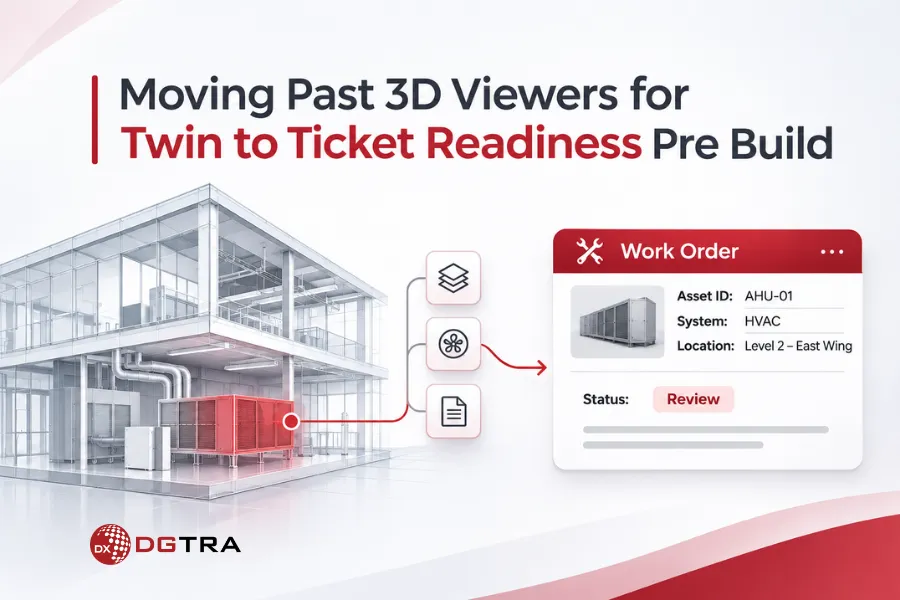
When a critical asset degrades, an operations team does not need to orbit a 3D mesh. They need an automated workflow: an IoT sensor flags a pressure drop, the building management system cross-references the asset’s exact location and manufacturer serial number, and a CMMS platform dispatches a technician with the right replacement part and lockout procedure already attached to the work order.
That is twin-to-ticket execution.
The reason most buildings fail to reach this level of maturity in 2026 has nothing to do with sensor hardware or cloud platforms. It comes down to broken data structures inherited from construction:
- Disconnected Tagging: Equipment barcodes installed in the field rarely match the element IDs buried inside design models.
- Unstructured Closeout Dumps: Handing over thousands of static PDF manuals forces operations teams to spend months manually keying warranty dates and maintenance intervals into enterprise asset systems.
- Missing System Logic: Models often capture physical geometry without mapping upstream and downstream dependencies—leaving operators guessing which isolation valves shut down a specific floor zone.
Insights from McKinsey’s digital twin practice show roughly 25% improvements in operational efficiency when real-time telemetry informs daily operations. You cannot capture those gains if your engineering team spends its first year post-handover cleaning up construction data.
The 2026–2027 Shift: Killing the Handover Boundary
The standards governing how we build and operate assets are actively catching up to this reality. The 2026 draft revisions to ISO 19650 are dismantling the artificial wall between project delivery (Part 2) and asset operations (Part 3), replacing them with a unified, continuous lifecycle Information Management process.
For project leaders planning 2027 capital pipelines, the takeaway is clear: an Asset Information Model (AIM) is no longer something a contractor “hands over” at ribbon-cutting. It is a living operational database that begins taking shape during pre-design.
Achieving true operational readiness before site mobilization comes down to three practical shifts:
Define Maintenance Outcomes Before Procurement
Rather than asking design teams for generic model detail, owners must write explicit Asset Information Requirements (AIR) into early trade contracts. Every maintainable asset needs a unified classification schema and naming convention locked in before tender ensuring the data generated during fabrication and installation maps straight into your CAFM or CMMS software without translation.
Replace Manual Audits With Machine-Readable Rules
Checking thousands of model parameters by hand at project milestones is slow and prone to human error. Forward-looking delivery teams are moving away from static spreadsheet checklists toward openBIM buildingSMART Information Delivery Specification (IDS) files. IDS embeds your exact data requirements into a machine-readable XML contract, allowing Common Data Environments to reject incomplete model uploads automatically long before closeout arrives.
Prepare Clean Metadata for Operational AI
As facility managers look to deploy predictive maintenance algorithms and agentic AI troubleshooting in 2027, data hygiene becomes non-negotiable. AI models trained on inconsistent asset names or missing commissioning logs generate unreliable alerts. Structuring your ISO 19650 CDE architecture early ensures your operational twin feeds clean, auditable records into enterprise analytics.
Connecting Delivery Controls to Lifecycle Performance
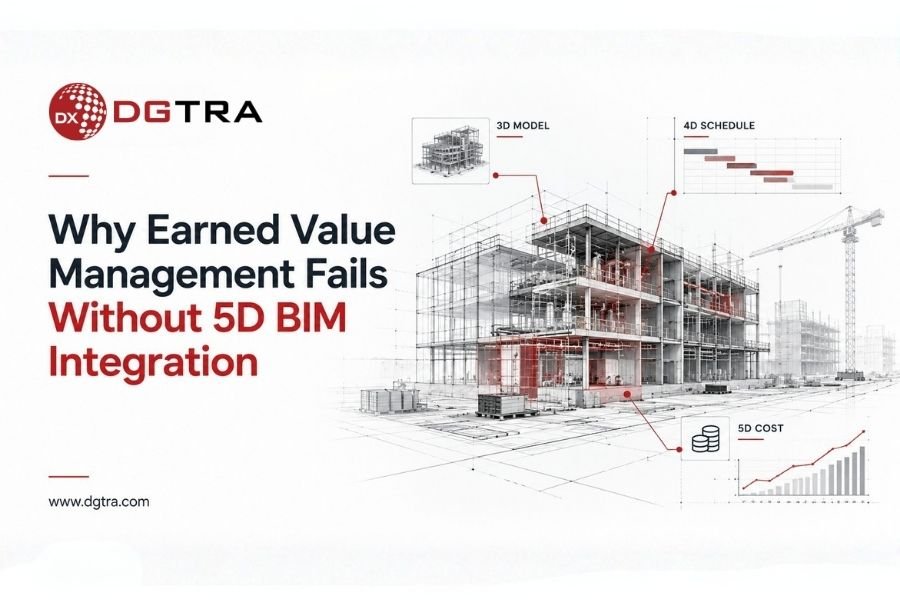
Operational readiness does not exist in a vacuum; it relies on disciplined execution throughout design and construction. When teams align 5D BIM project controls with early 4D VDC constructability reviews, every equipment substitution or field reroute updates the master asset record in real time.
Investing in structured asset management services during pre-construction stops data loss before it starts. Through dedicated digital twin support, owners can bridge design geometry, live BMS telemetry, and maintenance ticketing into a single operational ecosystem—turning capital projects into high-performing buildings from day one.
Frequently Asked Questions (FAQs)
What does "twin-to-ticket" mean in facility management?
Twin-to-ticket refers to an automated operational workflow where a digital twin integrates directly with building IoT sensors and a Computerized Maintenance Management System (CMMS). When equipment telemetry detects an anomaly, the system automatically generates a maintenance work order populated with the asset’s exact location, serial number, warranty status, and required spare parts.
How does buildingSMART IDS improve digital twin readiness?
The buildingSMART Information Delivery Specification (IDS) converts an owner’s asset data requirements into a machine-readable format. Instead of manually reviewing models at handover, project teams run automated checks at every design and construction milestone to verify that required equipment metadata is present and accurate.
Why is the 2026 ISO 19650 update important for asset owners?
The 2026 ISO 19650 revisions merge project delivery and operational phases into a single continuous information management process. This shifts responsibility toward defining clear asset information requirements upfront so operational data builds progressively throughout construction rather than being compiled at closeout.
Summary
A flashy 3D viewer will not lower energy bills or prevent unplanned equipment downtime. As the industry heads into 2027, real digital twin value comes from embedding machine-readable data governance and CMMS integration into pre-construction planning—building true twin-to-ticket readiness long before the first shovel hits the dirt.
About DGTRA
DGTRA is a trusted digital engineering partner for organizations building and operating complex assets across India, the US, the UK, and Australia. Recognized for rigor in BIM and VDC delivery, ISO 19650 information management, project controls, digital twins, and design automation, we guide real estate, construction, infrastructure, and manufacturing leaders from early planning through prefabrication coordination and handover. Backed by BSI ISO 19650 certification, we help project teams eliminate delivery guesswork and protect margins.
👉 To prepare your 2027 capital projects for seamless operational handover, explore DGTRA’s Asset Management Services or Schedule a Digital Twin Readiness Consultation.