Ask any capital project director about their biggest operational headache, and they won’t say it’s a lack of data or software. They’ll tell you it’s the constant, margin-draining disconnect between what was approved on paper and what happens on Level 4 on a Tuesday morning.
Every mega-project starts with baseline confidence. Schedules are built, critical paths are approved, and milestones are set. Yet, according to research by McKinsey & Company, a staggering 98% of mega-projects experience cost overruns or schedule delays exceeding 30%. Furthermore, landmark research from FMI Corporation and Autodesk reveals that 95.5% of all data generated across design and construction phases goes completely unused.
In our previous explorations on Why Well-Planned Construction Projects Still Face Schedule Slippage and How VDC Connects Project Planning with Site Execution, we exposed how static schedules manage abstract dates while site execution occurs in physical space.
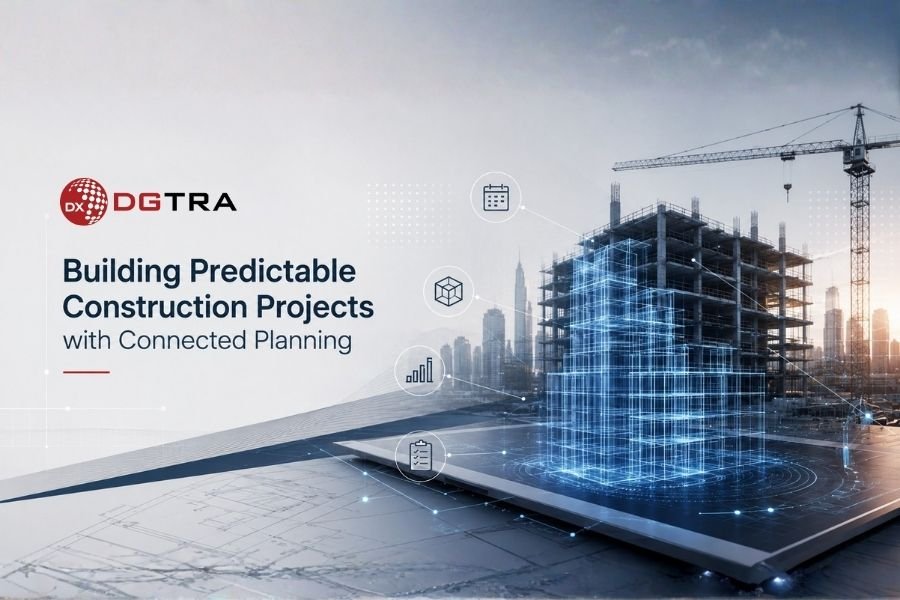
To break this cycle and unlock that lost 95% of project data, forward-thinking owners, EPC managers, and general contractors are moving beyond isolated tools to adopt Connected Planning—a spatial, VDC-driven framework that bridges the gap between master planning and field execution.
Moving Beyond Tool Adoption: The Connected Planning Framework
Most construction organizations fall into the trap of “technology accumulation.” They purchase 3D modeling tools for design, Primavera P6 for scheduling, ERP software for procurement, and mobile apps for field reporting.
However, running modern software tools in isolated silos does not create a modern project. It simply creates digitized silos.
Connected Planning moves your organization from point-tool adoption to Systemic Data Orchestration. Instead of handoffs occurring through static PDFs, emails, or weekly status meetings, the project operates inside an integrated data loop where every operational decision is dynamically linked.
The Three Operational Shifts of Connected Planning
- From Static Baselines to Live Constraint Verification: Traditional project controls verify progress by asking what was installed last week. Connected Planning verifies progress by analyzing whether upcoming work packages are 100% constraint-free across design, procurement, trade access, and safety before releasing crews to the field.
- From Linear Handoffs to Multi-Directional Data Flows: When an engineering change occurs in design, it automatically updates spatial models, material fabrication schedules, and critical path activities. No manual translation; no missing revisions.
- From Post-Mortem Reporting to Forward-Looking Predictive Control: Rather than spending executive meetings explaining past milestone slips, project directors utilize 4D variance engines to simulate potential bottlenecks four weeks in advance and evaluate mitigation paths in the model first.
The 4-Stage Capital Delivery Maturity Curve
To build predictable execution across complex infrastructure, commercial builds, or industrial assets, project organizations must evaluate where they stand on the delivery maturity spectrum:
Stage 1: Disconnected Analog Execution
Schedules are managed in Primavera P6 or MS Project; design is reviewed via 2D CAD markups; and field progress is logged on paper or basic spreadsheets. Disconnects are identified only when physical clashes or trade delays occur on the jobsite floor.
Stage 2: Isolated Digital Coordination
3D BIM models are created for design coordination and clash detection. However, these models remain disconnected from the master CPM schedule. Schedulers and BIM managers work in separate departments with minimal data integration.
Stage 3: Managed VDC Workflows
The project adopts 4D BIM simulations for key construction milestones and implements Common Data Environments (CDE) governed by ISO 19650 standards. Spatial clashes and major trade sequencing conflicts are resolved prior to site mobilization.
Stage 4: Enterprise Connected Planning
Spatial geometry, CPM schedule logic, procurement lead times, and reality capture data operate inside a single, synchronized decision-making ecosystem. Decision-makers utilize live predictive analytics to protect project margins, optimize trade productivity, and ensure handover reliability across the entire portfolio.
Driving Predictability at Scale with DGTRA
Transitioning an enterprise from Stage 2 or 3 to Stage 4 requires more than theoretical strategy—it demands domain expertise in digital engineering coupled with structured data governance.
This is where DGTRA transforms capital project delivery.
As a specialized technology consulting and BIM implementation partner, DGTRA brings global expertise in ISO 19650 information management frameworks, VDC engineering services, and digital project control management. DGTRA aligns project leadership, trade contractors, and owners around connected data architectures that eliminate information friction.
According to digital transformation analysis by Deloitte, capital project organizations that successfully integrate connected digital frameworks and standardized data governance achieve significant risk mitigation, improved labor efficiency, and predictable margin recovery across complex builds.
Frequently Asked Questions (FAQs)
What is the primary difference between VDC and Connected Planning?
Virtual Design & Construction (VDC) is the multidisciplinary methodology that combines 3D BIM models with scheduling, cost, and process optimization. Connected Planning is the broader enterprise execution strategy that links VDC models directly with procurement systems, ISO 19650 data governance, and field reality capture to create a continuous operational feedback loop.
How does Connected Planning protect project margins for Owners and General Contractors?
By identifying spatial trade congestion, long-lead procurement gaps, and design discrepancies digitally before field execution begins, Connected Planning eliminates the primary drivers of unbudgeted rework, trade standing-time, and liquidated damages.
How does DGTRA integrate Connected Planning with our existing software investments like Primavera P6 or Revit?
DGTRA does not require you to replace your existing enterprise software. DGTRA acts as a strategic digital delivery partner, structuring your workflows so that schedule logic from tools like Primavera P6 and geometry from authoring platforms like Revit or ACC are dynamically aligned inside a standardized Common Data Environment.
Is Connected Planning suitable for mid-sized projects or strictly mega-projects?
While mega-projects experience the highest volume of data fragmentation, Connected Planning principles deliver high ROI on mid-sized commercial, healthcare, data center, and infrastructure builds where tight handovers and dense trade coordination leave zero margin for field error.
Transform Your Project Delivery Pipeline Today
Static timelines and isolated data silos no longer need to dictate your project outcomes. By connecting spatial intelligence with master planning and jobsite execution, you can establish complete delivery control across your portfolio.
Take the Next Step Toward Schedule Certainty
Partner with DGTRA to establish an enterprise-grade Connected Planning framework tailored to your organization’s delivery goals.
👉 Schedule an Executive Strategy Session with DGTRA’s VDC Experts
👉 Register for Our Executive Webinar: “The Missing Link Between Project Schedules and Site Execution: Creating More Predictable Project Delivery Through VDC”
👉 Explore DGTRA’s Full Suite of Virtual Design & Construction (VDC) Services