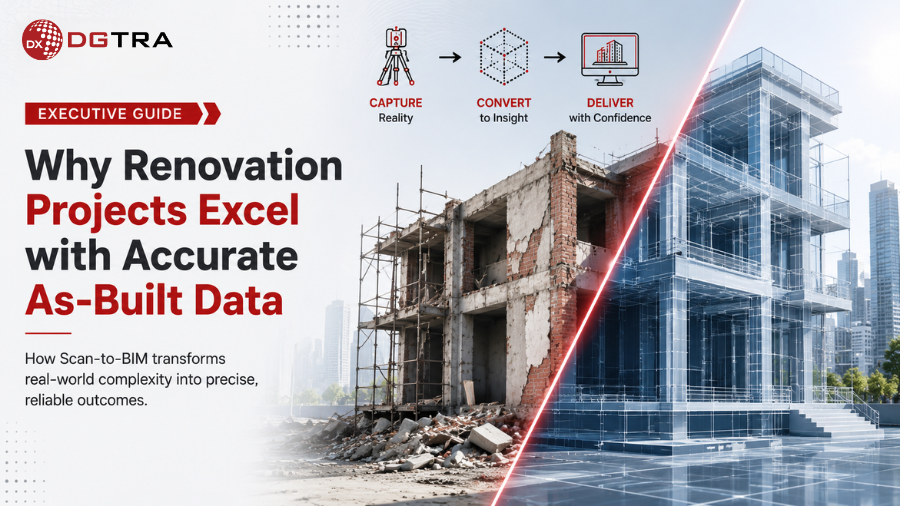
The defining moment of a building renovation rarely happens in the design studio; it happens during initial demolition. Every project team knows the sudden quiet on a job site when a wall comes down to reveal a structural column or a major mechanical run that never appeared on any historical blueprint. When teams rely on outdated legacy drawings, they are essentially modeling a hypothetical asset. The secret to bypassing this friction entirely is anchoring design decisions in absolute physical truth.
The traditional approach to retrofitting existing structures often treats site uncertainty as an unavoidable project variable. However, shifting the workflow toward precise reality capture transforms these unpredictable hurdles into clear, manageable development advantages. Starting your pre-construction phase with an accurate, high-fidelity digital baseline allows you to plan layout reconfigurations, structural alterations, and complex system upgrades with complete confidence and total design freedom.
The Strategic Premium of Real-World Data Fidelity
Relying on old paper archives or unverified CAD exports is rapidly becoming a liability for forward-thinking design and construction teams. Buildings are living structures that undergo decades of unrecorded modifications, structural shifts, and localized tenant fit outs. Attempting to design a modern, high-performance space on top of speculative measurements introduces compounding layout adjustments during construction.
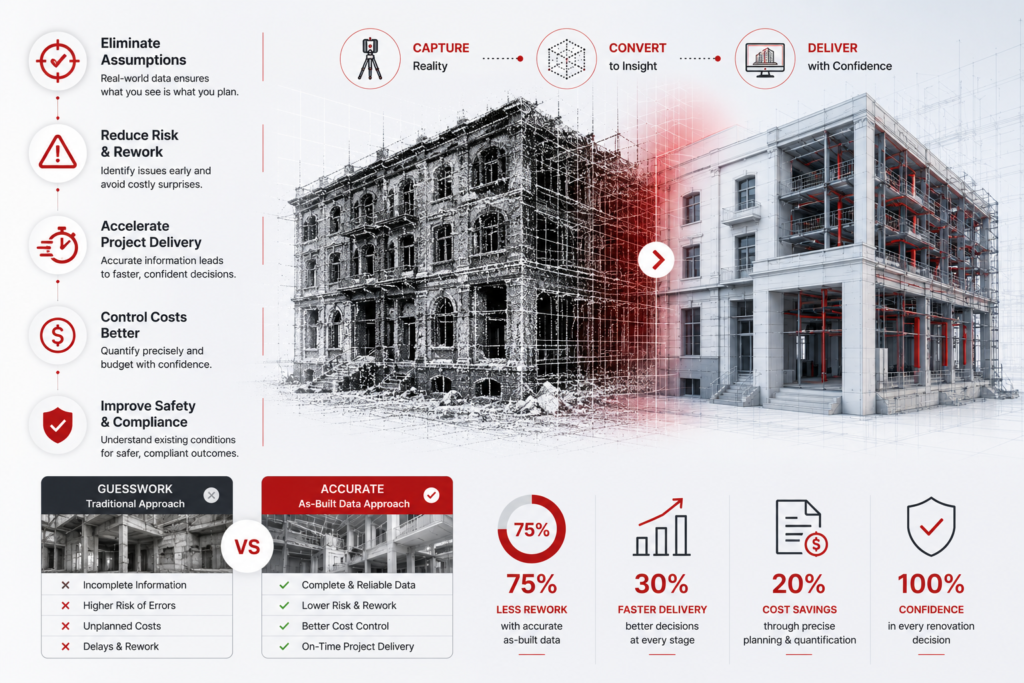
When you anchor your workflow in highly detailed as-built models, you eliminate the margin of error that typically derails fast-track retrofits. According to a 2026 industry capability report from the building SMART international data index, engineering teams that mandate open-standard as-built validation models at project kickoff experience a massive reduction in unexpected field coordination clashes and field resource waste. This data-first approach shifts the entire construction conversation from reactive problem-solving to structured, predictable execution.
Furthermore, precision spatial frameworks are essential for meeting today’s tight performance targets. A recent 2026 market analysis published by Research and Markets indicates that the global digital twin market has climbed significantly, driven by asset owners demanding perfect structural-to-digital alignment at handover. Having clean, reliable data from day one ensures your design functions flawlessly in the real world and transitions perfectly into long-term facility management.
Moving Beyond the Blueprint: The Reality Capture Workflow
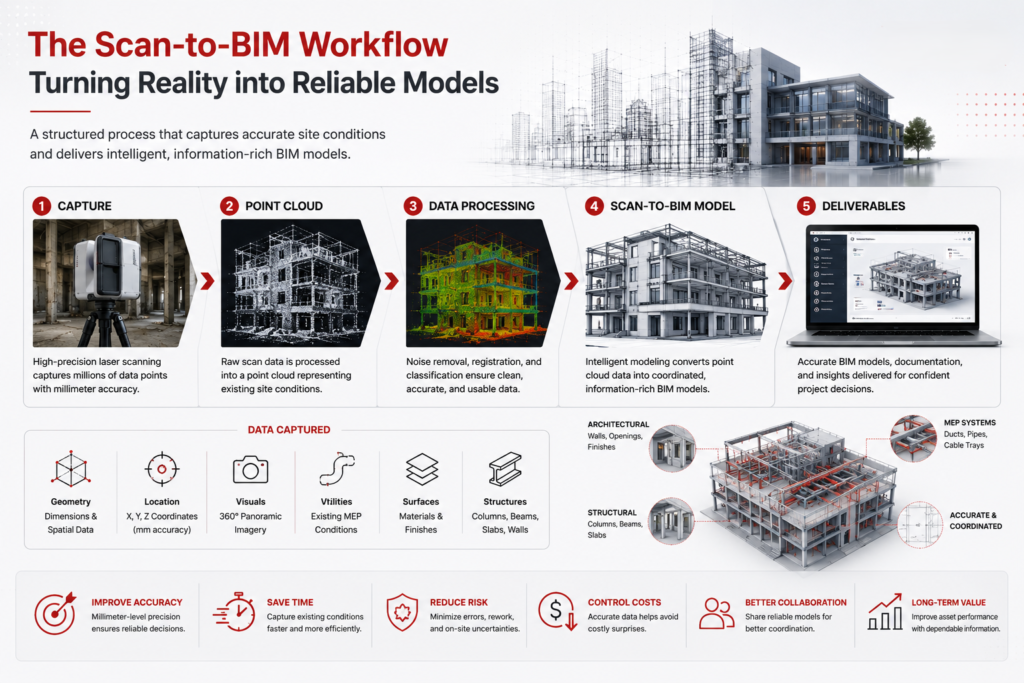
Embracing a modern verification pipeline changes your entire project timeline. Instead of manually cross-referencing mismatched dimensions, teams can implement a reliable, multi-stage data alignment workflow:
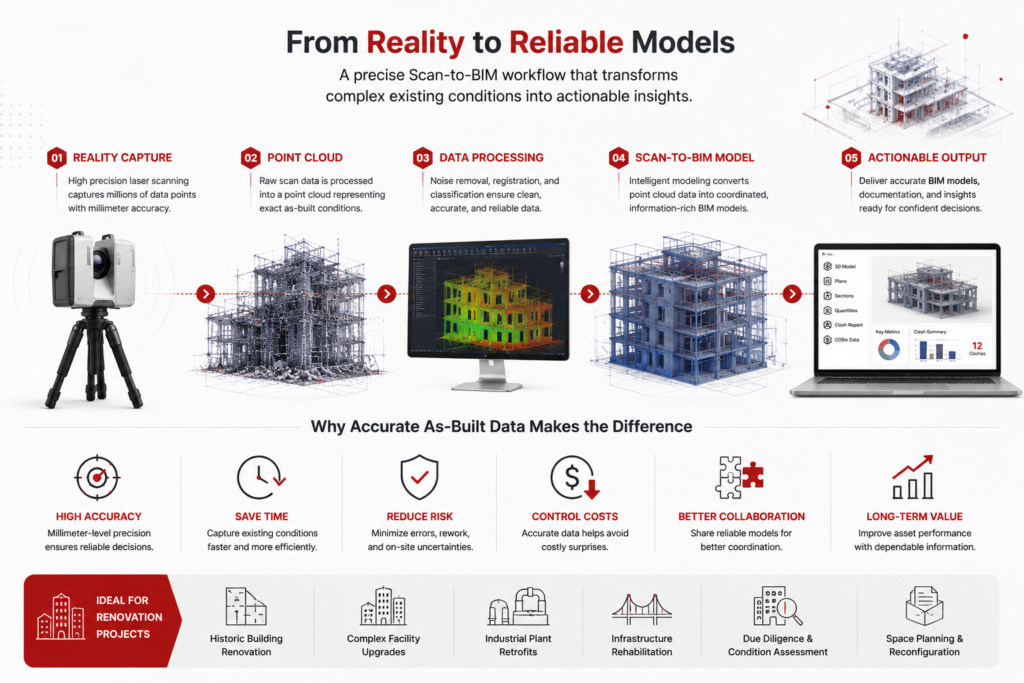
1.Field Laser Scanning: Zero-Disruption Reality Capture.
High-speed terrestrial scanners and drone sensors capture the exact coordinates of every visible structural, architectural, and MEP element without disrupting ongoing facility operations.
2.Point Cloud Registration: Unified Spatial Coordinate Map.
Individual field scans are indexed and registered into a comprehensive, millimetres-accurate 3D point cloud, creating a complete digital twin of the current building reality.
3.Scan-to-BIM Transformation: Parametric Geometry Mapping.
Modeling teams translate the raw point cloud into a clean, data-rich intelligent model. Every wall, conduit, and beam is mapped to its exact spatial location, creating a true foundation for your new design.
Cultivating Long-Term Asset Value and Predictable Procurement
Starting a project with verified structural data does more than just protect the pre-construction phase; it directly improves procurement accuracy. Exact dimensions mean that your 5D quantity takeoffs and material orders match site requirements perfectly. This allows you to pre-fabricate complex mechanical assemblies off-site with absolute certainty that they will fit into place on delivery day.
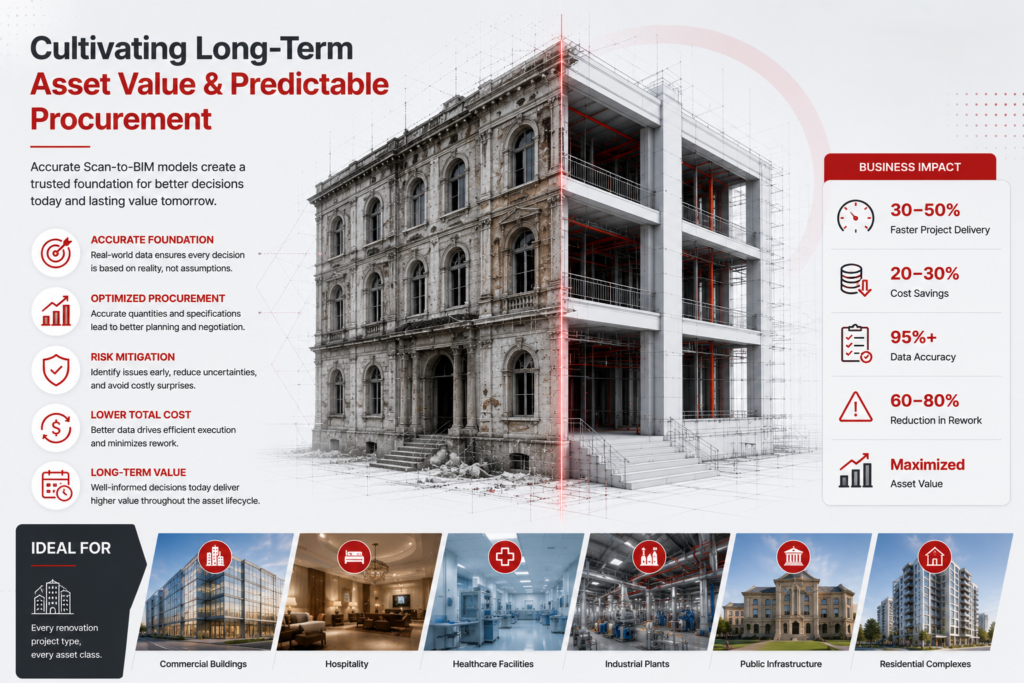
This unified approach brings immense clarity to every stakeholder, keeping projects moving forward smoothly. To explore how clear information management principles elevate complex structural handovers across global projects, read our strategic insights on optimizing your digital pipelines through the DGTRA Insights Portal.
Upcoming Live Technical Webinar
Want to see exactly how these data workflows operate on active job sites? Register for our upcoming live webinar: “What’s Hiding Behind Your Existing Drawings? How Scan-to-BIM Reduces Renovation Risk, Rework, and Costly Surprises.” Discover practical, real-world case studies on how reality capture protects project margins and streamlines design approvals.
Reserve Your Complimentary Webinar Seat Now
About DGTRA
DGTRA is a leading digital transformation partner and process-driven management consultancy operating at the global forefront of the AECO industry. Supported by an elite team of over 100 specialized professionals, we bridge the gap between advanced digital technology and practical, profitable execution across India, the UK, and the Middle East.
We partner directly with asset owners, tier-1 contractors, and premier design firms to build dependable, forward-thinking digital roadmaps. Our deep domain expertise spans advanced BIM Consulting & Management frameworks, precise asset information modeling, and the practical deployment of operational digital twins. At DGTRA, our guiding principle remains absolute: we engineer the digital processes that bring total predictability, structural transparency, and financial certainty to ambitious construction programs worldwide.
Ready to eliminate data gaps and secure your project margins?
Schedule a strategic consultation with a DGTRA Process Specialist today.