
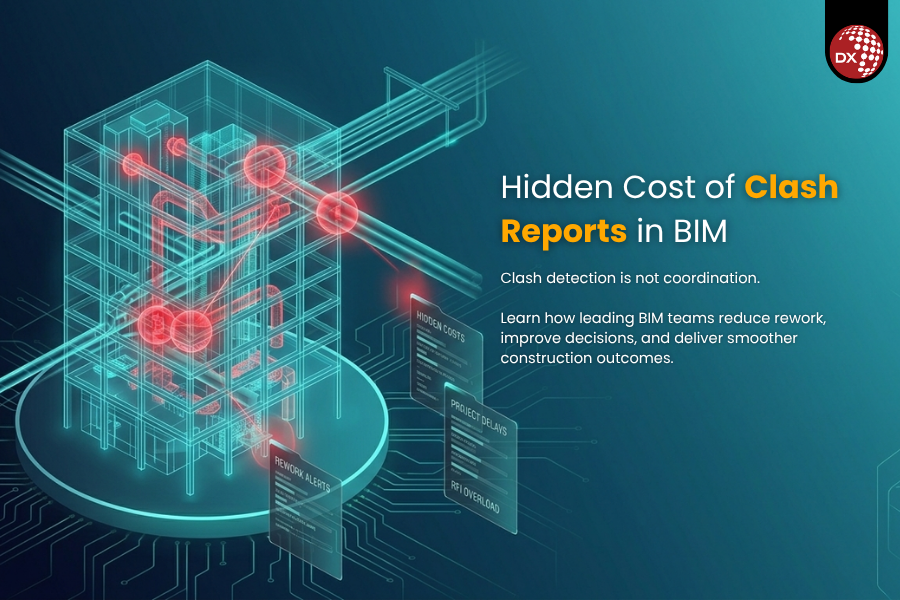
How smarter BIM coordination unlocks the project performance your team is already capable of Category: BIM Coordination | VDC Workflows | Construction Delivery | MEP Coordination The best BIM and VDC teams in the world share one thing in common. They have built a coordination process so intentional, so well-structured from day one that the site team walks in knowing exactly what to build. Fewer surprises. Faster decisions. Cleaner installations. And a clash detection workflow that validates great coordination rather than scrambling to create it. BIM coordination performance and clash report volume are two very different things. The teams that understand that distinction and build their process around it are the ones delivering the projects everyone else wants to talk about. If your team is investing serious effort into MEP coordination, design coordination, and constructability validation, and most are, this blog will show you where the highest-value opportunity in that effort lives. What the Research Tells Us About BIM’s Real Upside The ceiling on coordination performance when the process is built well is genuinely impressive. Research published in Discover Materials found that well-implemented BIM reduces design errors by 50–60%, cuts rework costs by 40–50%, and reduces coordination RFIs by up to 80%. These are not marginal improvements. These are project-defining outcomes — the kind that show up in budgets, delivery timelines, and the confidence of every stakeholder in the room. A study published in Scientific Reports found that BIM adoption reduced rework-related time waste by 70–85% and delivered cost savings of 65–75% specifically in projects where coordination and modeling processes were aligned from the outset of delivery. The common thread across every high-performing outcome is alignment. Early, intentional, structured alignment between disciplines, between teams, and between the digital model and the physical build. That alignment is what this blog is about. And it starts with understanding what happens when the clash detection volume grows faster than the BIM coordination process behind it. When Volume Outpaces Process — What to Watch For Here is a pattern that shows up on complex BIM coordination projects more often than most teams realize. The project is moving. Clash detection workflows are running on schedule. Reports are generating data. Coordination meetings have a cadence. By week 6 or 7, the rhythm feels strong. By week 12, something shifts not dramatically, but perceptibly. The reports are longer. The meetings are fuller. And the number of decisions per meeting is getting lower. This is not a performance problem. It is a structural signal. And recognizing it early is one of the most valuable things a BIM manager or VDC lead can do for a project. Here is what those signals look like in practice. Attention Concentrates on Volume, Not Value When the clash report volume is high, teams gravitate naturally toward what is flagged as critical. That instinct is right, but only when the classification system behind it is precise, consistent, and aligned with actual constructability risk. When it is not, genuinely important coordination decisions share visual space with minor clearance adjustments. Both live in the same column of the same spreadsheet. One of them quietly carries weeks of site delay into the construction phase. The opportunity here is not to review more carefully. It is to structure the report so that what matters is unmistakably visible. Coordination Decisions Take Longer Than They Should High-volume BIM coordination reviews tend toward caution sign-offs slow, meetings extend, and project momentum flattens. The solution is not speed for its own sake. It is a process clean enough that decisions are easy to reach with confidence, because the right people are in the room with the right information in front of them. Research in the Journal of Building Engineering shows that BIM delivers its strongest coordination results when clash detection is applied early and proactively enabling trades to execute their installation sequences independently, without mid-construction conflicts disrupting the build. Early and proactive. Two words that define where the best VDC coordination workflows are built and where most teams still have significant room to grow. Ownership Gets Distributed Rather Than Defined In a BIM coordination workflow built around high volume, responsibility can spread across zones and trade codes, making resolution difficult to track. Assignment is not the same as ownership. A discipline tag is not the same as a person accountable for a decision. The teams seeing the best clash resolution rates have moved toward named individual accountability a specific person, a clear decision, a defined deadline for every open item in the coordination workflow. That shift alone changes how quickly and cleanly clashes move through the resolution process. The Biggest Coordination Opportunity Lives Upstream Here is the insight that changes everything about BIM project coordination. The quality of a coordination outcome is largely determined before the first clash detection report ever runs. It is determined by how well the project set up discipline alignment, interface agreements, and constructability thinking in the strategy phase — before a single model was opened. When architecture, structure, and MEP teams begin modeling with shared BIM Execution Plan standards, agreed interface zones, and defined ownership protocols, the federated model becomes a coordination asset from day one. Clashes that do appear are fewer, better categorized, and faster to resolve because the decision-making structure is already in place around them. This upstream investment is what separates high-performing BIM coordination teams from teams working just as hard but fighting harder battles downstream. Research on BIM-based construction readiness confirms that coordination gaps arising during pre-construction modeling from design changes, incomplete interface planning, or ambiguous discipline ownership are among the leading contributors to clashes persisting into the construction phase. The good news is that these gaps are entirely addressable — with the right process structure in place before modeling begins. This is precisely what DGTRA builds through Constructability Reviews and BIM Maturity Audits & Competency Assessments — finding exactly where the upstream coordination opportunity lives on your specific project. What High-Performing BIM Coordination Teams Do Differently The practices that separate the best VDC and BIM coordination workflows from the rest are not complicated. They are consistent, intentional, and built into the process before the pressure of

Clash Detection Is Not Coordination
On-demand webinar Clash detection is Not coordination. If your model is clash-free, why is your site still a problem? You checked off every flag, yet chaos reigns on site. Trades collide, RFIs stack up, and confusion spreads as everyone wonders who owns the mess. Register to watch the on-demand webinar Fill out the form to join the free webinar. Webinar 4: Clash Detection Is Not Coordination First NameLast NameEmailJob TitleCompany NameCountrySelect CountryAfghanistanAland IslandsAlbaniaAlgeriaAmerican SamoaAndorraAngolaAnguillaAntarcticaAntigua and BarbudaArgentinaArmeniaArubaAustraliaAustriaAzerbaijanBahamasBahrainBangladeshBarbadosBelarusBelgiumBelizeBeninBermudaBhutanBoliviaBonaire, Saint Eustatius and SabaBosnia and HerzegovinaBotswanaBouvet IslandBrazilBritish Indian Ocean TerritoryBritish Virgin IslandsBruneiBulgariaBurkina FasoBurundiCabo VerdeCambodiaCameroonCanadaCayman IslandsCentral African RepublicChadChileChinaChristmas IslandCocos (Keeling) IslandsColombiaComorosCook IslandsCosta RicaCroatiaCubaCuraçaoCyprusCzech RepublicDemocratic Republic of the Congo (Kinshasa)DenmarkDjiboutiDominicaDominican RepublicEcuadorEgyptEl SalvadorEquatorial GuineaEritreaEstoniaEswatiniEthiopiaFalkland IslandsFaroe IslandsFijiFinlandFranceFrench GuianaFrench PolynesiaFrench Southern TerritoriesGabonGambiaGeorgiaGermanyGhanaGibraltarGreeceGreenlandGrenadaGuadeloupeGuamGuatemalaGuernseyGuineaGuinea-BissauGuyanaHaitiHeard Island and McDonald IslandsHondurasHong KongHungaryIcelandIndiaIndonesiaIranIraqIrelandIsle of ManIsraelItalyIvory CoastJamaicaJapanJerseyJordanKazakhstanKenyaKiribatiKosovoKuwaitKyrgyzstanLaosLatviaLebanonLesothoLiberiaLibyaLiechtensteinLithuaniaLuxembourgMacao S.A.R., ChinaMadagascarMalawiMalaysiaMaldivesMaliMaltaMarshall IslandsMartiniqueMauritaniaMauritiusMayotteMexicoMicronesiaMoldovaMonacoMongoliaMontenegroMontserratMoroccoMozambiqueMyanmarNamibiaNauruNepalNetherlandsNew CaledoniaNew ZealandNicaraguaNigerNigeriaNiueNorfolk IslandNorth KoreaNorth MacedoniaNorthern Mariana IslandsNorwayOmanPakistanPalauPalestinian TerritoryPanamaPapua New GuineaParaguayPeruPhilippinesPitcairnPolandPortugalPuerto RicoQatarRepublic of the Congo (Brazzaville)RomaniaRussiaRwandaRéunionSaint BarthélemySaint HelenaSaint Kitts and NevisSaint LuciaSaint Martin (Dutch part)Saint Martin (French part)Saint Pierre and MiquelonSaint Vincent and the GrenadinesSamoaSan MarinoSao Tome and PrincipeSaudi ArabiaSenegalSerbiaSeychellesSierra LeoneSingaporeSlovakiaSloveniaSolomon IslandsSomaliaSouth AfricaSouth Georgia/Sandwich IslandsSouth KoreaSouth SudanSpainSri LankaSudanSurinameSvalbard and Jan MayenSwedenSwitzerlandSyriaTaiwanTajikistanTanzaniaThailandTimor-LesteTogoTokelauTongaTrinidad and TobagoTunisiaTurkmenistanTurks and Caicos IslandsTuvaluTürkiyeUgandaUkraineUnited Arab EmiratesUnited Kingdom (UK)United States (US)United States (US) Minor Outlying IslandsUnited States (US) Virgin IslandsUruguayUzbekistanVanuatuVaticanVenezuelaVietnamWallis and FutunaWestern SaharaYemenZambiaZimbabweWatch Now You Ran Clash Detection. The Site Still Blew Up. The truth is, even with zero clashes, 30–40% of rework still happens. Clash detection only sees geometry, not the real-world build. It spots conflicts, not choices. True BIM coordination is not a box to tick. It demands ownership, teamwork across disciplines, and a process that begins before the first model takes shape. What You'll Walk Away With Most webinars hand you information. This one holds up a mirror, showing exactly where your coordination process falters and what you can fix by Monday morning. Construction-Ready vs. Clash-Free Why is clash-free not the same as construction-ready and how to identify the hidden site risks in a ‘clean’ model. Coordination of Ownership Where coordination of ownership breaks down across disciplines and how to assign true accountability. The 5-Step Gap Framework A concrete, field-tested 5-step framework to close the gap between your digital model and the physical site. Buildability Validation How to validate for buildability, not just simple geometry. Spot the issues that clash detection misses. This Session Is for You If… Maybe you’re a BIM manager tired of defending a process that never seems to improve. Or a VDC lead who senses something’s off but can’t quite pinpoint it. Or a project manager watching RFIs stack up on a model that promised smooth sailing. If you’ve ever sat through a coordination meeting thinking, ‘here we go again’. Don't Wait for The Site to Demand It. Seats go quickly. Every project has that moment when you wish someone had caught the issue sooner. Let this be that moment for your team. Reserve your spot- It’s Free
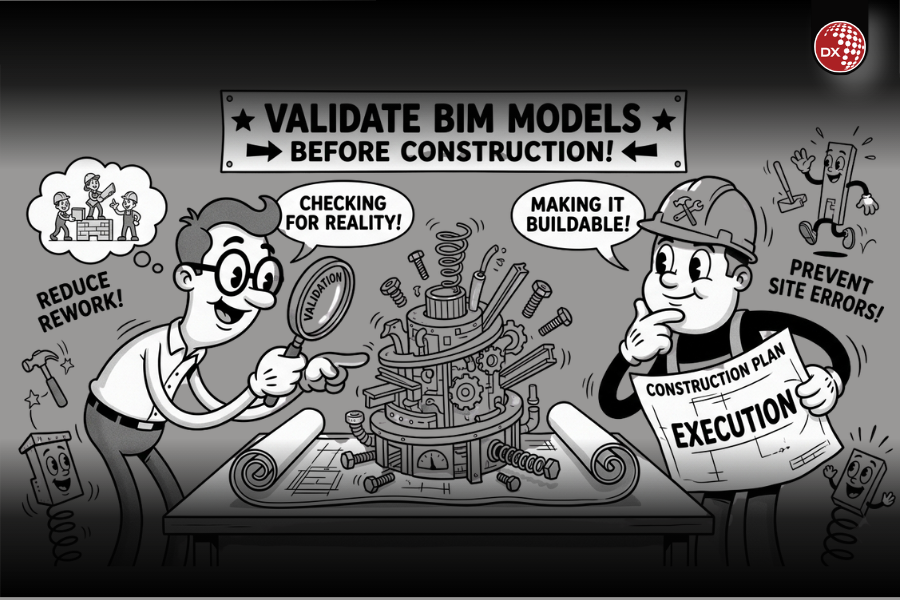
How to Validate BIM Models Before Construction Begins
The Costly Disconnect Between BIM and Site Reality You’re on-site. The structure is progressing. But suddenly, the MEP system doesn’t align with the structural opening. The BIM model showed no clash. Yet here you are—cutting, reworking, and losing time. This isn’t rare. It’s a recurring issue across projects where BIM models don’t match site conditions. The real problem isn’t BIM—it’s lack of validation before construction begins. In this article, you’ll learn: Why BIM models fail on-site What most teams miss during coordination A practical BIM validation framework How to reduce rework by up to 30% Where BIM Model Issues Actually Start Most BIM model errors during construction don’t originate on-site—they begin much earlier. Common Root Causes Incomplete or outdated inputs from consultants Poor BIM coordination between disciplines Lack of constructability validation Over-reliance on clash detection BIM tools without context No structured pre-construction planning BIM workflow Hidden Impacts on Projects Construction rework (cutting slabs, rerouting MEP systems) Delays due to redesign and approvals Increased cost and resource wastage Loss of trust between stakeholders The biggest issue? Teams assume the BIM model is “ready” when it’s only “modeled.” Why Current BIM Approaches Fail Many teams believe they are doing BIM correctly—but the reality is different. What Teams Think vs What Actually Happens What Teams Think What Actually Happens Clash detection is enough Clashes are resolved digitally, not constructively Model = Site-ready Model lacks real-world validation Coordination meetings solve issues Issues are discussed, not systematically resolved LOD 300/400 ensures accuracy Geometry is detailed, but workflows are incomplete BIM managers handle everything No accountability across disciplines The gap is not in tools—it’s in process and ownership. The Consultant’s Approach: BIM Validation Framework Before Construction To bridge the BIM model vs site reality gap, you need a structured validation workflow—not just coordination. A 5-Step BIM Model Validation Framework Model Completeness Check Are all disciplines included in the federated BIM model? Are latest revisions integrated? Are scope gaps identified? Clash Detection + Context Validation Run clash detection Validate: Is it buildable? Is there access for installation? Does it consider sequencing? Clash-free doesn’t mean construction-ready. Constructability Review Check Installation feasibility Equipment access Material handling Involve site engineers and construction managers Site Condition Alignment Compare BIM model with: Survey data As-built references Real site constraints This step reduces BIM model not matching as-built drawings issues. Approval & Sign-off Workflow Define responsibility: Who validates what? Create: Discipline-wise approval matrix Ensure: No model moves forward without validation Outcome of This Framework Reduced construction rework Improved coordination confidence Clear accountability Practical Scenario: From Clash-Free to Construction-Ready Project Situation A commercial building project had: Fully coordinated BIM model Zero major clashes reported Yet on-site: MEP ducts conflicted with beam depths Ceiling heights were compromised What Went Wrong Clash detection ignored installation tolerances No constructability validation Lack of coordination with site execution teams Corrective Approach Re-validated the BIM model using: Site constraints Installation sequencing Introduced MEP BIM coordination site error prevention checks Outcome Reduced rework by 28% Faster installation cycles Improved stakeholder confidence Traditional vs Validated BIM Workflow Traditional BIM Workflow Validated BIM Workflow Focus on modeling Focus on buildability Clash detection only Clash + constructability validation Design-driven decisions Execution-driven decisions Limited site involvement Strong site collaboration Reactive issue resolution Proactive issue prevention Before vs After BIM Validation Implementation Before Validation After Validation Frequent site conflicts Minimal discrepancies High rework cost Up to 30% cost reduction Delayed project timelines Predictable execution Poor coordination Integrated workflows Key Takeaways A clash-free model is not equal to a construction-ready model BIM model accuracy depends on validation, not just modeling Involving site teams early prevents execution errors A structured BIM validation checklist is critical Proactive validation can reduce construction rework by 30% Conclusion: BIM Success Depends on Validation, Not Just Modeling The industry doesn’t have a BIM problem—it has a validation problem. If your BIM models are not aligned with execution realities, they will fail on-site—no matter how advanced your tools are. The shift you need is simple but powerful: From modeling-focused BIM to execution-ready BIM How DGTRA Solves This — From Modeling Support to Delivery Ownership At DGTRA, we don’t just support BIM workflows—we take responsibility for making them work in the real world. Our approach is built on structured BIM validation, ensuring your models move beyond coordination and become construction-ready, reliable, and execution-aligned. We work as an embedded BIM delivery partner alongside your team—bringing clarity where models fail, and control where coordination alone falls short. Federated model validation across disciplines Deep QA/QC checks aligned with ISO 19650 workflows Site-aligned model verification to eliminate execution gaps Pre-construction BIM audits to reduce downstream risk Because in real projects, a coordinated model is not a validated model. And without validation, certainty does not exist. Move From Vendor to BIM Delivery Partner If your projects are experiencing: Model vs site discrepancies Rework due to coordination gaps Inconsistent parameters and standards Delays caused by unreliable BIM data Then the issue isn’t just BIM execution—it’s the absence of a validation-driven process. It’s time to move beyond transactional outsourcing and work with a partner accountable for outcomes—not just models. Start With Insight — Join the Webinar Before solving the problem, you need to clearly understand where it begins. In this session, we’ll break down: Why most BIM models fail during construction The hidden risks of relying on coordination alone How leading firms implement validation-driven BIM workflows What it takes to make BIM truly buildable Register webinar to learn more: https://zma.page/W3T Build With Confidence — Partner With DGTRA If your goal is not just to deliver models—but to deliver certainty on-site, let’s move beyond conversations and build a long-term BIM partnership focused on performance, accuracy, and outcomes. Let’s connect and redefine how your BIM delivers in the real world.
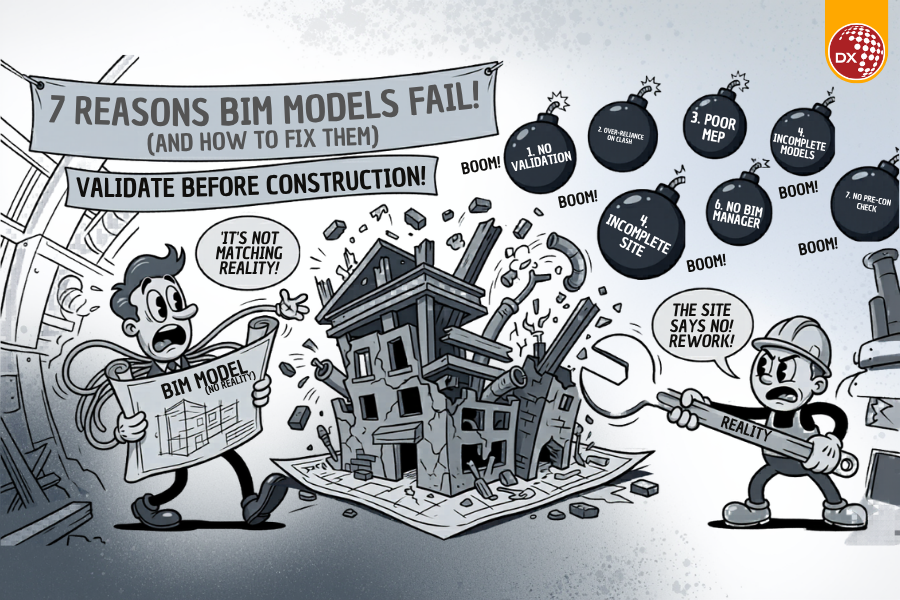
7 Reasons BIM Models Fail During Construction
You’ve seen it before. The BIM model looks flawless in coordination meetings—no visible clashes, clean documentation, and confident approvals. But once construction begins, reality tells a different story: Services don’t align Structural openings are misplaced MEP systems clash on-site Teams start improvising And suddenly, your “coordinated” model becomes a source of rework, delays, and cost overruns. This isn’t a rare issue—it’s a recurring industry problem. In this article, we’ll break down why BIM models fail during construction, what teams often overlook, and how to implement a practical validation framework that bridges the gap between digital models and site reality. Where the Problem Starts: The Hidden Gaps in BIM Models The issue isn’t BIM itself—it’s how BIM models are created, coordinated, and validated. Most failures originate in the pre-construction phase, where: Coordination is treated as a checklist activity Clash detection BIM is mistaken for full validation Design intent is not aligned with construction feasibility The Real Impact on Projects When BIM model accuracy doesn’t reflect site conditions, the consequences are immediate: Construction rework increases by 20–40% Delays due to redesign and approvals Loss of trust between teams Budget overruns and contractual disputes These are not software problems—they are process and decision-making failures. Why Current BIM Approaches Fail What Teams Think vs What Actually Happens What Teams Think What Actually Happens “Clash detection is complete, so we’re good” Only geometric clashes are resolved—not constructability “The model is approved, so it’s accurate” Approval ≠ validation against site conditions “All disciplines are coordinated” Coordination lacks depth (especially MEP BIM coordination) “We can fix issues during construction” Fixing on-site = expensive rework The Core Problem Most teams focus on model completeness, not model reliability. That’s why BIM models don’t match site conditions—even when they appear technically correct. 7 Reasons BIM Models Fail During Construction Lack of Pre-Construction BIM Validation Models are often pushed forward without a structured validation checklist. Result: Errors are discovered only during execution. Over-Reliance on Clash Detection Clash detection BIM identifies conflicts—but doesn’t answer: Can this be installed? Is there enough clearance? Is sequencing feasible? Clash-free doesn’t mean construction-ready. Poor MEP BIM Coordination MEP systems are the most complex—and most prone to errors. Common issues: Incorrect routing assumptions Missing tolerances Ignoring site constraints Result: Major site-level conflicts. Incomplete Federated BIM Models Disciplines are combined—but not fully integrated. Structural, architectural, and MEP models lack alignment Dependencies are not validated This creates hidden coordination gaps. Ignoring Site Reality Design teams often work with ideal conditions, while sites operate under constraints: Space limitations Installation sequence Material availability This creates a digital vs physical mismatch. Lack of Ownership (No Clear BIM Manager Role) Without a defined BIM manager or VDC leader: Coordination becomes fragmented Decisions lack accountability Result: Errors slip through unnoticed. No BIM Model Quality Check Before Construction Teams skip final model audits before execution. Missing checks include: Tolerance validation Installation feasibility Access and maintenance clearance This is where most construction rework originates. BIM Validation Framework for Construction Readiness To prevent these failures, you need more than coordination—you need a structured validation workflow. The 5-Step BIM Validation Framework Step 1: Model Integrity Check Ensure all disciplines are fully integrated Validate geometry consistency Step 2: Clash Detection + Contextual Review Go beyond clashes Assess constructability and sequencing Step 3: MEP Coordination Deep Dive Validate routing against real site conditions Check installation feasibility Step 4: Site Reality Alignment Compare model with site constraints Incorporate real-world limitations Step 5: Final BIM Model Quality Audit Use a pre-construction BIM validation checklist Sign off only after practical verification This approach shifts BIM from design validation to construction readiness. Reducing Construction Rework with BIM Validation Project Scenario A mid-sized commercial project faced repeated MEP clashes during construction, despite prior BIM coordination. Problem Clash detection was completed No constructability validation No final BIM model quality check Approach Implemented a structured BIM validation workflow Conducted detailed MEP coordination review Introduced site-based validation checks Outcome Reduced construction rework by 30% Improved coordination between teams Faster execution with fewer disruptions The difference wasn’t tools—it was process clarity. Comparison: Traditional vs BIM-Driven Construction Workflow Traditional Approach BIM Validation Approach Reactive issue resolution Proactive error prevention Site-driven corrections Pre-construction validation High rework costs Reduced rework (up to 30%) Fragmented coordination Integrated decision-making Before vs After BIM Implementation Before BIM Validation After BIM Validation Frequent site conflicts Minimal on-site clashes Delays and rework Smooth execution Misaligned models Site-aligned BIM models High uncertainty Predictable outcomes Key Takeaways Clash detection alone is not enough—you need full BIM validation Most BIM failures originate before construction begins MEP coordination is the biggest risk area A structured BIM validation workflow can reduce rework by up to 30% BIM success depends on process, not just technology BIM Doesn’t Fail—Processes Do BIM models don’t fail because of technology—they fail because of gaps in validation, coordination, and decision-making. If your projects are facing: Frequent rework Model-to-site discrepancies Coordination breakdowns …it may be time to rethink your current BIM approach. A validated BIM model isn’t just a design asset—it’s a construction enabler. If you’re exploring how to improve BIM model accuracy, reduce construction rework, or implement a validation-driven workflow, this is exactly where strategic consulting makes the difference. How DGTRA Solves This — Beyond Coordination, Toward Certainty At DGTRA, we don’t just coordinate BIM models—we take ownership of making them construction-ready. Our validation-first approach is built for projects where accuracy isn’t optional. We work alongside your team as a BIM delivery partner, identifying hidden risks, validating model integrity, and aligning every element with real site conditions—before execution begins. From deep MEP coordination validation to pre-construction BIM audits, we ensure your models don’t just look right—they perform right on-site. Because in real projects, coordination is not enough.Confidence is built through validation. Move From Vendor to Partner If your projects are facing BIM discrepancies, coordination gaps, or repeated rework—this isn’t just a model issue. It’s a process gap. It’s time to move beyond transactional support and work with a BIM validation partner invested in your project outcomes. Start
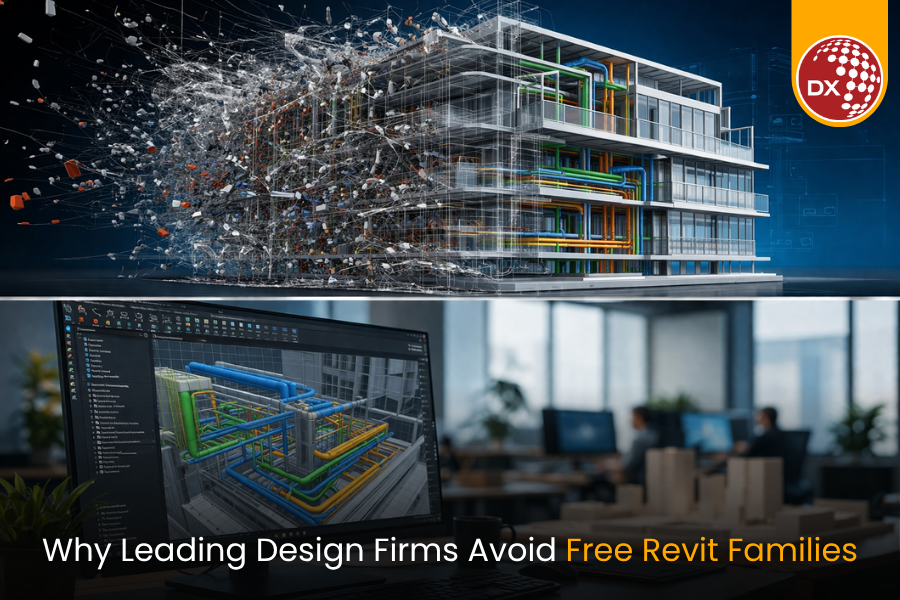
Why Leading Design Firms Avoid Free Revit Families (And What It’s Costing Your Projects)
Across global AEC projects, BIM adoption is increasing—but so are model performance issues, coordination failures, and rework costs. Surprisingly, one of the biggest hidden causes isn’t design complexity—it’s free Revit families. Most teams rely on them to save time. But what starts as a quick fix often leads to slow models, inaccurate data, and site clashes. In our recent webinar, we explored why top design firms are moving away from free content—and what they do instead. The Real Problem with Free Revit Families At first glance, free Revit families seem harmless. But the problem doesn’t show up immediately. It builds over time. Where the Issue Starts: Urgent downloads during deadlines Reuse of outdated families No standardization across teams What Happens Later: Model performance degradation Parameter inconsistency Coordination conflicts Documentation errors As highlighted in the webinar, BIM success is not determined on day one—it’s revealed during coordination and delivery. Hidden Project Impacts (That Teams Underestimate) Free Revit families introduce four critical risks: 1. Model Performance Risk (Stability Killer) Heavy geometry Over-modeled components Nested families Result: Lag, slow sync, file crashes 2. Data & Parameter Risk (Information Killer) Unstructured parameters Missing shared data Inconsistent naming Result: Scheduling errors, poor quantity take-offs 3. Coordination Risk Missing clearances Incorrect geometry Unrealistic modeling Result: Site clashes and rework 4. Documentation Risk Incorrect 2D representation Visual inconsistency Result: Drawing errors and RFIs Why Current Approaches Fail Most teams believe they are “managing” families. But reality is very different. What Teams Think vs What Actually Happens What Teams Think What Actually Happens Free families save time Time lost in cleanup and fixing More detail = better model Over-modeling slows performance Reuse is efficient Version inconsistency spreads Downloaded = ready to use Requires hours of rework As discussed in the webinar, teams often spend 2–3 hours cleaning a single family—negating any initial time savings. A Better Approach: High-Performance BIM Content Strategy Leading firms follow a structured content strategy, not ad-hoc downloads. Step-by-Step Framework Step 1: Standardization Naming conventions Parameter structure Category alignment Step 2: Controlled Parametric Design Clean reference planes Defined parameters Stable formulas Step 3: Geometry Optimization Avoid over-modeling Use detail levels (coarse/medium/fine) Replace model lines with symbolic lines Step 4: Centralized Content Library Single source of truth Version control Team-wide consistency Step 5: Continuous Audit System Monitor family size Remove redundant data Maintain performance benchmarks Mini Case Scenario Problem: A residential high-rise project used a 5–6 MB sliding door family across multiple units. Impact: Floor plans took 45 seconds to open Frequent crashes Coordination delays Approach: Reduced geometry complexity Removed unnecessary details (screws, rollers) Optimized parameters Outcome: Family reduced to ~300 KB Faster model performance Improved coordination This aligns with webinar insights: architects don’t need excessive detail—just functional accuracy. Traditional vs Optimized BIM Content Traditional Approach Optimized Approach Download & use Build & standardize Heavy geometry Lightweight models Uncontrolled parameters Structured data Reactive fixes Proactive planning Fragmented versions Centralized library Key Takeaways Free Revit families create long-term project risks Model performance issues often originate from poor content quality Standardization is more important than speed Lightweight, parametric families improve coordination and delivery BIM success depends on systems—not shortcuts FAQs 1. Why do free Revit families cause performance issues? Because they often contain heavy geometry and unstructured data, increasing file size and slowing models. 2. Are free families always bad? Not always—but they require cleanup, standardization, and validation before use. 3. What is the ideal size for a Revit family? Typically 200–500 KB for architectural use, depending on complexity. 4. How can teams manage Revit families better? By using a centralized library, standard parameters, and regular audits. Conclusion Free content isn’t the real problem—uncontrolled content is. If your team is struggling with slow models, coordination issues, or inconsistent outputs, it’s time to rethink your BIM content strategy—from quick fixes to structured systems. How DGTRA Helps At DGTRA, we work with global AEC firms to transform fragmented BIM workflows into structured, scalable content ecosystems. Our approach goes beyond family creation—we focus on building high-performance BIM systems that improve coordination, reduce rework, and enhance delivery predictability. We support teams through: BIM content audits and performance benchmarking Standardized Revit family libraries aligned with global standards Parameter structuring for data consistency across projects Centralized content management systems for multi-team collaboration Automation strategies to scale modeling efficiently Whether you’re dealing with slow models, inconsistent outputs, or coordination challenges, DGTRA helps you move from reactive fixes to proactive BIM delivery systems. Final Thoughts Watch the full webinar to see how leading design firms are eliminating content inefficiencies and building scalable BIM systems. If you’re looking to implement a similar approach, partner with DGTRA to bring structure, performance, and consistency to your BIM workflows.

Why Your BIM Models Don’t Match Site Reality
Webinar on Why Your BIM Models Don’t Match Site Reality Bridging the Gap Between Digital Intent and Construction Truth Learn why clash-free models still fail on site — and the framework that finally fixes it. Watch Now! Workshop Registration-3 First NameLast NameEmailJob TitleCompany NameCountrySelect CountryAfghanistanAland IslandsAlbaniaAlgeriaAmerican SamoaAndorraAngolaAnguillaAntarcticaAntigua and BarbudaArgentinaArmeniaArubaAustraliaAustriaAzerbaijanBahamasBahrainBangladeshBarbadosBelarusBelgiumBelizeBeninBermudaBhutanBoliviaBonaire, Saint Eustatius and SabaBosnia and HerzegovinaBotswanaBouvet IslandBrazilBritish Indian Ocean TerritoryBritish Virgin IslandsBruneiBulgariaBurkina FasoBurundiCabo VerdeCambodiaCameroonCanadaCayman IslandsCentral African RepublicChadChileChinaChristmas IslandCocos (Keeling) IslandsColombiaComorosCook IslandsCosta RicaCroatiaCubaCuraçaoCyprusCzech RepublicDemocratic Republic of the Congo (Kinshasa)DenmarkDjiboutiDominicaDominican RepublicEcuadorEgyptEl SalvadorEquatorial GuineaEritreaEstoniaEswatiniEthiopiaFalkland IslandsFaroe IslandsFijiFinlandFranceFrench GuianaFrench PolynesiaFrench Southern TerritoriesGabonGambiaGeorgiaGermanyGhanaGibraltarGreeceGreenlandGrenadaGuadeloupeGuamGuatemalaGuernseyGuineaGuinea-BissauGuyanaHaitiHeard Island and McDonald IslandsHondurasHong KongHungaryIcelandIndiaIndonesiaIranIraqIrelandIsle of ManIsraelItalyIvory CoastJamaicaJapanJerseyJordanKazakhstanKenyaKiribatiKosovoKuwaitKyrgyzstanLaosLatviaLebanonLesothoLiberiaLibyaLiechtensteinLithuaniaLuxembourgMacao S.A.R., ChinaMadagascarMalawiMalaysiaMaldivesMaliMaltaMarshall IslandsMartiniqueMauritaniaMauritiusMayotteMexicoMicronesiaMoldovaMonacoMongoliaMontenegroMontserratMoroccoMozambiqueMyanmarNamibiaNauruNepalNetherlandsNew CaledoniaNew ZealandNicaraguaNigerNigeriaNiueNorfolk IslandNorth KoreaNorth MacedoniaNorthern Mariana IslandsNorwayOmanPakistanPalauPalestinian TerritoryPanamaPapua New GuineaParaguayPeruPhilippinesPitcairnPolandPortugalPuerto RicoQatarRepublic of the Congo (Brazzaville)RomaniaRussiaRwandaRéunionSaint BarthélemySaint HelenaSaint Kitts and NevisSaint LuciaSaint Martin (Dutch part)Saint Martin (French part)Saint Pierre and MiquelonSaint Vincent and the GrenadinesSamoaSan MarinoSao Tome and PrincipeSaudi ArabiaSenegalSerbiaSeychellesSierra LeoneSingaporeSlovakiaSloveniaSolomon IslandsSomaliaSouth AfricaSouth Georgia/Sandwich IslandsSouth KoreaSouth SudanSpainSri LankaSudanSurinameSvalbard and Jan MayenSwedenSwitzerlandSyriaTaiwanTajikistanTanzaniaThailandTimor-LesteTogoTokelauTongaTrinidad and TobagoTunisiaTurkmenistanTurks and Caicos IslandsTuvaluTürkiyeUgandaUkraineUnited Arab EmiratesUnited Kingdom (UK)United States (US)United States (US) Minor Outlying IslandsUnited States (US) Virgin IslandsUruguayUzbekistanVanuatuVaticanVenezuelaVietnamWallis and FutunaWestern SaharaYemenZambiaZimbabweWatch Now Live Zoom Webinar + Interactive Q&A (60 minutes) Wednesday, April 22, 2026 8:30 PM IST | 4:00 PM BST | 10:00 AM CT The Reality Check “We Followed the Model. So Why Did It Fail?” You approved the model. Every clash was resolved. Every stakeholder signed off. Then site execution began — and everything unravelled. The Numbers Don’t Lie RFIs triggered by model mismatches 0 % Coordination issues missed in BIM 0 % Project cost lost to rework 0 % Longer decision cycles 0 X This is the industry baseline. And those who optimize it are the ones turning efficiency into margin, consistency into trust, and time into a competitive advantage. The Problem The Problem Isn’t BIM. It’s How BIM Is Being Used. Everything looked perfect in the model. Until it wasn’t. Design ≠ Construction Logic Models are built for coordination. Design intent and construction reality speak different languages, and no one built the translator. A Feedback Loop That Doesn’t Exist BIM is controlled and centralized. Sites are dynamic and unpredictable. Without a live feedback loop, assumptions calcify into errors. Costs You Can’t See Until It’s Too Late Rework cycles, surprise RFIs, change orders, delayed decisions. The real damage isn’t visible in the model — it shows up in your P&L. Knowledge Transfer What You’ll Walk Away With Practical insights and a clear framework you can start applying right away. The Real Gap Between BIM & Construction Clash-free models don’t always translate into smooth execution on site. We’ll break down where that gap begins and how it shows up in your day-to-day workflow. Why 30–40% of RFIs Come from Model Issues We’ll unpack the common points where design intent starts to break during execution—and how you can identify and address them early. The 4-Step Framework: Reality Alignment A simple, structured approach to bridging the gap between design and on-site reality—so your models work the way they’re supposed to. How to Measure Decision Quality It’s not just about having BIM in place—it’s about how well it performs. Learn how leading teams track success and focus on metrics that impact the bottom line. Building a Feedback Loop That Works Discover how to create a continuous flow of insights between site teams and coordination models so improvements happen in real time, not after the fact. Actionable Next Steps for Your Projects Leave with a practical roadmap you can apply immediately whether it’s an ongoing project or something in the pipeline. Right For You Who This Webinar Is For Whether you’re an architect shaping design intent, a contractor driving execution on site, or an owner focused on cost and timelines—this webinar speaks directly to the challenges you deal with every day. Architects & Design Leaders Your clash-free model still leads to RFIs once it reaches the site Accountability gets blurred between design and coordination You’re looking for a way to validate design intent before it moves into modelling General Contractors & Project Managers Site teams are forced to improvise when models don’t reflect real conditions Rework starts impacting margins faster than expected You need better alignment across trades with a system you can rely on Owners & Developers Timelines slip due to coordination gaps across stakeholders You’re often navigating between conflicting perspectives from teams You need stronger control over outcomes through a more effective BIM strategy If any of this sounds familiar, this session will show you how the Reality Alignment Framework helps bridge the gap between what’s designed and what gets built. Real Results The Biggest Shift Wasn’t Technical — It Was Procedural Commercial Tower MEP Coordination — From Breakdown to Breakthrough Before: The Starting Point A clash-free model was approved by all stakeholders Alignment across teams was established at the design stage The focus was on delivering a coordinated model After: What Changed Constructability checks became an integral part of the process Sequencing was validated before approvals Models evolved with real-time site inputs Stronger alignment built greater stakeholder confidence Reduction in RFIs ↓ Decreased 0 % Faster Installation ↑ Improved 0 X Reduction in Rework ↓ Decreased 0 % Stakeholder Confidence ↑ Improved 0 % BIM Success = Better Decision Quality When processes are aligned with real-world execution, BIM becomes more than a documentation tool—it becomes a system that drives smarter, faster decisions on site. Register Now — Free Be part of a more reliable, outcome-driven approach to BIM. Register now to learn how to turn coordination into confident execution and make every decision count.
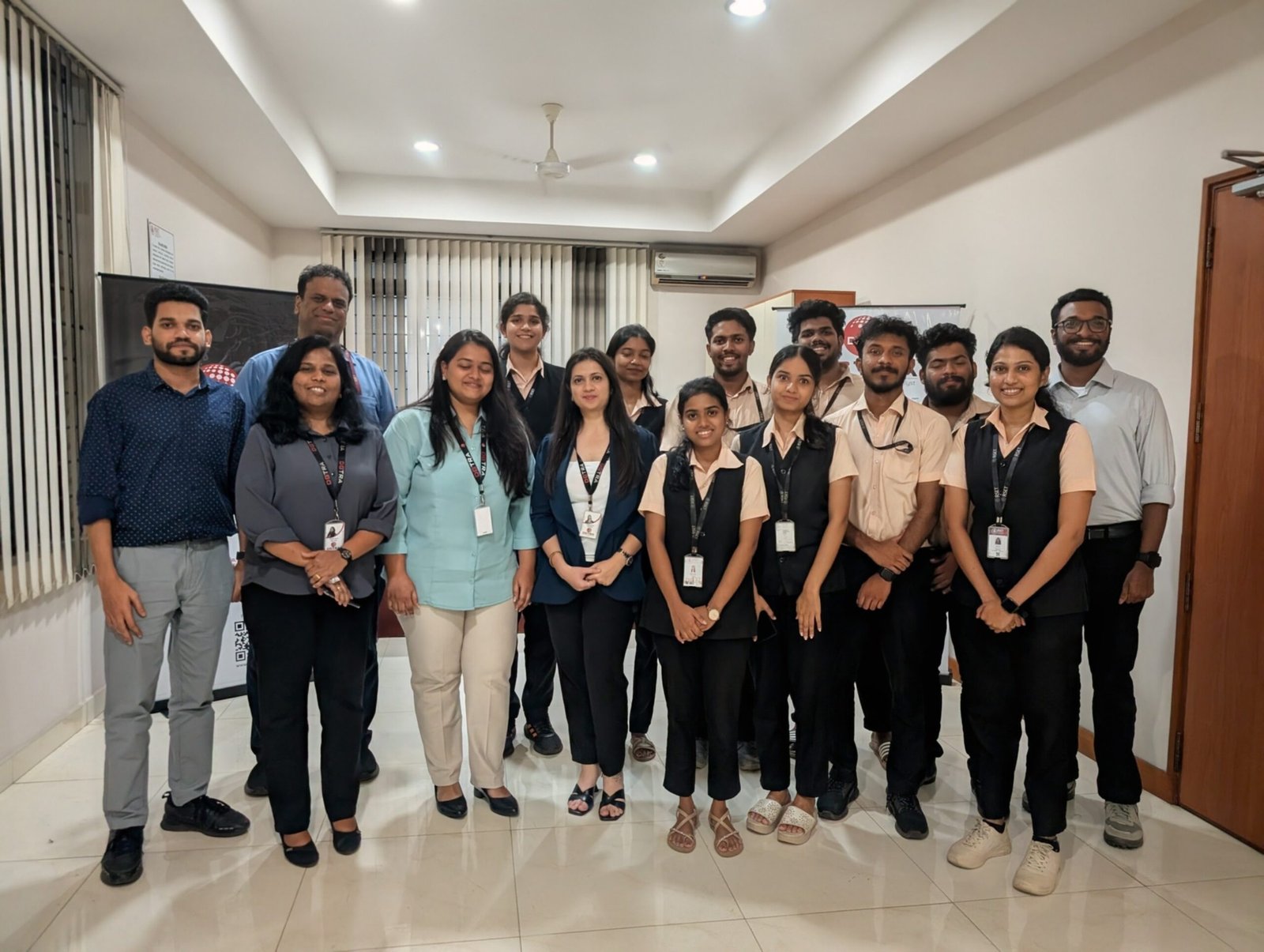
Bridging the Gap: How DGTRA’s BIM Bootcamp is Shaping Future AEC Professionals
One of the biggest challenges in the AEC industry today is not just technology adoption—but talent readiness. While BIM, digital twins, and data-driven workflows are transforming project delivery, there remains a gap between academic learning and real-world industry requirements. DGTRA is actively addressing this gap through its industry-focused BIM bootcamp initiative, recently conducted at Rajagiri School of Engineering & Technology (RSET), Kochi. From Classroom to Construction: Practical BIM Learning The DGTRA bootcamp was designed to move beyond theory and introduce students to real-world applications of BIM and digital construction workflows. Through interactive sessions led by industry experts, students gained exposure to: Practical BIM implementation in infrastructure projects Digital project delivery workflows Coordination challenges in multi-disciplinary environments The role of data and Common Data Environments (CDE) This hands-on approach ensures that students understand not just what BIM is, but how it is used in live projects. Consulting-Led Learning Approach Unlike traditional academic sessions, DGTRA’s bootcamp reflects its consulting-first mindset. The focus was on: Problem-solving in real project scenarios Understanding stakeholder collaboration Applying BIM for decision-making and efficiency Aligning workflows with global standards This approach prepares students for the realities of working in a digitally driven AEC ecosystem. Creating Career Pathways in Digital Construction A standout outcome of the initiative was DGTRA’s campus recruitment drive, where 10 students were selected to join the organization. These students will now work on: BIM modeling and coordination Project controls and delivery support Digital engineering workflows Technology implementation in live projects This is more than hiring—it is about building the next generation of BIM professionals. Strengthening Industry-Academia Collaboration DGTRA’s collaboration with RSET reflects a broader vision: Align academic training with industry needs Enable smoother transition from education to employment Build a sustainable pipeline of skilled AEC professionals Such partnerships are critical for the future of the industry, where digital capability is becoming a core requirement. DGTRA’s Role in Shaping the Future of AEC As a growing BIM consulting and digital transformation company, DGTRA is not only delivering projects—but also shaping the ecosystem. Through initiatives like this bootcamp, DGTRA is: Driving awareness of digital construction practices Enabling practical skill development Supporting talent growth aligned with industry demands Conclusion The future of the AEC industry depends on the seamless integration of technology, processes, and people. DGTRA’s BIM bootcamp is a strong step in that direction—bridging the gap between academia and industry while reinforcing its role as a growing leader in BIM consulting and digital transformation.

DGTRA Expands Its Footprint: Strengthening BIM & Digital Delivery with New Kochi Office
The Architecture, Engineering, and Construction (AEC) industry is undergoing a significant transformation driven by digitalization, data, and integrated project delivery. At the forefront of this evolution, DGTRA continues to scale its impact. With the launch of its new office at Infopark Kakkanad, Kochi, DGTRA marks a strategic milestone in its growth journey—reinforcing its position as a leading BIM consulting and digital transformation partner for the built environment. A Strategic Expansion into a Growing Tech Ecosystem Kochi is rapidly emerging as one of South India’s most promising technology and engineering hubs. By establishing a presence here, DGTRA is not just expanding geographically—it is strengthening its ability to deliver high-quality BIM consulting and digital engineering services to clients across India and global markets. The Kochi center is designed to: Enhance digital project delivery capabilities Scale BIM consulting services across complex infrastructure projects Support global clients with integrated engineering workflows Build a strong regional talent base for digital construction This expansion aligns with DGTRA’s long-term vision of combining global expertise with localized delivery excellence. Driving Digital Transformation in AEC The Kochi office will play a key role in delivering DGTRA’s core service offerings, including: BIM Consulting aligned with ISO 19650 standards Asset Information Modeling and lifecycle data management Scan-to-BIM and Digital Twin implementation Project controls and digital delivery frameworks These services are critical for AEC organizations looking to: Improve coordination across stakeholders Reduce project risks and delays Enable data-driven decision-making Achieve higher efficiency across project lifecycles DGTRA’s approach goes beyond tools—it focuses on consulting-led transformation, ensuring that BIM and digital technologies deliver measurable business outcomes. Empowering Talent, Enabling Growth A key highlight of this expansion is DGTRA’s commitment to talent development. Kochi provides access to a strong pool of engineering graduates and technology professionals, enabling the company to build high-performing teams. By investing in local talent, DGTRA is: Creating career opportunities in BIM and digital engineering Building future-ready AEC professionals Strengthening India’s role in global digital delivery ecosystems As highlighted in the announcement, this move represents not just growth, but a long-term investment in capability building. A Growing Force in the Built Environment From its origins in Pune to now expanding across India, DGTRA continues to evolve as a trusted consulting partner for infrastructure and construction organizations. The Kochi expansion reinforces: DGTRA’s position as a scaling BIM and digital consulting firm Its ability to deliver complex, multi-disciplinary projects Its commitment to innovation in the AEC industry As the AEC industry embraces digital transformation, organizations need more than just technology—they need the right consulting partner. With its new Kochi office, DGTRA is not only expanding operations but also strengthening its role as a catalyst for BIM-driven project excellence and digital transformation in the built environment.
Hidden Risks of Free Revit Families — Why Leading Design Firms Stay Cautious
In today’s design and construction landscape, efficiency and accuracy define competitive advantage. When deadlines are tight and projects grow increasingly complex, many design professionals look for shortcuts to accelerate modeling and documentation. One common approach is downloading free Revit families from online sources. At first glance, these families seem like a time-saver — instantly accessible, diverse, and free of charge. But for leading design firms managing multi-disciplinary BIM workflows, these “free” assets often introduce more problems than benefits. Let’s explore why firms that prioritize performance, consistency, and reliability often avoid freely available Revit families, and how your team can manage content smarter. 1. Model Instability and Performance Degradation Revit families sourced from public libraries can be poorly optimized. Many contain excessive geometry, nested elements, or unnecessary detail levels, which significantly increase file size and slow down model performance. At firm scale — where multiple users collaborate across linked models — these inefficiencies multiply, resulting in lag, crashes, or model corruption. Over time, your project teams spend more effort managing instability than producing deliverables. 2. Inconsistent Parameters and Naming Conventions Every firm has its own BIM standards and naming protocols designed to ensure interoperability across disciplines. Online families rarely align with these standards. Freely available Revit families often introduce inconsistent parameter structures, unclassified data fields, or conflicting naming systems, making schedules, tags, and filters unreliable. This inconsistency forces BIM coordinators and model managers to perform manual cleanups — a tedious task that undermines the very productivity those free assets were supposed to deliver. 3. Broken Constraints and Unreliable Data Many downloadable families are created without considering proper parametric relationships or BIM use cases. These broken constraints lead to geometry distortions when scaled or re-hosted, causing alignment and clash issues during coordination. Even worse, such families often contain incorrect or incomplete metadata, reducing the quality of asset information passed to contractors and facility managers — directly affecting project handover and lifecycle performance. 4. Late-Stage Rework and Coordination Issues When these issues remain unnoticed early in design, they surface during coordination or documentation — precisely when project timelines are most critical. Late-stage fixes for broken families can delay deliverables, require re-modelling of entire systems, and disrupt collaboration between architectural, structural, and MEP teams. The cumulative impact? Cost overruns, missed deadlines, and loss of client confidence. 5. QA/QC Failures During Documentation A firm’s quality assurance and quality control (QA/QC) processes depend on reliable family templates and standardized metadata. Using online families bypasses these controls, making it harder to maintain drawing accuracy, tag consistency, and schedule integrity. When auditors or clients request validation, non-standard or incomplete data within these families can lead to compliance issues and rejected submittals. 6. Increased Professional and Delivery Risk In the AEC industry, professional liability extends to the accuracy and reliability of design documentation. Incorporating unverified Revit families from unknown sources increases the risk of design discrepancies, inaccurate data, and misrepresented specifications. For leading design firms, such risks are unacceptable — even a single data error in a critical component can have legal, contractual, and reputational consequences. Smarter Alternatives for Firms Top-performing firms don’t reject Revit families altogether — they just manage them better.They invest in: Centralized, vetted content libraries built to firm standards. Automated QA/QC scripts for validating family geometry and parameters. Periodic reviews of family data to ensure alignment with evolving BIM protocols (like ISO 19650). Internal training to help modelers understand when and how to safely incorporate third-party content. By building controlled BIM content ecosystems, firms maintain the agility to design faster — without compromising integrity. Join Our Webinar: Building Trust in BIM Content To dive deeper into this topic, DGTRA is hosting a webinar on how leading design firms are tackling Revit content challenges at scale. Learn how to:✅ Identify unreliable Revit families before they enter your projects✅ Build content libraries aligned with ISO 19650 and firm standards✅ Streamline QA/QC for long-term BIM efficiency✅ Protect your projects from hidden risks in digital assets 📅 Webinar: Why Most Leading Design Firms Avoid Freely Available Online Revit Families🌐 Register now at: https://zma.page/revit

The Hidden Cost of “Free” Revit Families: Why Smart Firms Invest in BIM Content Quality
In today’s fast-paced design environment, speed and convenience often take center stage. For many design and engineering teams, downloading freely available Revit families feels like a simple way to accelerate modeling tasks. But behind that convenience lies a silent threat — one that impacts performance, consistency, and even project profitability. Forward-thinking firms have learned that the real cost of free content is hidden in the hours spent fixing, coordinating, and reworking models. Let’s explore why Free Doesn’t Mean Fit-for-Purpose Most Revit families available online are created for general use — not your firm’s specific standards, workflows, or project requirements. They might look perfect in isolation, but once integrated into your model, they often fail to align with design parameters or client deliverables. The result? Revisions, replacements, and endless coordination calls. Data Consistency Is the Foundation of BIM A well-managed BIM environment depends on reliable, standardized data. When you import families from multiple sources, you inherit their inconsistencies — mismatched parameters, naming conventions, and data fields. Over time, this disrupts schedules, quantity of take-offs, and data analytics. What begins as a few shortcuts quickly snowballs into a loss of data trust across the organization. Model Performance Suffers in the Long Run Revit families downloaded from unknown sources often carry excess geometry or unnecessary nested elements. These increase file size, slow down model performance, and lead to instability in large, multidisciplinary projects. Instead of improving productivity, they quietly reduce it — especially when multiple teams collaborate in a shared environment. Compromised Quality = Increased Risk For firms working under ISO 19650 or similar frameworks, every BIM object carries a quality responsibility. Poorly structured or unverified families introduce risk — not just in design coordination but in contractual deliverables. What may seem like a harmless symbol can later cause documentation errors or compliance failures, directly impacting client confidence. Efficiency Comes from Control, Not Convenience The most successful BIM teams don’t rely on what’s free — they rely on what’s verified. By developing a centralized BIM content library, firms can control naming, parameters, geometry, and metadata — ensuring every family performs predictably across projects. This level of consistency doesn’t just save time — it strengthens trust between teams and clients alike. The Smarter Way Forward DGTRA’s BIM Content Management Services help organizations move beyond ad-hoc Revit downloads toward structured, high-performance content ecosystems. Through standardized templates, QA validation, and metadata optimization, DGTRA enables teams to deliver faster, maintain compliance, and reduce rework — all while improving model stability. Conclusion The truth is simple: free Revit families aren’t really free. They come with hidden costs — time, errors, and lost confidence. Leading firms are redefining BIM efficiency not by cutting corners, but by building stronger foundations of data, consistency, and control. And that’s exactly where the future of intelligent design begins. Are free Revit families always bad to use? Not necessarily—but they are rarely suitable for enterprise or large-scale BIM workflows. Most free families are built for generic use, not aligned with firm-specific standards, project LOD requirements, or ISO-compliant data structures. Without validation, they often introduce inconsistencies and rework. What hidden costs do free Revit families create? The biggest costs are not financial upfront—but operational over time. Teams spend hours fixing parameters, correcting geometry, resolving coordination clashes, and troubleshooting performance issues. These hidden inefficiencies directly affect delivery timelines and profitability. How do poor-quality families impact BIM data and deliverables? Inconsistent or poorly structured families compromise schedules, quantity take-offs, and downstream data use. When BIM data can’t be trusted, it weakens decision-making, reporting accuracy, and client confidence—especially on data-driven or asset-focused projects. Why is BIM content quality critical for ISO 19650 compliance? ISO 19650 requires controlled, reliable information management. Unverified families introduce risk in naming conventions, parameters, and data integrity—potentially leading to non-compliance, documentation errors, and contractual issues. What is the advantage of investing in a managed BIM content library? A managed BIM library ensures consistency, performance, and predictability across all projects. Standardized geometry, parameters, and metadata reduce rework, improve collaboration, and enable teams to scale BIM delivery with confidence—without sacrificing quality.